Henry Jutsum: A Quiet Observer of British Landscapes
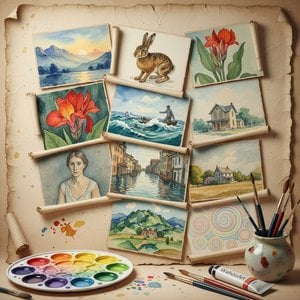
Henry Jutsum (1816 – 3 march 1869) stands as a testament to the understated elegance of Victorian landscape painting, particularly within the Norwich School tradition. Born in London and nurtured by a formative exposure to Devonshire’s artistic spirit—specifically the influence of James Stark—jutsum embarked on a journey to capture the serene beauty of Britain's countryside through meticulous watercolor and oil canvases. His dedication to observation and skillful brushwork cemented his reputation as one of the era’s most respected artists, producing works that continue to resonate with viewers today.- Early Life & Education: Jutsum’s formative years were spent honing his artistic sensibilities in Devonshire, where he developed a profound appreciation for capturing natural light and texture. This early training laid the groundwork for his subsequent academic pursuits, culminating in studies at Burlington College (later Slade School of Fine Art) in London.
- The Norwich School Influence: Jutsum’s artistic trajectory was decisively shaped by James Stark, a prominent figure within the Norwich School—a movement characterized by its commitment to plein air painting and a focus on depicting atmospheric landscapes with remarkable realism. Stark's emphasis on capturing fleeting moments of beauty profoundly impacted Jutsum’s approach to composition and color palette.
- Royal Academy Debut & Watercolor Society Membership: Jutsum’s artistic ambitions found expression through his participation in the Royal Academy exhibitions from 1836 onwards, showcasing his talent alongside fellow luminaries of the Victorian art world. Recognizing the importance of watercolor as a medium for conveying nuanced tonal variations and atmospheric effects—a technique championed by John Sell Cotman—he was elected to the Watercolour Society in 1843, furthering his exploration of expressive landscapes.
- Continuing Artistic Practice & Collaborations: Despite relinquishing his Watercolor Society membership, Jutsum remained a prolific contributor to Royal Academy exhibitions until his untimely death in 1869. His artistic partnership with Henry Bright fostered intellectual exchange and mutual inspiration, resulting in collaborative paintings that exemplify the spirit of their time.
- Legacy & Notable Works: Jutsum’s enduring legacy resides in his captivating depictions of British landscapes—particularly “The Foot Bridge” (Victoria and Albert Museum) and “The Noonday Walk” (Royal Collection)—which embody the Romantic ideal of sublime beauty and meticulous artistic detail. These paintings continue to inspire admiration for their masterful execution and evocative portrayal of the English countryside.
Technique & Style: Watercolor vs Oil
Jutsum’s artistic style was defined by a preference for watercolor, largely influenced by Cotman's pioneering work. Watercolor allowed him to achieve subtle tonal gradations and capture atmospheric effects with remarkable delicacy—a technique perfectly suited for conveying the ethereal quality of twilight landscapes or misty mornings. However, Jutsum also excelled in oil painting, utilizing thick impasto brushstrokes to build up textural surfaces and imbue his canvases with a palpable sense of solidity and depth. This versatility demonstrated his mastery of multiple mediums and underscored his ability to adapt his artistic vision to suit the specific characteristics of each subject matter.Major Achievements & Recognition
Jutsum’s unwavering dedication to landscape painting garnered widespread acclaim during his lifetime, securing him a prominent position within the Norwich School and establishing him as one of the most respected artists of his era. His paintings were consistently praised for their accuracy, sensitivity, and emotional resonance—capturing not merely visual representations but also conveying an intangible sense of tranquility and contemplation. Furthermore, “The Foot Bridge” achieved international renown through its engraving in "The Art Journal," cementing Jutsum’s place as a celebrated figure within the artistic discourse of Victorian Britain.Historical Significance
Henry Jutsum's contribution to landscape painting aligns seamlessly with the broader Romantic movement—a period characterized by an intense fascination with nature and a belief in its capacity to inspire profound emotional responses. His canvases embody the Romantic ideal of sublime beauty, reflecting a desire to transcend mere observation and engage in a dialogue with the grandeur and majesty of the natural world. Jutsum’s work serves as a poignant reminder of Victorian England's artistic sensibilities—a testament to the enduring power of quiet contemplation and masterful artistic technique.Questions & Answers
Can I explore Henry Jutsum's works by subject?
The Subject Atlas page maps Henry Jutsum's artworks by subject.
Can I sort Henry Jutsum's artworks by color?
The Spectral Index page organizes Henry Jutsum's artworks by color.
In which historical period did Henry Jutsum work?
Henry Jutsum worked in the 19th-Century period. The period situates the artist's activity in history.
Which artworks by Henry Jutsum are the most viewed?
The Stats page of Henry Jutsum presents statistics computed from the artist's artworks listed on this website.
Is there a complete list of Henry Jutsum's artworks?
Every work by Henry Jutsum on this website can be browsed from the artist's All Artworks page.
How many artworks by Henry Jutsum are available to browse?
You can browse 9 artworks by Henry Jutsum on the All Artworks page.
How do I find works by Henry Jutsum in a specific palette?
Henry Jutsum's works can be browsed by color palette on the artist's By Palettes page.
Can I browse Henry Jutsum's works by medium?
The All Medium page groups Henry Jutsum's artworks by technique.