Wang Dongling: Bridging Tradition and Abstraction in Chinese Ink
Wang Dongling, born in Rudong, China, in 1945, stands as one of the most revered figures in contemporary Chinese art. His journey is a fascinating synthesis of rigorous classical training – specifically, his deep immersion in traditional calligraphy – with an increasingly bold exploration of abstract expressionism. More than simply an artist, Dongling embodies a bridge between centuries-old artistic heritage and the dynamic spirit of modern China, forging a unique visual language that continues to captivate audiences worldwide.
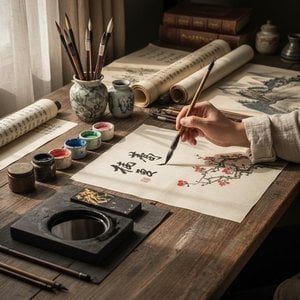
Dongling’s early life was steeped in the discipline of calligraphy. He began his formal training at the Zhejiang Academy, laying a foundational understanding of brushwork, ink control, and the profound philosophical undercurrents embedded within Chinese writing. This grounding proved crucial as he later transitioned to a more experimental approach, driven by an insatiable curiosity about the possibilities beyond representational art. His shift wasn’t abrupt; rather, it was a gradual evolution fueled by exposure to Western abstract expressionism – movements like those of Pollock and Rothko – which ignited within him a desire to liberate calligraphy from its traditional constraints.
The ‘Calligraphic Paintings’: A Fusion of Disciplines
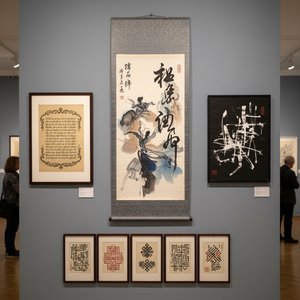
Dongling’s most recognized body of work, often referred to as “calligraphic paintings,” represents the culmination of this transformative journey. These monumental pieces are not mere imitations of calligraphy; they are entirely new artistic expressions born from a deep respect for their roots. He describes these works as "poetry painted," meticulously layering calligraphic forms onto vast canvases with an almost meditative intensity. The process is deeply performative, often involving extended periods of intense brushwork and physical exertion – mirroring the very act of writing itself.
Central to Dongling’s approach is his deliberate use of monochrome palettes, predominantly shades of grey. This choice isn't arbitrary; it serves to heighten the focus on texture, gesture, and the inherent dynamism of the ink. The absence of color forces the viewer to engage with the materiality of the medium – the subtle variations in tone, the delicate interplay of wet and dry brushstrokes, and the sheer physicality of the artwork. His work is frequently described as “abstract ink art,” a term that accurately captures its unique blend of tradition and innovation.
Performance and Process: The Embodied Art
A defining characteristic of Dongling’s practice is his incorporation of performance into the creation of his ‘calligraphic paintings.’ He doesn't simply apply ink to canvas; he *performs* the act of writing, translating poems – often from classical Chinese literature – into gestural abstractions. These performances are not mere demonstrations of skill but deeply ritualistic events, imbued with a sense of spiritual intensity. As Roberta Smith noted in her New York Times review, Dongling “liberates calligraphic gesture, form and space from the bounds of text.”
This emphasis on embodied action is further explored through his technique of ‘chemical photography.’ By directly applying ink to silver-gelatin photographic paper, he captures the very traces of his movements – the pressure of his brush, the angle of his hand, the subtle shifts in tone. This process creates a layered dialogue between performance and image, revealing the intimate connection between the artist’s body and the artwork.
Recognition and Legacy
Wang Dongling's work has garnered widespread recognition both within China and internationally. He is considered one of the foremost living calligraphers in China, holding the distinction of being granted three solo exhibitions at the National Art Museum of China. His pieces have been exhibited extensively across Europe, North America, and Asia, including prestigious venues such as the Metropolitan Museum of Art in New York and the British Museum in London.
Currently, Dongling serves as Director of the Modern Calligraphy Research Center at the China Academy of Arts in Hangzhou, continuing to nurture and promote the art form he has so profoundly shaped. His legacy extends beyond individual artworks; he represents a vital link between China’s rich artistic past and its dynamic future, demonstrating how tradition can be both honored and reimagined through innovative expression.
Ερωτήσεις & Απαντήσεις
Υπάρχει μια επισκόπηση όλων των θεμάτων που ζωγράφισε ο/η Wang Dongling;
Τα έργα του/της Wang Dongling μπορούν να εξερευνηθούν ανά θέμα στη σελίδα Ατλάς Θέματων του καλλιτέχνη/της.
Πώς χωρίζεται η καριέρα του/της Wang Dongling σε περιόδους;
Η καριέρα του/της Wang Dongling αναπτύσσεται περίοδο προς περίοδο στη σελίδα Χρονικό: μια οριζόντια χρονοσειρά των έργων, τα οποία είναι ομαδοποιημένα σε κεφάλαια ανά περίοδο της καριέρας του/της.
Πόσα έργα του/της Wang Dongling είναι διαθέσιμα για περιήγηση;
Μπορείτε να περιηγηθείτε σε 4 έργα τέχνης έργα του Wang Dongling στη σελίδα Όλα τα έργα τέχνης.