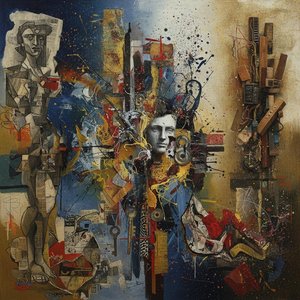
Santanu Dey: Sculptor of Urban Decay and Ecological Concern
Santanu Dey is an Indian artist whose compelling mixed media artworks, notably ‘Untitled,’ explore themes of environmental degradation and the impact of urbanization on human existence. Born in Kolkata, India, around 1981 (the exact year remains undisclosed), Dey’s artistic journey began with a formal education at the Government College of Art & Craft, followed by postgraduate studies at MSU Baroda, shaping his perspective on art and its role in addressing societal challenges.- Early Influences: Dey's formative years were marked by exposure to traditional Indian sculpture techniques and aesthetics, fostering a deep appreciation for craftsmanship and material exploration.
- Formal Training: His academic pursuits at MSU Baroda honed his sculptural skills and instilled in him a critical understanding of contemporary art movements.
- Environmental Advocacy: Driven by profound concern for ecological issues—particularly the unsustainable exploitation of natural resources and the consequences of consumerism—Dey’s artistic practice serves as a powerful conduit for conveying these urgent messages.
The Art of Mixed Media: Transforming Waste into Vision
Dey distinguishes himself through his innovative use of mixed media, repurposing discarded materials like e-waste, paper, wood, and aluminum litho-plate to create artworks that grapple with complex narratives. His distinctive style eschews conventional color palettes, prioritizing stark minimalism—a deliberate choice reflecting the desolate landscapes he seeks to depict. This stylistic approach underscores a broader preoccupation with materiality and its ability to communicate profound emotional resonance.- Material Exploration: Dey’s artistic process involves meticulous experimentation with diverse materials – e-waste, paper, wood, aluminum litho-plate, graphite, steel pins—transforming them into sculptural forms that embody both fragility and resilience.
- Minimalist Aesthetic: The absence of color serves as a deliberate stylistic device, mirroring the bleakness of urban environments and prompting viewers to contemplate the significance of texture and form.
- Industrial Influence: He incorporates industrial paint and printing ink—materials often associated with manufacturing and labor—to convey themes of societal transformation and questioning established norms.
Notable Achievements & Recognition
Santanu Dey’s artistic endeavors have garnered considerable acclaim, culminating in prestigious awards including the Governor Gold Medal Award (2008), Best Sculpture Award by the Prafulla Dhanukar Art Foundation (2017), and Best Sculpture Award by the WB State Academy of Dance, Drama, Music & Visual Art (2014). His participation in initiatives like the Gurugram Interactive Public Art Project (2019) and Khoj Peers Share Program (2015) demonstrates his commitment to engaging with broader artistic dialogues. Furthermore, he was selected for the prestigious India Art Fair and showcased at Mohali’s Plaksha University.Contemporary Relevance & Artistic Legacy
Dey's artworks resonate powerfully with contemporary concerns regarding environmental sustainability and social justice—particularly the plight of refugees displaced by historical events like Partition. His exploration of themes such as urban dystopia, memory, and cultural heritage contributes to a richer understanding of human experience in the 21st century. Through his distinctive artistic vision and unwavering dedication to conveying critical narratives, Santanu Dey cements his position as a significant voice within the Indian art landscape—a sculptor who transforms discarded materials into poignant reflections on our relationship with the environment and the complexities of societal transformation.Ερωτήσεις και Απαντήσεις
Πού μπορώ να βρω τα έργα του Santanu Dey ομαδοποιημένα ανά παλέτα χρωμάτων;
Στη σελίδα Κατά Παλέτα Χρωμάτων, τα έργα του/της Santanu Dey ομαδοποιούνται ανάλογα με τις χρωματικές τους παλέτες.
Πού μπορώ να δω τα έργα του/της Santanu Dey ταξινομημένα ανά ατμόσφαιρα;
Στη σελίδα Κόρνερ Αίσθησης του Santanu Dey, τα έργα του καλλιτέχνη είναι διατεταγμένα ανάλογα με τη διάθεση.
Πού μπορώ να επισκεφτώ μια 3D γκαλερί με τα έργα του/της Santanu Dey;
Τα έργα τέχνης του/της Santanu Dey μπορούν να περιηγηθούν σε μια 3D γκαλερί στη σελίδα 3D Μουσείο του καλλιτέχνη/της.