A Life Bridging Worlds: The Story of Oscar Bluemner
Born Friedrich Julius Oskar Blümner in 1867, in the quiet Prussian town of Prenzlau, Oscar Bluemner’s journey was one of constant reinvention and a relentless pursuit of artistic expression. His early life was steeped in the practical world of architecture, a discipline he studied diligently in Berlin. However, this foundation would prove to be less a constraint than a crucial element shaping his later visual language. The seeds of his modernist vision were sown during his move to America in 1893, initially working as a draftsman at the World’s Columbian Exposition in Chicago before settling in New York City. These formative years were marked by struggle; finding consistent architectural work proved elusive, yet they provided fertile ground for observing the burgeoning urban landscape and contemplating the interplay between man-made structures and the natural world—themes that would dominate his artistic output. A pivotal moment arrived in 1903 with his winning design for the Bronx Borough Courthouse, a triumph quickly overshadowed by scandal and accusations of corruption, an experience that likely fueled his eventual departure from the architectural realm.From Architect to Painter: The Stieglitz Influence
The true turning point came in 1908 with his encounter with Alfred Stieglitz, the champion of modern art in America. This meeting was nothing short of transformative. Stieglitz’s circle—a vibrant hub of avant-garde thought and artistic experimentation—exposed Bluemner to a world beyond traditional academic painting. He absorbed influences from European movements like Cubism and Futurism, yet never fully succumbed to any single style. By 1910, he had decisively committed himself to painting, driven by a desire to explore color and form in ways architecture could not allow. The 291 gallery, Stieglitz’s famed exhibition space, became Bluemner's artistic home, culminating in a significant solo show in 1915. This exhibition showcased his evolving style—a unique blend of prismatic shapes, bold colors, and architectural precision. He wasn’t merely depicting landscapes or cityscapes; he was dissecting them, revealing their underlying structures and emotional resonance. Bluemner's participation in the groundbreaking 1913 Armory Show further cemented his place within the American modernist movement, though he voiced criticism of its organization, perceiving it as driven by artistic rivalries rather than genuine curatorial vision.The Language of Color and Symbolism
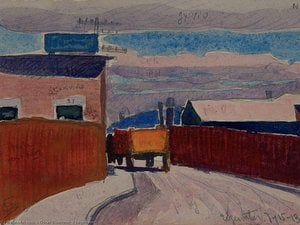
Bluemner’s art is characterized by a deeply personal system of color symbolism. He believed that colors possessed inherent psychological power, capable of evoking specific emotions and states of mind. Yellow, for him, represented light and illumination, while black embodied sorrow and the weight of existence. This wasn’t simply an intellectual exercise; it was a fundamental aspect of his artistic process. His “Situation” paintings—a recurring series in his oeuvre—are particularly revealing in this regard. These works often feature contrasting colors and forms deliberately arranged to depict philosophical or psychological concepts, exploring themes of duality, the relationship between humanity and nature, and the eternal tension between ego and alterity. Architectural elements – houses, trees, roads – frequently appear as symbolic representations within these landscapes, acting as stand-ins for human presence and internal states. He wasn’t interested in realistic representation; he sought to capture the *essence* of a place or emotion through color, form, and composition.Later Years, Recognition, and Lasting Legacy
Despite his artistic contributions and regular exhibitions, Bluemner faced persistent financial hardship throughout much of his career. The Great Depression brought further challenges, but also an opportunity to contribute to the Federal Arts Project, providing some measure of stability. Following the death of his wife in 1926, he relocated to South Braintree, Massachusetts, seeking solace and a new perspective. His later works, such as “A Situation in Yellow” (c. 1935-1937), exemplify his mature style—a masterful synthesis of color symbolism, architectural forms, and emotional intensity. A 1935 exhibition at the Marie Harriman Gallery finally garnered him significant critical acclaim, with Edward Alden Jewell praising his “bold, exclamatory style.” Tragically, this recognition came late in life; Bluemner took his own life in 1938, a poignant end to a life dedicated to artistic exploration. For decades, he remained largely overlooked, but today, Oscar Bluemner is rightfully recognized as a pivotal figure in early American Modernism. The remarkable Vera Bluemner Kouba Collection—a bequest of over 1,000 works to Stetson University—stands as a testament to his prolific output and provides invaluable insight into the mind of an artist who bridged European avant-garde movements with a uniquely American sensibility, foreshadowing developments in Color Field painting and establishing a distinctive voice within the landscape of modern art. He was a pioneer, a visionary, and a master of color whose work continues to resonate with audiences today.Ερωτήσεις και Απαντήσεις
Πού μπορεί να ανακαλυφθούν τα έργα του Oscar Bluemner ταξινομημένα ανά θέμα;
Εξερευνήστε τα έργα του/της Oscar Bluemner ανά θέμα στη σελίδα Ατλάς Θεμάτων του καλλιτέχνη/της.
Πόσα έργα του/της Oscar Bluemner είναι διαθέσιμα για περιήγηση;
Μπορείτε να περιηγηθείτε σε 28 έργα τέχνης έργα του Oscar Bluemner στη σελίδα Όλα τα έργα.
Ποιες διαθέσεις εκφράζουν τα έργα του/της Oscar Bluemner;
Στη σελίδα Κόρνερ Αίσθησης του καλλιτέχνη, μπορείτε να δείτε τα έργα του Oscar Bluemner ταξινομημένα ανάλογα με την ατμόσφαιρά τους.