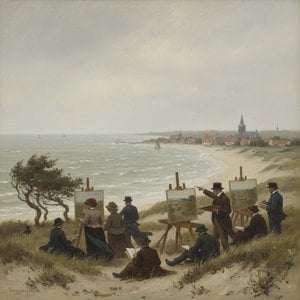
The Landscape of a Dutch Life
Rotterdam, 1863. The air in the Netherlands carries the weight of the lowlands, a landscape that would define the visual language of Hermannus Adrianus van Oosterzee. He begins his formal training at the Academie voor Beeldende Kunsten in Rotterdam, absorbing the technical rigor required of a painter, etcher, and draftsman. Under the guidance of Jan Striening, and later Paul Joseph Constantin Gabriël and Simon Moulijn, his hand learns the nuances of light and shadow. His early years are spent in the bustling atmosphere of Rotterdam-Kralingen, but the pull of the horizon is constant.
The movement of his life follows the geography of the Netherlands. He moves from Rotterdam to Den Haag, then settles in Rijswijk, where he remains until 1924. His gaze is not confined to the borders of his home; he travels through Drenthe, Noord-Brabant, Limburg, and Zeeland. Even the rugged terrain of Norway becomes a subject for his studies. He is a man of the earth and the sky, seeking out the specific textures of the Dutch countryside.
Technical Mastery and Artistic Circles
His work is characterized by a focus on the natural world, specifically the quietude of meadows, the expanse of heathlands, and the shifting light of summer. He captures the specific atmosphere of moonlight and the stark, dramatic quality of Norwegian night landscapes. His technique is versatile, moving between the fluid application of oil on panel and the precise, biting lines of etching and lithography. His style aligns with the sensibilities of the Hague School, prioritizing the atmospheric truth of a scene over mere decoration.
His professional life is deeply embedded in the institutional fabric of Dutch art. He does not work in isolation but is a central figure in the creative communities of his time. His involvement includes:
- Membership in Pulchri Studio in Den Haag
- Membership in Arti et Amicitiae in Amsterdam
- Membership in the Haagsche Kunstkring
- Founding role in the Vereenigde Rijswijksche Kunstschilders
- Service as Treasurer of the Nederlands Steuncomité voor beeldende kunstenaars
The Final Horizon
The later years of his life see him moving toward Doorn, away from the coastal centers. His output remains a dedicated study of the environment, from the dunes of Wassenaar to the river views that define his smaller, intimate works. He leaves behind a body of work that documents the shifting moods of the Dutch landscape, from the bright clarity of a summer day to the deep shadows of a moonlit heath. He dies in Utrecht in 1933, leaving a legacy etched into the very soil he spent his life observing.
Ερωτήσεις και Απαντήσεις
Μπορώ να περιηγηθώ στα έργα του/της Χερμάνους Αδριανούς Φαν Οστερχεζε ανά τεχνική;
Για να βρείτε όλα τα έργα του/της Χερμάνους Αδριανούς Φαν Οστερχεζε ανά τεχνική, επισκεφθείτε τη σελίδα Κατά Τεχνική του καλλιτέχνη.
Υπάρχει μια επισκόπηση όλων των θεμάτων που έχει ζωγραφίσει ο/η Χερμάνους Αδριανούς Φαν Οστερχεζε;
Η σελίδα Ατλάς Θεμάτων αναλύει τα έργα του Χερμάνους Αδριανούς Φαν Οστερχεζε ανά θέμα.
Σε ποια πόλη και χώρα γεννήθηκε ο/η Χερμάνους Αδριανούς Φαν Οστερχεζε;
Ο/Η Χερμάνους Αδριανούς Φαν Οστερχεζε γεννήθηκε στην/στη Ρότερνταμ, στο/στη Ολλανδία.