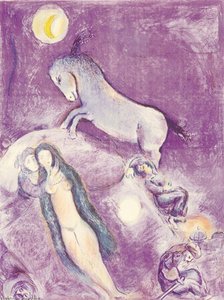
A Visionary Encounter: Decoding William Blake’s “Beatrice Addressing Dante”
William Blake's "Beatrice Addressing Dante," created in 1824, stands as a testament to the artist’s singular ability to fuse mythology, allegory, and profound spiritual contemplation into a breathtaking watercolor on paper. This artwork isn’t merely a depiction of Dante Alighieri’s “Divine Comedy”; it’s an immersive experience—a visual journey mirroring the poet's arduous ascent through Hell, Purgatory, and Paradise, guided by Beatrice Portinari, his idealized love interest and spiritual mentor. Blake brilliantly captures this pivotal moment from Dante’s epic poem, transforming it into a richly layered symbol of divine grace and human aspiration.
- Style & Technique: Blake's Romantic style is immediately recognizable through its dramatic use of color—particularly vibrant reds and blues—that imbues the scene with an ethereal luminescence. The watercolor medium lends itself perfectly to conveying texture and luminosity, allowing for subtle gradations of tone that heighten the emotional impact. Blake’s meticulous attention to detail extends beyond mere representation; he employs expressive brushstrokes to convey movement and emotion, mirroring Dante's struggle and Beatrice’s unwavering encouragement.
- Historical Context: Produced during Blake’s mature period, “Beatrice Addressing Dante” reflects the broader intellectual currents of the Romantic era—a fervent belief in imagination as a pathway to spiritual truth and an embrace of visionary experience. Blake drew inspiration from Milton's Paradise Lost and Dante’s Divine Comedy, aligning himself with the tradition of biblical allegory and striving to communicate complex theological ideas through symbolic imagery.
Symbolism: Angels, Birds & The Lion – Layers of Meaning
The composition is populated by figures imbued with potent symbolism. Beatrice herself embodies purity and divine grace—a radiant presence overseeing Dante’s perilous journey. Above her head floats an angel, representing celestial guidance and spiritual illumination. Two birds circling Dante symbolize hope and resurrection, mirroring the biblical motif of doves ascending to heaven. Notably, a lion positioned on Dante's right side symbolizes courage and strength—essential qualities for confronting evil and achieving salvation. These elements converge to create a visual narrative that transcends literal depiction, inviting contemplation on themes of faith, redemption, and divine love.
- Detailed Analysis: Blake’s masterful use of color contributes significantly to the artwork's symbolic resonance. The dominant reds evoke passion and suffering—reflecting Dante’s descent into Hell—while blues convey tranquility and spiritual serenity—representing Beatrice’s influence on Dante’s ascent toward Paradise.
- Emotional Impact: “Beatrice Addressing Dante” powerfully communicates the transformative potential of love—understood not merely as romantic affection but as a conduit for divine grace. Blake's emotive brushwork captures the palpable tension between Dante’s despair and Beatrice’s unwavering compassion, conveying an unforgettable impression of spiritual yearning.
Beyond Representation: Blake’s Artistic Legacy
William Blake remains an artist whose work continues to inspire awe and provoke interpretation. “Beatrice Addressing Dante” exemplifies his distinctive approach—a rejection of academic conventions in favor of intuitive expression rooted in personal vision. His groundbreaking technique, blending watercolor with meticulous detail, established a precedent for Romantic illustration and cemented his place as a pioneer of imaginative art. Reproductions of this masterpiece offer an opportunity to experience Blake’s artistic brilliance firsthand, transporting viewers into the heart of Dante's spiritual odyssey—a journey illuminated by Beatrice’s radiant presence.
Ερωτήσεις και Απαντήσεις
Ποιος είναι ο καλλιτέχνης πίσω από το "Beatrice";
Το έργο "Beatrice" δημιουργήθηκε από τον/την Βίλλιαμ Μπλέικ. Οι πληροφορίες σε αυτή τη σελίδα περιγράφουν το πρωτότυπο έργο του/της Βίλλιαμ Μπλέικ.
Τι συναίσθημα αποπνέει το "Beatrice" του Βίλλιαμ Μπλέικ;
Η ατμόσφαιρα του έργου "Beatrice" του Βίλλιαμ Μπλέικ είναι Romantic, ενώ ο συναισθηματικός του τόνος είναι Mysterious.
Ποια εκτύπωση προτείνεται για το έργο "Beatrice" του Βίλλιαμ Μπλέικ;
Προτείνεται η εκτύπωση του έργου "Beatrice" του Βίλλιαμ Μπλέικ σε μέγεθος Large με προσανατολισμό Landscape.



 Προεπισκόπηση σε πραγματική κλίμακα
 Αγορά χειροποίητου πίνακα
 Αποστολή
 Κοινοποίηση
 Λεπτομέρειες
 Οδηγός

 Λήψη
Λήψη
 Παρόμοια αντικείμενα συλλογής
 Ακτινογραφία
 Παρουσίαση
 Q&A
Q&A Στατιστικά
 Περισσότερα






































 Η επιλογή με γυαλί είναι διαθέσιμη μόνο για μεγέθη κάτω από 110 εκ.