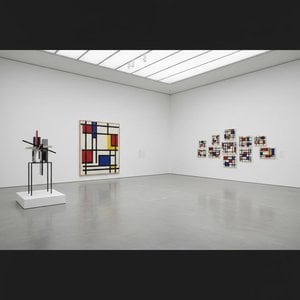
The Architect of Abstraction: A Life in Geometric Harmony
Theo van Doesburg, born Christian Emil Marie Küpper on August 30, 1883, in Utrecht, Netherlands, wasn’t merely a painter; he was a revolutionary force who fundamentally reshaped the landscape of modern art. His journey began amidst the lingering echoes of Impressionism and Post-Impressionism, initially mirroring styles reminiscent of Vincent van Gogh – both in their emotional intensity and the way they captured fleeting moments of light and color. However, this early phase served as a crucial prelude, a necessary stepping stone towards the radical transformation that would define his enduring legacy. A pivotal moment arrived in 1913 with his encounter with Wassily Kandinsky’s *Rückblicke*. This text ignited within van Doesburg a profound realization: true artistic expression wasn't about faithfully replicating the external world, but rather channeling an inner, spiritual reality through the pure language of abstraction. It was this conviction that birthed Neoplasticism – more commonly known as De Stijl – a movement he founded and fiercely championed, becoming its most ardent advocate.
Forging a New Visual Language: The Principles of De Stijl
De Stijl wasn’t simply an artistic style; it was a comprehensive philosophical manifesto translated into visual form. Van Doesburg believed in stripping art down to its most essential elements – straight lines, right angles, and the primary colors of red, yellow, and blue, alongside black, white, and gray. This austere palette wasn't born from limitation but from a desire for universality—a belief that these fundamental forms resonated with an underlying cosmic order. He envisioned a *total* work of art, extending beyond the canvas to encompass architecture, design, and even everyday objects. Collaboration was key; van Doesburg worked closely with architects like J.J.P. Oud and Gerrit Rietveld, designing stained glass windows, furniture, and entire interiors that embodied the principles of De Stijl. His collaborations extended to fellow artists such as Piet Mondrian, with whom he co-founded the influential journal *De Stijl*, a platform for disseminating their ideas and attracting like-minded creatives. However, despite their shared origins, tensions arose between van Doesburg and Mondrian regarding the rigidity of Neoplasticism. Van Doesburg introduced “Elementarism” in 1926, advocating for diagonal lines and more dynamic compositions – a departure that ultimately led to a schism within the movement, revealing his restless spirit and constant pursuit of artistic evolution. The core tenet of De Stijl was the belief that art should be independent of nature, existing instead as an autonomous system governed by mathematical principles and geometric harmony.
Beyond Painting: A Multifaceted Artistic Vision
While celebrated as a painter, Theo van Doesburg’s artistic pursuits were remarkably diverse. He wasn't content to remain solely within the realm of visual arts; he was a prolific writer, poet, and critic, using his pen to articulate the theoretical underpinnings of De Stijl and challenge conventional notions of art. His engagement with Dadaism in the early 1920s further broadened his artistic horizons, leading to experimental works that incorporated collage and typography. This period also saw him teaching at the Bauhaus, where he shared his ideas with a new generation of artists and designers, fostering dialogue about the future of design and architecture. He wasn’t simply lecturing; he was actively participating in the school's innovative environment, experimenting with materials and techniques alongside his students. His designs for interiors and furniture weren't merely aesthetic exercises but attempts to create harmonious living spaces that reflected the principles of De Stijl – a holistic approach to artistic creation aimed at shaping not just objects, but entire environments. A prime example is his collaboration on designing artist residences, showcasing a vision of integrated art and architecture.
Key Works & Lasting Influence
- Study for Simultaneous Compositions XXII (1922): This iconic work exemplifies Neoplasticism’s signature geometric forms and limited color palette – a testament to the movement's core principles.
- Composition with half values (1928): Demonstrates van Doesburg’s exploration of tonal variations within the De Stijl aesthetic, showcasing his subtle manipulation of light and shadow.
- Dancers (1917-1918): Represents a transitional phase in his work, blending figurative elements with emerging abstract tendencies – a glimpse into his evolving artistic language.
- Collaboration on *De Stijl* journal: The journal served as a crucial platform for disseminating the movement’s ideas and fostering dialogue among artists and intellectuals, solidifying De Stijl's influence.
- Elementarism (1926): Van Doesburg’s attempt to inject dynamism into Neoplasticism, introducing diagonal lines and a more fluid approach to composition – a bold departure that ultimately led to the movement’s fragmentation.
Van Doesburg’s influence can be seen in countless aspects of modern design – from architecture and furniture to graphic design and typography. His emphasis on geometric abstraction, pure color, and functionalism continues to resonate with artists and designers today. He remains a pivotal figure in the history of art, a true pioneer who dared to challenge conventions and envision a new visual language for the 20th century and beyond—a legacy etched in straight lines and primary hues.
A Tragic End & A Lasting Legacy
Theo van Doesburg’s life was tragically cut short on March 7, 1931, at the age of 47, in Davos, Switzerland. The circumstances surrounding his death remain somewhat shrouded in mystery, adding a layer of melancholy to his already complex legacy. Despite this untimely end, his impact on modern art is undeniable. De Stijl, though relatively short-lived as a cohesive movement, exerted an enormous influence on subsequent artistic developments, including Bauhaus design, Minimalism, and Constructivism. His work continues to inspire architects, designers, and artists worldwide, reminding us of the power of abstraction and the enduring quest for universal harmony in art and life. His vision of a world shaped by geometric principles remains a potent symbol of modernism’s ambition—a testament to one man's unwavering belief in the transformative potential of pure form.



 Προεπισκόπηση
 Αγορά χειροποίητου πίνακα
 Αποστολή
 Κοινοποίηση
 Λεπτομέρειες
 Οδηγός

 Λήψη
Λήψη
 Παρόμοια αντικείμενα συλλογής
 Ακτινογραφία
 Παρουσίαση
 Στατιστικά


 Περισσότερα λεπτομέρεια






































 Η επιλογή με γυαλί είναι διαθέσιμη μόνο για μεγέθη κάτω από 110 εκ.