A Dialogue Among Philosophers: Salvator Rosa's Vision
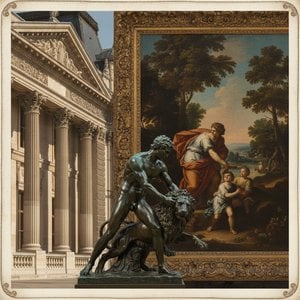
To stand before Salvator Rosa’s "Democrito E Protagora" is to step directly into the vibrant, dramatic heart of the Baroque era. This painting is not merely a depiction of historical figures; it is an immersive encounter with the very essence of philosophical inquiry. The scene unfolds amidst a lush, almost theatrical grove, where ancient trees frame a profound conversation. Rosa masterfully captures a moment suspended in time—a gathering of minds grappling with the mysteries of existence. The composition draws the viewer into the intimate circle formed by the figures: two women and a man, all clad in the flowing drapery evocative of classical antiquity. One woman seems to hold an object of contemplation, while another gazes upon her, suggesting that knowledge itself is being passed down or revealed.
Baroque Drama and Naturalistic Grandeur
Rosa’s signature style imbues this work with an unparalleled sense of drama. His technique eschews mere portraiture for something far grander—a tableau vivant imbued with emotional weight. The Baroque period favored intensity, movement, and the dramatic interplay between light and shadow, and Rosa executes this with breathtaking skill. While his influence draws from the naturalism of contemporaries like Rivera, his refusal to be confined by a single style lends the piece an untamed vitality. Observe how the deep greens of the foliage contrast with the warm tones of the skin and drapery; this careful handling of color and texture gives the scene a palpable depth, making the viewer feel the cool shade beneath the canopy.
Symbolism in the Grove
The inclusion of Democritus and Protagoras—names synonymous with foundational Greek philosophy—elevates the painting beyond simple genre scene. The natural setting itself functions as a symbolic backdrop for intellectual pursuit. Nature, in this context, is not just scenery; it is the eternal stage upon which human thought plays out its dramas. The interaction between the figures suggests a dialogue concerning truth, perception, and the structure of the universe. It invites us, the modern viewer, to pause our own hurried lives and consider what fundamental questions we are currently contemplating.
Bringing Antiquity Home: Reproduction for Your Space
Owning a reproduction of "Democrito E Protagora" is an opportunity to anchor your interior space with a piece steeped in intellectual romance and artistic drama. The original, painted in 1664, carries the weight of centuries of artistic mastery. Our hand-painted reproductions aim not just for visual accuracy, but for emotional resonance. Imagine this scene—the quiet intensity of philosophical debate set against the dramatic sweep of Baroque artistry—illuminating a drawing-room or library. It serves as a magnificent focal point, whispering tales of ancient wisdom and unparalleled artistic passion to every passerby.
Ερωτήσεις & Απαντήσεις
Τι επίπεδα κορεσμού και έντασης παρουσιάζει το "Democrito E Protagora" του Σαλβατόρ Ρόσα;
Το έργο "Democrito E Protagora" του Σαλβατόρ Ρόσα καταγράφεται με κορεσμό Subtle Color και ένταση Monochromatic.
Ποια εκτύπωση προτείνεται για το έργο "Democrito E Protagora" του Σαλβατόρ Ρόσα;
Μέγεθος Large, οριζόντια/κάθετη διάταξη Portrait: αυτή είναι η προτεινόμενη ρύθμιση εκτύπωσης για το έργο "Democrito E Protagora" του Σαλβατόρ Ρόσα.
Τι εξηγεί την κατάσταση των πνευματικών δικαιωμάτων του έργου "Democrito E Protagora" του Σαλβατόρ Ρόσα;
Το έργο "Democrito E Protagora" του Σαλβατόρ Ρόσα ανήκει στο δημόσιο κτήμα - τα δικαιώματα αυτορության έχουν λήξει. Η διάρκεια της προστασίας των πνευματικών δικαιωμάτων ξεκινά από τον θάνατο του καλλιτέχνη, ο οποίος συνέβη το 1673.



 Προεπισκόπηση
 Αγορά χειροποίητου πίνακα
 Αποστολή
 Κοινοποίηση
 Λεπτομέρειες
 Οδηγός

 Λήψη
Λήψη
 Παρόμοια αντικείμενα συλλογής
 Ακτινογραφία
 Παρουσίαση
 Στατιστικά


 Περισσότερα λεπτομέρεια






































 Η επιλογή με γυαλί είναι διαθέσιμη μόνο για μεγέθη κάτω από 110 εκ.