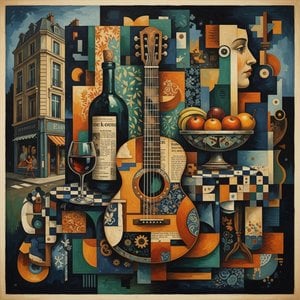
The Raw Pulse of a Community – Purvis Young's "Ritual Processional"
Purvis Young’s “Ritual Processional,” painted in 1985-1999, isn’t merely a depiction of a gathering; it’s an immersive experience. It’s a vibrant snapshot pulled from the heart of Overtown, Miami – a neighborhood that pulsed with both hardship and resilience during Young's lifetime. The painting immediately assaults the senses with its unapologetic energy: a dense throng of figures moving within a claustrophobic space, bathed in the warm glow of an unseen light source. It’s a scene brimming with movement, a feeling of collective purpose—a ritual unfolding before our eyes.
Young, largely self-taught and working outside traditional art circles, eschewed polished techniques for a directness that resonated powerfully with his subjects. He utilized inexpensive materials – wood scraps, cardboard, and house paint – transforming discarded objects into canvases brimming with life. This deliberate choice speaks volumes about Young’s philosophy: art wasn't about prestige or refinement; it was about capturing the essence of everyday experience, particularly within marginalized communities. The slightly rough texture of the paint, the visible layering of materials, all contribute to a sense of immediacy and authenticity—as if you could reach out and feel the heat of Overtown’s summer sun on your skin.
Decoding the Figures – Symbolism in Motion
The figures themselves are remarkably diverse, rendered with an astonishing lack of detail. They aren't portraits; they represent a collective, a community engaged in something significant. Some appear to be leading the procession, their gestures emphatic and directed. Others seem lost in contemplation, absorbed in the moment. The sheer number of individuals—a multitude coalescing into a single force—underscores the strength and solidarity of Overtown’s residents. Notice the varying heights and sizes; this isn't an attempt at photographic realism but rather a celebration of human diversity.
The background, rendered in a bold yellow hue, acts as both a stage and a symbolic anchor. It’s not a realistic landscape; it’s an intensified color field that amplifies the energy of the scene. Some art historians suggest this vibrant backdrop represents the hope and optimism that persisted within Overtown despite its challenges. The lack of specific details in the background further emphasizes the figures themselves, drawing our attention to their actions and emotions.
A Legacy Forged on the Streets – Context and Influence
Purvis Young’s work emerged during a period of profound social change in Miami. Overtown was undergoing gentrification, facing displacement and economic hardship. Young's art became a powerful voice for his community, documenting its struggles and celebrating its spirit. He wasn’t interested in creating pretty pictures; he wanted to tell the stories of the people who lived there – their hopes, their fears, their resilience.
His influence extends far beyond Miami. Young's raw, emotive style paved the way for a new generation of outsider artists and street artists. He demonstrated that art could be created anywhere, by anyone, and that it didn’t need to conform to traditional notions of beauty or skill. The painting’s directness and emotional honesty continue to resonate with audiences today, reminding us of the power of art to connect us to our shared humanity.
Bringing "Ritual Processional" Home – Reproduction Considerations
Reproductions of “Ritual Processional” offer a remarkable opportunity to bring a piece of Overtown’s soul into your own space. When selecting a reproduction, consider the quality of materials and printing techniques. A high-quality print on archival paper will ensure that the colors remain vibrant for years to come. The scale of the reproduction is also important; a larger format will allow you to fully appreciate the painting's intricate details and dynamic composition. Ultimately, a carefully chosen reproduction can serve as a powerful reminder of Purvis Young’s legacy – a testament to the enduring spirit of Overtown and the transformative power of art.
Ερωτήσεις & Απαντήσεις
Ποια είναι η χρωματική ταυτότητα του "Ritual Processional" του Πούρβις Γιουνγκ;
Το έργο "Ritual Processional" του Πούρβις Γιουνγκ χρησιμοποιεί μια παλέτα με αποχρώσεις Neutrals, με το Rosy Brown (#bdb678) να αποτελεί το κυρίαρχο χρώμα.
Ποια εποχή της καριέρας του/της Πούρβις Γιουνγκ αντιπροσωπεύει το έργο "Ritual Processional";
Στο πλαίσιο της καριέρας του/της Πούρβις Γιουνγκ, το έργο "Ritual Processional" ανήκει στην περίοδο Late Period. Αυτή η φάση διευκολύνει τη σύγκρισή του με άλλα έργα του/της καλλιτέχνη/της.
Πού τοποθετείται το "Ritual Processional" ανάμεσα στα επαναλαμβανόμενα θέματα του Πούρβις Γιουνγκ;
Το έργο "Ritual Processional" απεικονίζει τα ritual, processional, overtown, figures, mural, community, african american, spirituality, ενώ τα καταγεγραμμένα θέματα του Πούρβις Γιουνγκ είναι τα overtown life, street art, african american experience, social commentary, protest, spiritual, ritual imagery, unique. Η σύγκριση των δύο αναδεικνύει τον τρόπο με τον οποίο το έργο συνδέεται με τα συνηθισμένα θέματα του καλλιτέχνη.



 Προεπισκόπηση
 Αγορά χειροποίητου πίνακα
 Αποστολή
 Κοινοποίηση
 Λεπτομέρειες
 Οδηγός

 Λήψη
Λήψη
 Παρόμοια αντικείμενα συλλογής
 Ακτινογραφία
 Παρουσίαση
 Στατιστικά


 Περισσότερα λεπτομέρεια






































 Η επιλογή με γυαλί είναι διαθέσιμη μόνο για μεγέθη κάτω από 110 εκ.