A Window into Mondrian’s Evolution: ‘Oval Composition’
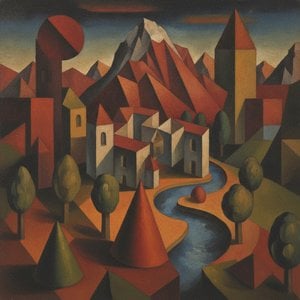
This striking monochrome drawing offers a fascinating glimpse into the artistic development of Piet Mondrian, predating his iconic geometric abstractions. Created sometime before 1911, *Oval Composition* reveals a pivotal moment in the artist's journey – a transition from representational landscapes to the radical simplification that would define his later work and the De Stijl movement. The artwork isn’t merely a study; it’s an energetic exploration of form and space, brimming with the seeds of Mondrian’s future aesthetic.
Deconstructing the Landscape
The subject matter appears to be an abstracted landscape – perhaps mountains or a coastline – but any direct representation is deliberately obscured. Instead, Mondrian employs a dynamic interplay of jagged, angular lines and geometric shapes within an oval frame. This isn’t about *depicting* nature; it's about distilling its essence into fundamental forms. The composition lacks a traditional focal point, encouraging the eye to wander across the densely packed arrangement, experiencing the artwork as a unified field of energy.
Technique and Materials
Mondrian’s masterful technique is immediately apparent. Executed in graphite or charcoal on paper, the work showcases meticulous control of line weight and shading.
Hatching and cross-hatching are employed to build form and create a sense of depth, despite the overall flattening of perspective. The varying densities of these lines imply light and shadow, adding nuance to the monochrome palette. This isn’t simply sketching; it's a carefully considered study in tonal values and textural effects.
Style & Influences
*Oval Composition* sits at the crossroads of several early 20th-century art movements. The fragmented forms and distorted perspective hint at
Cubist influences, while the expressive use of line and emphasis on emotional impact align with
Expressionism. However, Mondrian quickly moved beyond these styles, using them as stepping stones toward his unique brand of abstraction. This piece demonstrates his early experimentation with reducing reality to its most basic components – a process that would ultimately lead to Neoplasticism.
Symbolism and Interpretation
The symbolism within *Oval Composition* is subtle yet potent. The angularity of the lines can be interpreted as representing chaos, disruption, or the inherent instability of the natural world. Conversely, the enclosing oval frame might symbolize containment, a desire to impose order on this perceived chaos, or even represent a self-contained universe. It’s a work that invites contemplation and multiple interpretations.
Historical Context & Significance
During this period (1872-1911), Mondrian was transitioning from traditional Dutch Impressionism to more avant-garde approaches. He was actively seeking new ways to represent reality, moving away from purely visual representation towards a more spiritual and philosophical approach to art. *Oval Composition* is a crucial example of this transitional phase, demonstrating his willingness to experiment and challenge conventional artistic norms.
Emotional Impact & Aesthetic Appeal
Despite its monochrome palette, *Oval Composition* possesses an undeniable energy. The dynamic lines and fragmented forms create a sense of movement and tension, while the meticulous technique conveys a feeling of intense focus and control. This artwork is not about serene beauty; it’s about intellectual exploration and emotional resonance. It's a piece that rewards close viewing and offers a compelling visual experience for art lovers and collectors alike.
- For Art Lovers: A rare opportunity to witness the genesis of one of modern art’s most influential styles.
- For Collectors: An important work in Mondrian's oeuvre, representing a crucial stage in his artistic development.
- For Interior Designers: A sophisticated and thought-provoking piece that adds depth and intellectual weight to any space. Its monochrome palette makes it incredibly versatile, complementing a wide range of interior styles.
Ερωτήσεις και Απαντήσεις
Σε ποιο καλλιτεχνικό ρεύμα και σε ποια εποχή τοποθετείται το "Oval Composition" του Πιτ Μοντριάν;
Το "Oval Composition" ανήκει στο καλλιτεχνικό ρεύμα Cubism, και ο δημιουργός του εργάστηκε στην εποχή Μοντέρνα εποχή.
Μπορώ να προβιβάσω το "Oval Composition" σε μορφή διαφάνειας σε πλήρη οθόνη;
Το έργο "Oval Composition" του Πιτ Μοντριάν μπορεί να προβληθεί σε μορφή διαφάνειας στη σελίδα Παρουσίαση διαφάνειων του έργου.
Σε ποια εποχή δημιουργήθηκε το "Oval Composition" του Πιτ Μοντριάν;
Το έργο "Oval Composition" ανήκει στην εποχή του Modern.



 Προεπισκόπηση σε πραγματική κλίμακα
 Μετάβαση σε Εκτυπώσεις
 Αποστολή
 Κοινοποίηση
 Λεπτομέρειες
 Οδηγός

 Λήψη
Λήψη
 Παρόμοια αντικείμενα συλλογής
 Ακτινογραφία
 Παρουσίαση
 Q&A
Q&A Στατιστικά

 Περισσότερα






































 Η επιλογή με γυαλί είναι διαθέσιμη μόνο για μεγέθη κάτω από 110 εκ.