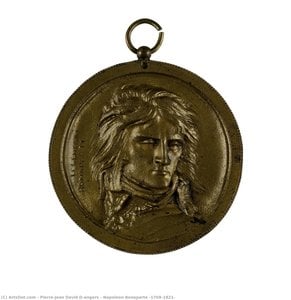
A Portrait of Scholarly Pursuit: Charles Lenormant by Pierre-Jean David d'Angers
The bronze medallion depicting Charles Lenormant offers more than just a likeness; it’s a window into the burgeoning field of archaeology in 19th-century France. Crafted by the esteemed sculptor Pierre-Jean David d’Angers, this remarkable piece captures not merely a man's features but also his intellectual fervor and dedication to uncovering the secrets of the past. Lenormant, a pivotal figure in French archaeology, was an inspector of fine arts who dedicated himself to exploring Egypt and Greece, contributing significantly to our understanding of ancient civilizations. The medallion serves as a tangible reminder of his pioneering work, embodying the spirit of scientific inquiry that defined the era.
A Neoclassical Masterpiece: Style, Technique, and Material
David d’Angers's style is firmly rooted in the neoclassical tradition, evident in the meticulously rendered profile of Lenormant. The work showcases a remarkable attention to detail – from the subtle lines etched into his face to the texture of his hair, each element speaks to the sculptor’s mastery. The bronze itself—a material prized for its durability and ability to capture fine details—is skillfully manipulated to create a sense of depth and realism. Notice how the artist employs *chiaroscuro*, using light and shadow to sculpt volume and define form, lending a dramatic quality to the portrait. The casting process, likely utilizing the lost-wax method, would have involved creating a wax model, then investing it in plaster before melting down the wax to create the final bronze form. This technique ensures a remarkable level of precision and surface finish.
Symbolism and Historical Context: A Reflection of an Age
Beyond its aesthetic qualities, the medallion is rich with symbolic meaning. Lenormant’s pose—a thoughtful gaze directed towards the viewer—suggests a man deeply engaged in contemplation and intellectual pursuit. The inclusion of the scroll or document (though details are difficult to discern without higher resolution) hints at his scholarly work and dedication to historical research. The period itself, the early 19th century, was one of immense change and discovery, fueled by the Enlightenment’s emphasis on reason and scientific inquiry. Archaeology was gaining prominence as a legitimate field of study, driven by figures like Champollion and inspired by Napoleon's campaigns in Egypt. This medallion stands as a testament to that intellectual excitement and the growing interest in understanding our shared human past.
Emotional Resonance: A Portrait of Dedication
Looking at this portrait, one is struck not only by its technical brilliance but also by the sense of quiet determination it conveys. Lenormant’s face—lined with experience and imbued with a thoughtful expression—suggests a man who has dedicated his life to unraveling the mysteries of antiquity. The bronze itself, with its patina of age and wear, adds to this feeling of historical weight and enduring legacy. It's a portrait that invites us to reflect on the importance of intellectual curiosity, perseverance, and the pursuit of knowledge—qualities that continue to resonate today. The piece evokes a sense of reverence for scholarship and the individuals who have shaped our understanding of history.



 Μετάβαση σε Εκτυπώσεις
 Αποστολή
 Κοινοποίηση
 Λεπτομέρειες
 Οδηγός

 Λήψη
Λήψη
 Παρόμοια αντικείμενα συλλογής
 Παρουσίαση
 Στατιστικά


 Περισσότερα λεπτομέρεια






































 Η επιλογή με γυαλί είναι διαθέσιμη μόνο για μεγέθη κάτω από 110 εκ.