A Vision of Grace: Unveiling Paolo Uccello’s ‘Faith’
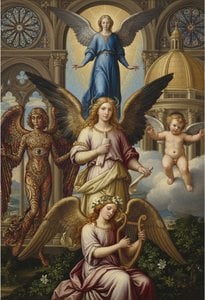
Paolo Uccello's ‘Faith’, painted around 1435, is not merely an image; it’s a whispered prayer rendered in pigment and gold. The painting presents a serene Madonna, crowned and winged, tenderly cradling the Christ Child. Her gaze, though gentle, possesses a profound dignity, suggesting both earthly motherhood and divine grace. The composition immediately draws the eye to this central devotional figure, yet Uccello’s genius lies in how he expands beyond simple piety, embedding the scene within a subtly complex world that speaks to the burgeoning Renaissance fascination with perspective and symbolic representation.
The Dawn of Perspective and Narrative Detail
Uccello was a pioneer, deeply captivated by the mathematical principles governing visual space. While not as dramatically showcased as in his famed battle scenes – like those depicting the Battle of San Romano – the seeds of this obsession are clearly present in ‘Faith’. Notice how the delicate folds of her garments and the subtle modeling of her face demonstrate an evolving understanding of form and volume, moving away from the flatter conventions of Gothic art. The inclusion of two boats on either side of the composition is particularly intriguing. These aren’t merely background elements; they introduce a sense of journey, perhaps alluding to the Church as a vessel carrying souls towards salvation, or even referencing the biblical story of Noah and the flood, subtly reinforcing themes of faith and redemption. Uccello's meticulous attention to detail—the intricate patterns adorning her crown, the delicate feathers of her wings spanning the entire width of the canvas—reveals a dedication to craftsmanship that was characteristic of the Early Renaissance.
Symbolism Woven into Every Brushstroke
The symbolism within ‘Faith’ is rich and layered. The Madonna herself embodies both divine wisdom and maternal love, a potent combination central to Christian iconography. Her wings, expansive and luminous, signify her celestial nature, elevating her beyond the earthly realm. The crown she wears isn't simply an emblem of royalty; it represents her position as Queen of Heaven. Even the choice of colors—the deep blues and golds—carry symbolic weight, representing holiness, divinity, and spiritual enlightenment. Uccello wasn’t just painting a beautiful image; he was constructing a visual sermon, designed to inspire contemplation and devotion in the viewer. Considering his broader body of work, particularly his fascination with geometry and pattern, it's tempting to see ‘Faith’ as an exploration of divine order manifested through artistic form.
A Legacy of Innovation
Paolo Uccello stands at a pivotal moment in art history—a bridge between the elegance of the Gothic period and the burgeoning realism of the Renaissance. His unique style, characterized by its blend of decorative detail, mathematical precision, and narrative storytelling, continues to captivate audiences centuries later. ‘Faith’ is a testament to his innovative spirit, offering a glimpse into the mind of an artist who sought not only to represent the world around him but also to understand the underlying principles that governed it. Owning a reproduction of this masterpiece isn't simply acquiring a beautiful artwork; it’s inviting a piece of Renaissance history and spiritual contemplation into your space.



 Προεπισκόπηση
 Μετάβαση σε Εκτυπώσεις
 Αποστολή
 Κοινοποίηση
 Λεπτομέρειες
 Οδηγός

 Λήψη
Λήψη
 Παρόμοια αντικείμενα συλλογής
 Ακτινογραφία
 Παρουσίαση
 Στατιστικά


 Περισσότερα λεπτομέρεια






































 Η επιλογή με γυαλί είναι διαθέσιμη μόνο για μεγέθη κάτω από 110 εκ.