A Dance of Shadows and Desire: Unveiling Picasso’s “Untitled (51)”
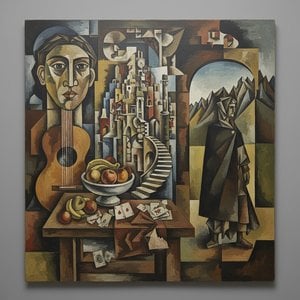
Pablo Picasso's "Untitled (51)," created in 1966, isn’t merely a drawing; it’s a visceral exploration of the human condition, a potent distillation of Symbolism and early Expressionism channeled through the masterful hand of one of art history’s most revolutionary figures. This work, rendered primarily in charcoal – though hints of graphite suggest layering – captures a group of nude figures engaged in an intimate, almost unsettling, tableau. The composition is dynamic, deliberately unbalanced, mirroring the turbulent emotions it seeks to convey. It's a piece that demands attention, inviting viewers into a world where form and feeling are inextricably linked.
The scene unfolds with a remarkable immediacy. Figures sprawl across the page in various states of repose and interaction – some reclining languidly, others locked in close embraces, their bodies intertwined in a complex choreography of desire and vulnerability. Picasso’s signature style is immediately apparent: bold, expressive lines dominate, creating a sense of movement and energy that pulsates through the entire composition. These aren't precise renderings of anatomy; rather, they are stylized representations, emphasizing gesture and emotion over strict realism. The overlapping forms create an illusion of depth, pulling the viewer into the intimate space depicted.
Echoes of Symbolism and Early Expressionism
To understand “Untitled (51),” it’s crucial to consider Picasso's artistic journey and the movements that profoundly influenced him. The work resonates strongly with the tenets of Symbolism, a late 19th-century movement characterized by its focus on subjective experience and the use of evocative imagery to convey deeper meanings. Like many Symbolist artists, Picasso employs suggestion rather than explicit representation, relying on visual cues to evoke feelings of mystery, longing, and psychological complexity. Furthermore, there’s a clear kinship with early Expressionism, particularly in the heightened emotionality and distortion of form. The figures aren't presented as idealized beauties; they are imbued with raw feeling – a sense of vulnerability, perhaps even pain.
The deliberate use of black and white further amplifies this effect. The stark contrast between light and shadow creates dramatic effects, intensifying the emotional impact of the scene. The lack of color forces the viewer to focus entirely on line, texture, and form, heightening their awareness of the figures’ physicality and psychological states. It's a technique that Picasso frequently employed during this period, allowing him to explore themes of darkness, mortality, and the complexities of human relationships with remarkable intensity.
Decoding the Symbolism: Desire, Vulnerability, and Social Commentary
While seemingly straightforward in its depiction of nude figures, “Untitled (51)” is rich in symbolic potential. The poses themselves – the reclining figures, the intimate embraces – speak to themes of desire, vulnerability, and perhaps even social commentary. The central figure, often interpreted as a woman, appears both exposed and empowered, her gaze directed outwards with an air of quiet strength. The surrounding figures seem to orbit around her, suggesting a complex dynamic of power and attraction.
Interestingly, Picasso’s own life during this period – marked by personal struggles and artistic experimentation – undoubtedly informed the work's emotional tenor. The drawing can be viewed as an exploration of his own inner landscape, a reflection on themes of love, loss, and the challenges of navigating relationships. The overall mood is one of intense emotion, suggesting that Picasso was grappling with profound questions about human nature and the complexities of the world around him.
A Legacy in Line: Reproduction and Artistic Appreciation
Reproductions of “Untitled (51)” offer a remarkable opportunity to experience the power and artistry of this iconic work. The meticulous line work, achieved through charcoal or graphite, is particularly striking when reproduced, revealing the subtle nuances of texture and form that are often lost in smaller formats. Whether displayed as a statement piece in a contemporary interior or studied by art historians, this drawing continues to captivate viewers with its raw emotion and enduring artistic merit. It stands as a testament to Picasso’s genius – a timeless exploration of the human spirit through the language of line.
Ερωτήσεις και Απαντήσεις
Ποια είναι η προτεινόμενη χρήση μιας εκτύπωσης του "Untitled (51)";
Μια αναπαραγωγή του έργου "Untitled (51)" του Πάμπλο Πικάσο προτείνεται για Statement, καθώς η πρόταση αυτή πηγάζει από το θέμα, τη διάθεση και τα χρώματα του ίδιου.
Σε ποιο καλλιτεχνικό ρεύμα και σε ποια εποχή τοποθετείται το "Untitled (51)" του Πάμπλο Πικάσο;
Στο έργο "Untitled (51)" του Πάμπλο Πικάσο, το κίνημα του Expressionism συναντά την εποχή του Μοντέρνα εποχή.
Το έργο "Untitled (51)" ανήκει στο δημόσιο περιουσιακό αγαθό;
Το έργο "Untitled (51)" του Πάμπλο Πικάσο ανήκει στο ακόμα προστατευόμενο από δικαιώματα αυτορικού. Η κατάσταση αυτή διέπει τον τρόπο με τον οποίο μπορεί να αναπαραχθεί η εικόνα του έργου.



 Προεπισκόπηση σε πραγματική κλίμακα
 Αγορά χειροποίητου πίνακα
 Αποστολή
 Κοινοποίηση
 Λεπτομέρειες
 Οδηγός

 Λήψη
Λήψη
 Παρόμοια αντικείμενα συλλογής
 Ακτινογραφία
 Παρουσίαση
 Στατιστικά

 Περισσότερα






































 Η επιλογή με γυαλί είναι διαθέσιμη μόνο για μεγέθη κάτω από 110 εκ.