


Χειροποίητη oil painting σε καμβά στο δικό σας μέγεθος και πλαίσιο, κατά παραγγελία από τους καλλιτέχνες μας. ( Αγορά εκτύπωσης Αγορά ψηφιακής εικόνας)





























Επιλέξτε από τις προκαθορισμένες διαστάσεις μας που διατηρούν τις αρχικές αναλογίες του έργου τέχνης.

Μπορείτε να ορίσετε δικές σας διαστάσεις ώστε το έργο να ταιριάζει σε ένα συγκεκριμένο πλαίσιο ή χώρο. Εάν το επιλεγμένο μέγεθος δεν συμπίπτει με τις αναλογίες της αρχικής εικόνας, θα περικοψούμε το έργο ή θα επεκτείνουμε τη ζωγραφιά με πρόσθετα χειρόγραφα στοιχεία. Ένα ψηφιακό προσχέδιο θα σας αποσταλεί για έγκριση πριν την έναρξη της παραγωγής.
Παρακαλούμε σημειώστε ότι η προεπισκόπηση στην οθόνη δεν αντικατοπτρίζει την πραγματική περικοπή ή επέκταση. Μόνο το προσχέδιο θα δείξει με ακρίβεια την τελική σύνθεση.
Παρόλο που είναι διαθέσιμα προσαρμοσμένα μεγέθη, συνιστούμε να επιλέξετε μια διάσταση από τη λίστα των προκαθορισμένων μεγεθών για τη διατήρηση των αρχικών αναλογιών.
Παγκόσμια Αποστολή () σε 3-4 εβδομάδες αντί για τις συνήθεις 5 εβδομάδες. (7 Σεπτέμβριος). Χωρίς συμβιβασμούς στην ποιότητα.


The wine bottle
Διαστάσεις Αναπαραγωγής
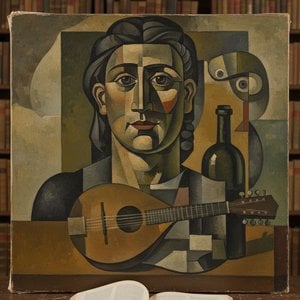
Pablo Picasso’s “The Wine Bottle,” painted in 1912 during the analytical phase of Cubism, isn't merely a depiction of everyday objects; it’s an invitation into a radically new way of seeing. This unassuming still life—a bottle of wine, a glass, a carafe, and a scattering of fruit – becomes a complex puzzle when viewed through the lens of this revolutionary movement. Rather than presenting a single, unified reality, Picasso dismantles the familiar, fracturing the forms and reassembling them in an abstract composition that challenges our perception of space and form. It’s a deliberate rejection of traditional perspective, a move away from mimicking the world as it appears to the eye, and instead, offering a simultaneous representation of multiple viewpoints – a core tenet of Cubism's groundbreaking approach.
Created during a period of intense experimentation within the Cubist movement, “The Wine Bottle” exemplifies the analytical phase. This stage, co-developed by Picasso and Georges Braque, involved a painstaking process of breaking down objects into their fundamental geometric components – cubes, cones, cylinders – before reconstructing them on the canvas. The muted palette—primarily browns, greens, and grays—further emphasizes this deconstruction. Colors are not used to create illusion or depth but rather as tonal markers within the fragmented forms. Notice how the bottle is presented from several angles at once; we see its profile, side view, and even a suggestion of its top simultaneously. The glass appears to shimmer with reflected light, while the fruit seems to float in an ambiguous space, all contributing to the sense of disorientation and multiple perspectives.
While often perceived as purely formal experimentation, “The Wine Bottle” also carries a subtle layer of symbolism. The wine itself, a recurring motif in Picasso’s work, can be interpreted as representing pleasure, conviviality, or even mortality – themes frequently explored by the artist. The inclusion of simple objects like a bottle and fruit elevates the scene to a level beyond mere representation; it becomes a meditation on the nature of perception and the relationship between the object and its observer. The banana, in particular, is intriguing, hinting at the burgeoning interest in non-Western cultures and artistic traditions that influenced Picasso’s thinking during this period – a connection visible in his exploration of African masks and sculptures.
“The Wine Bottle” stands as a pivotal work in Picasso’s oeuvre and a cornerstone of Cubism. It demonstrates the artist’s willingness to push boundaries, challenging established artistic conventions and paving the way for future generations of avant-garde artists. His exploration of multiple viewpoints, fragmented forms, and abstract representation profoundly impacted the course of 20th-century art, influencing movements like Futurism and Constructivism. Studying this painting offers a fascinating glimpse into Picasso’s creative process and his profound contribution to our understanding of visual language. The work's enduring appeal lies in its ability to simultaneously challenge and intrigue, inviting viewers to engage with the complexities of perception and representation.


1881 - 1973 , Ισπανία

Explore the profound evolution of Cubism through an expert analysis of Pablo Picasso's revolutionary works. From Analytical to Synthetic Cubism, discover the techniques that redefined modern art and learn how to curate these iconic masterpieces for your private collection.
Master the complexities of Analytical Cubism with our expert guide. Explore how Picasso and Braque revolutionized art through fragmented perspective, geometric abstraction, and muted palettes—essential knowledge for every discerning art collector.

 Δείτε σε πραγματικό χώρο
 Αποστολή
 Κοινοποίηση
 Λεπτομέρειες

 Λήψη
Λήψη
 Παρόμοια αντικείμενα συλλογής
 Ακτινογραφία
 Παρουσίαση

 Διαβάστε περισσότερα







 Η επιλογή με γυαλί είναι διαθέσιμη μόνο για μεγέθη κάτω από 110 εκ.


