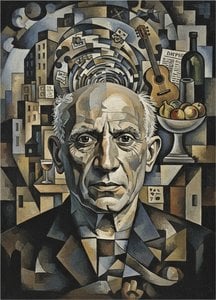
The mirror (1932) από τον/την Πάμπλο Πικάσο, αναπαραγωγή λαδω絵 ζωγραφικής με χειρόπληκτο τεχνικό από έναν κορυφαίο καλλιτέχνη
Προεπισκόπηση σε πραγματική κλίμακα Προεπισκόπηση σε AR Μετάβαση σε Εκτυπώσεις Μετάβαση σε Ψηφιακή Αποτέλεσμα Αποστολή
Λεπτομέρειες Οδηγός Προσθήκη στα αγαπημένα Λήψη Παρόμοια αντικείμενα συλλογής Ακτινογραφία Παρουσίαση Ερωτήσεις & Απαντήσεις Λήψη παρουσίασης Στατιστικά

The mirror Αντιγραφή ελαιογραφίας με χειρό painted τεχνική

Pablo Picasso's 'The Mirror' (1932) is a captivating Naive Art piece exploring themes of identity and reflection through Cubist influences & striking visuals. A unique glimpse into the artist’s mind.

Συνιδρυτής του Κυβισμού και δημιουργός του Γκέρνικα. Ανακαλύψτε σήμερα τα επαναστατικά έργα του Πάμπλο Πικάσο.

Το έργο τέχνης που εμφανίζεται σε αυτή τη σελίδα προστατεύεται από τους νόμους περί πνευματικών δικαιωμάτων, γεγονός που σημαίνει ότι δεν μπορούμε νομικά να δημιουργήσουμε ή να πουλήσουμε μια ταυτόσημη αναπαραγωγή του. Αυτή η προστασία επιβάλλεται βάσει διεθνών συμφωνιών, όπως η Σύμβαση της Βέρνης καθώς και από τους εθνικούς νόμους, συμπεριλαμβανομένων αυτών που ορίζονται από το Νομοθεσία περί πνευματικών δικαιωμάτων των ΗΠΑ - Τίτλος 17. Όλα τα δικαιώματα κατοχυρωμένα. Απαγορεύεται η αναπαραγωγή χωρίς άδεια.

Ως μια σεβαστή και νόμιμη εναλλακτική, προσφέρουμε προσαρμοσμένα, χειροποίητα έργα τέχνης εμπνευσμένα από το πρωτότυπο. Οι έμπειροι και επαγγελματίες καλλιτέχνες μας μελετούν προσεκτικά το στυλ, τη διάθεση και την καλλιτεχνική ουσία του πρωτοτύπου, ώστε να δημιουργήσουν ένα νέο, μοναδικό έργο που προκαλεί την ίδια αίσθηση — παραμένοντας όμως μια πρωτότυπη δημιουργία από μόνη της.

Αυτή η μέθοδος συμμορφώνεται πλήρως με τους κανονισμούς περί πνευματικών δικαιωμάτων, καθώς δεν περιλαμβάνει την αντιγραφή ή την αναπαραγωγή του προστατευόμενου έργου. Αντίθετα, πρόκειται για μια δημιουργική ερμηνεία — ένα νέο έργο που επηρεάζεται από το πρωτότυπο, χωρίς όμως να είναι πανομοιότυπο με αυτό.

Χειροποίητη Αναπαραγωγή σε Έλαιο

Χειροποίητη ελαιογραφία σε καμβά στο δικό σας μέγεθος και πλαίσιο, κατά παραγγελία από τους καλλιτέχνες μας. ( Μετάβαση σε Εκτυπώσεις Μετάβαση σε Ψηφιακή Αποτέλεσμα)

Corner sample of the P118B picture frame: μολυσμένο πολυστερίνη, 5 cm wide and 3 cm thick
P118B €10
Corner sample of the P118H picture frame: μολυσμένο πολυστερίνη, 5 cm wide and 3 cm thick
P118H €10
Corner sample of the P118W picture frame: μολυσμένο πολυστερίνη, 5 cm wide and 3 cm thick
P118W €10
Corner sample of the P438Z picture frame: μολυσμένο πολυστερίνη, 5.5 cm wide and 3.5 cm thick
P438Z €10
Corner sample of the P508JH picture frame: μολυσμένο πολυστερίνη, 7 cm wide and 3.5 cm thick
P508JH €12
Corner sample of the P508YH picture frame: μολυσμένο πολυστερίνη, 7 cm wide and 3.5 cm thick
P508YH €12
Corner sample of the P805H picture frame: μολυσμένο πολυστερίνη, 5 cm wide and 3.5 cm thick
P805H €10
Corner sample of the P805Z picture frame: μολυσμένο πολυστερίνη, 5 cm wide and 3.5 cm thick
P805Z €10
Corner sample of the P919BZ picture frame: μολυσμένο πολυστερίνη, 7 cm wide and 3.5 cm thick
P919BZ €10
Corner sample of the P919G picture frame: μολυσμένο πολυστερίνη, 7 cm wide and 3.5 cm thick
P919G €10
Corner sample of the P919XJ picture frame: μολυσμένο πολυστερίνη, 7 cm wide and 3.5 cm thick
P919XJ €10
Corner sample of the P959ZH picture frame: μολυσμένο πολυστερίνη, 5 cm wide and 3 cm thick
P959ZH €10
Corner sample of the P968JZ picture frame: μολυσμένο πολυστερίνη, 6 cm wide and 4 cm thick
P968JZ €12
Corner sample of the W106C picture frame: πλήρες ξύλο, 5 cm wide and 3 cm thick
W106C €8
Corner sample of the W218G picture frame: πλήρες ξύλο, 5 cm wide and 3 cm thick
W218G €10
Corner sample of the W218JH picture frame: πλήρες ξύλο, 5 cm wide and 3 cm thick
W218JH €8
Corner sample of the W218Y picture frame: πλήρες ξύλο, 5 cm wide and 3 cm thick
W218Y €10
Corner sample of the W307PJ picture frame: πλήρες ξύλο, 6 cm wide and 3 cm thick
W307PJ €10
Corner sample of the W316G picture frame: πλήρες ξύλο, 6 cm wide and 3 cm thick
W316G €10
Corner sample of the W316PJ picture frame: πλήρες ξύλο, 6 cm wide and 3 cm thick
W316PJ €8
Corner sample of the W316Y picture frame: πλήρες ξύλο, 6 cm wide and 3 cm thick
W316Y €10
Corner sample of the W398PJ picture frame: πλήρες ξύλο, 5 cm wide and 3 cm thick
W398PJ €8
Corner sample of the W4111J picture frame: πλήρες ξύλο, 6.5 cm wide and 3.5 cm thick
W4111J €10
Corner sample of the W500HY picture frame: πλήρες ξύλο, 7 cm wide and 5 cm thick
W500HY €15
Corner sample of the W500JH picture frame: πλήρες ξύλο, 7 cm wide and 5 cm thick
W500JH €15
Corner sample of the W692G picture frame: πλήρες ξύλο, 8 cm wide and 4 cm thick
W692G €12
Corner sample of the W849H picture frame: πλήρες ξύλο, 5 cm wide and 3 cm thick
W849H €8
Corner sample of the W940BG picture frame: πλήρες ξύλο, 7.5 cm wide and 4.5 cm thick
W940BG €15
Corner sample of the W953PJ picture frame: πλήρες ξύλο, 6 cm wide and 3.5 cm thick
W953PJ €8

Πρότυπο
κατόπιν παραγγελίας
CM
INCH

Επιλέξτε από τις προκαθορισμένες διαστάσεις μας που διατηρούν τις αρχικές αναλογίες του έργου τέχνης.

πλάτος
ύψος

Πληκτρολογήστε το πλάτος και το ύψος που επιθυμείτε, ώστε να ταιριάζουν στο κάδሮ ή στον τοίχο σας. Ε เนื่องจาก πρόκειται για χειροποίητη ζωγραφική, σε περίπτωση διαστάσεων με διαφορετικό σχήμα, ο καλλιτέχνης μπορεί να ζωγραφίσει λίγο παραπάνω γύρω από το έργο ή να αφαιρέσει ένα μέρος — η επιλογή είναι δική σας. Σας στέλνουμε ένα ψηφιακό mockup για έγκριση πριν ξεκινήσει η δημιουργία του έργου. Η εικόνα που εμφανίζεται σε αυτή τη σελίδα δεν δείχνει το τελικό αποτέλεσμα — μόνο το mockup το αναδεικνύει.

Παραδείγματα αλλαγών: Αντικατάσταση προσώπου με φωτογραφία του πελάτη· Προσθήκη κατοικίδιου (π.χ., αντικατάσταση γάτας με σκύλο)· Ενσωμάτωση κρυφού μηνύματος στο φόντο· Αλλαγή τοπίου ή στοιχείων του φόντου.
Μετά την παραγγελία, η ομάδα του WahooArt.com θα στείλει email στον πελάτη με οδηγίες και θα παρέχει μια προεπισκόπηση προσχεδίου

Παγκόσμια Αποστολή () σε 3-4 εβδομάδες αντί για τις συνήθεις 5 εβδομάδες. (11 Νοέμβριος). Χωρίς συμβιβασμούς στην ποιότητα.

Δωρεάν γρήγορη διεθνής αποστολή
Κάμβας από Λινό Υψηλής Ποιότητας
Πλήρης ασφάλιση μεταφοράς
Εγγύηση επιστροφής δασμών και φόρων εισαγωγής
Εγγύηση Απόλυτης Ομοιότητας Χρωμάτων
Πολιτική Επιστροφής 100 Ημερών (Μόνο σε περίπτωση ελαττωμάτων)
Εγγύηση επιστροφής 100% των χρημάτων
Προσφορά για πολλαπλές παραγγελίες

Συνολική Τιμή

€ 243

The mirror

Μέσο Αναπαραγωγής

Διαστάσεις Αναπαραγωγής

-

Τελική Τιμή

€ 243

Σημαντικά στοιχεία

  • Influences:
    • Cubism
    • Primitivism
  • Notable elements: Mirror reflection,
  • Title: The Mirror
  • Artistic style: Cubism, Deco influence
  • Year: 1932

ΚВИΖ Τέχνης

Για κάθε ερώτηση υπάρχει μόνο μία σωστή απάντηση.

Ερώτηση 1:
What artistic movement is Pablo Picasso’s ‘The Mirror’ most closely associated with?
Ερώτηση 2:
What is a key characteristic of Naive Art, as exemplified by ‘The Mirror’?
Ερώτηση 3:
The image ‘The Mirror’ prominently features a reflection. What does this element primarily contribute to the artwork's overall meaning?
Ερώτηση 4:
Which artistic style heavily influenced Picasso’s use of multiple perspectives and geometric forms in ‘The Mirror’?
Ερώτηση 5:
In what year was Pablo Picasso's painting ‘The Mirror’ created?

The Enigmatic Mirror: A Window into Picasso’s Psyche

Pablo Picasso's “The Mirror,” painted in 1932 during his prolific period of exploration and experimentation, isn’t merely a depiction of a reflective surface; it’s a profound meditation on identity, vulnerability, and the complexities of self-perception. Created within the framework of Naive Art – a movement he embraced yet subtly subverted – the painting immediately draws the viewer in with its bold simplicity and arresting use of color. The composition centers around a young woman lying on her side, her head resting gently upon the floor, while a mirror in the background reflects her form. This seemingly straightforward arrangement belies a wealth of symbolic layers and artistic innovation deeply rooted in Cubism and influenced by the broader currents of primitivism. Picasso’s choice to render the scene with such directness, eschewing traditional perspective and embracing simplified forms, speaks volumes about his desire to strip away artifice and confront the raw essence of human experience. The painting's power lies not just in its visual impact but also in the questions it subtly poses about how we see ourselves and how that image is shaped by external reflections – both literal and metaphorical.

Cubist Innovations and Primitivist Roots

“The Mirror” stands as a compelling example of Picasso’s ongoing dialogue with Cubism, a movement he co-founded alongside Georges Braque. However, unlike the fragmented geometric forms often associated with Analytic Cubism, this work leans towards a more expressive and emotionally charged approach. The use of multiple perspectives – subtly incorporated through the mirror's reflection – creates an unsettling sense of disorientation, mirroring the internal turmoil that can accompany self-examination. This technique, characteristic of Cubism, forces the viewer to actively engage with the image, piecing together its fragmented reality much as Picasso himself was grappling with his own identity and artistic evolution at the time. Furthermore, the painting’s embrace of Naive Art – a style favored by untrained artists – aligns it with a broader primitivist impulse, seeking to capture an unmediated view of the world, free from the constraints of academic conventions. This deliberate simplification allows Picasso to focus on core emotional truths, bypassing intellectual analysis and appealing directly to the viewer's intuition. The painting’s stark contrasts and bold lines are reminiscent of early works in his Blue Period, suggesting a return to themes of melancholy and introspection.

Symbolism and the Portrait of Vulnerability

The woman depicted is not simply a passive subject; she embodies a potent blend of vulnerability and defiance. Her nakedness, while potentially provocative, isn’t presented in a overtly sexual manner. Instead, it evokes a sense of exposed fragility, suggesting a moment of quiet contemplation or perhaps even surrender. The placement of her head on the floor – a gesture of humility and introspection – further emphasizes this theme. Crucially, the mirror itself acts as a powerful symbol, reflecting not just her physical form but also her inner self. Notice how Picasso subtly alters the reflection, hinting at an underlying tension between the perceived image and the reality of her experience. The slight distortion in the mirrored image suggests that our self-perception is rarely entirely accurate, often shaped by external judgments and societal expectations. The presence of two figures in the background – one near the top left corner and another at the bottom right – adds an intriguing layer of complexity, hinting at a shared narrative or perhaps simply the quiet observation of a private moment. These secondary figures remain largely undefined, allowing the viewer to project their own interpretations onto the scene.

A Masterpiece of Color and Technique

Technically, “The Mirror” showcases Picasso’s masterful command of oil on canvas. The use of bold, vibrant colors – primarily blues, greens, and browns – creates a dynamic visual experience, injecting energy into the otherwise contemplative scene. Picasso employs a technique that blends elements of both realism and abstraction, utilizing simplified forms and expressive brushstrokes to convey emotion and atmosphere. The deliberate layering of paint and the visible texture contribute to the painting’s tactile quality, inviting close examination. The stark contrast between the dark background and the luminous figure draws attention to her vulnerability while simultaneously creating a sense of depth and dimensionality. The overall effect is one of arresting immediacy – a snapshot of a fleeting moment captured with remarkable precision and emotional resonance. It's a testament to Picasso’s ability to distill complex ideas into a deceptively simple visual language, making “The Mirror” a truly enduring masterpiece.

Ερωτήσεις και Απαντήσεις

Πώς συνδυάζονται η αντίθεση και η αρμονία στο "The mirror";

Η χρωματική ανάλυση του έργου "The mirror" του Πάμπλο Πικάσο αποτυπώνει μια Statement αντίθεση και μια Softly Mixed Palette αρμονία.

Πότε δημιουργήθηκε το έργο "The mirror" του Πάμπλο Πικάσο και σε ποιο καλλιτεχνικό ρεύμα ανήκει;

Το έργο "The mirror" του Πάμπλο Πικάσο χρονολογείται στο 1932 και ανήκει στο Cubism.

Με ποιο υλικό έχει εκτελεστεί το έργο "The mirror" του Πάμπλο Πικάσο;

Η τεχνική του έργου "The mirror" του Πάμπλο Πικάσο είναι το Acrylic On Canvas. Οι αναπαραγωγές στοχεύουν στην πιστή απόδοση της εμφάνισης αυτής της τεχνικής.


Εξερευνήστε έργα τέχνης ταξινομημένα ανά θέμα, στυλ και χαρακτηριστικά.