A Fragmented Portrait: Deconstructing Reality with Picasso’s “Head”
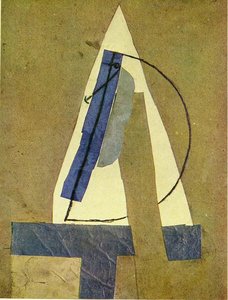
Pablo Picasso's "Head," painted in 1929, isn’t merely a portrait; it’s a distilled essence of the artist’s revolutionary approach to representation. This deceptively simple work, housed within the Berardo Collection Museum in Lisbon, offers a profound glimpse into the heart of Cubism and its lasting influence on modern art. The painting immediately confronts the viewer with an intensely concentrated image – a close-up study of a face fractured and rebuilt according to Picasso’s radical vision. It's a deliberate rejection of traditional perspective and a bold assertion of the artist’s subjective experience of reality.
The technique employed is characteristic of Picasso’s mature Cubist style. Geometric shapes – sharp angles, interlocking planes, and fragmented forms – dominate the composition. The face isn’t rendered as a unified whole but rather as a collection of distinct elements, each presented simultaneously from multiple viewpoints. This creates an unsettling yet captivating effect, forcing the viewer to actively engage with the image and reconstruct it mentally. Notice how the nose is broken into angular shards, the eyes are reduced to simplified geometric forms, and the mouth appears almost like a mask. The use of black and white further amplifies this sense of deconstruction, stripping away any potential for illusionistic depth or color-based distraction.
Echoes of Horta de Ebro: The Genesis of Cubism
Interestingly, Picasso’s exploration of this fractured portrait style began during a summer in 1909 at Horta de Ebro, a small town in northeastern Spain. During this period, he experimented with breaking down objects and figures into their basic geometric components – a technique that would become the cornerstone of Cubism. The “Head” can be seen as a direct descendant of these early studies, retaining a raw energy and immediacy that reflects its origins. The Metropolitan Museum of Art’s online record highlights this connection, noting the faceting evident in the work's construction, mirroring Picasso’s initial explorations with Fernande Olivier, his companion at the time.
It’s crucial to understand that Picasso wasn’t simply dismantling forms; he was actively challenging the very notion of representation. He sought to capture not just *what* something looked like but *how* it appeared – its essence – through a multiplicity of perspectives. This shift in focus marked a radical departure from traditional Western art, which had long prioritized realistic depiction and illusionistic space.
Symbolism and Emotional Resonance
While the precise meaning behind “Head” remains open to interpretation, several symbolic elements contribute to its emotional depth. The intense gaze of the subject – often interpreted as a self-portrait – conveys a sense of vulnerability and introspection. There’s an undeniable melancholy woven into the composition, perhaps reflecting Picasso's personal experiences with loss and mortality, themes that frequently surfaced in his work following the death of his sister. The simplification of features suggests a focus on fundamental human qualities—strength, resilience, and perhaps even a hint of suffering – rather than superficial appearances.
Furthermore, the monochromatic palette contributes to the painting’s somber mood. The absence of color allows the viewer to concentrate solely on the formal elements of the composition: the interplay of shapes, lines, and planes. This deliberate restraint amplifies the work's emotional impact, creating a powerful and enduring image that continues to resonate with audiences today.
A Legacy in Reproduction
WahooArt offers meticulously crafted hand-painted reproductions of Picasso’s “Head,” allowing art lovers to experience this iconic masterpiece in stunning detail. Our skilled artists replicate the nuances of Picasso's technique, capturing the fragmented forms and emotional intensity with remarkable accuracy. Whether you are a collector seeking an authentic addition to your collection or an interior designer aiming to infuse your space with artistic inspiration, our reproductions provide a beautiful and accessible way to connect with one of the 20th century’s most influential artists. Explore the available options and bring this captivating portrait into your world.
Ερωτήσεις & Απαντήσεις
Προς ποια απόχρωση τείνει το "Head 1";
Μια Ochre to Sepia απόχρωση κυριαρχεί στο έργο "Head 1" του Πάμπλο Πικάσο.
Τι είδους έργο είναι το "Head 1";
Το έργο "Head 1" του Πάμπλο Πικάσο ταξινομείται ως WallArt. Η κατηγορία αυτή περιγράφει το είδος του πρωτοτύπου έργου τέχνης.
Τι χρωματική αρμονία παρουσιάζει το "Head 1" του Πάμπλο Πικάσο;
Το έργο "Head 1" του Πάμπλο Πικάσο παρουσιάζει μια χρωματική αρμονία τύπου Strong Color Unity.



 Προεπισκόπηση
 Αγορά χειροποίητου πίνακα
 Αποστολή
 Κοινοποίηση
 Λεπτομέρειες
 Οδηγός

 Λήψη
Λήψη
 Παρόμοια αντικείμενα συλλογής
 Ακτινογραφία
 Παρουσίαση
 Στατιστικά
 Περισσότερα λεπτομέρεια






































 Η επιλογή με γυαλί είναι διαθέσιμη μόνο για μεγέθη κάτω από 110 εκ.