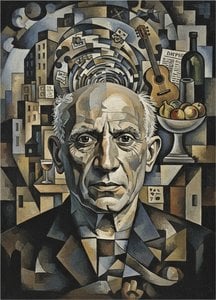
Escudilla Verde y Tomates
“Escudilla Verde y Tomates,” also known as “Green Bowl and Tomatoes,” is a captivating painting created by Pablo Picasso in 1947. This artwork showcases his unique Cubism style that revolutionized modern art.
Introduction to Cubism
Cubism is a revolutionary art movement that emerged in the early 20th century, characterized by its fragmented and abstract depiction of objects. The movement was co-founded by Pablo Picasso and Georges Braque, who sought to break away from traditional perspective and create a new visual language.
For more information on Cubism, visit Cubism | Musée Picasso Paris.
Analysis of Escudilla Verde y Tomates
In this painting, Picasso depicts a green bowl filled with tomatoes on a tabletop. The composition is divided into geometric shapes that represent the various elements in the scene. By breaking down the objects into their basic forms and reassembling them in an abstract manner, Picasso creates a sense of depth and movement within the artwork.
The use of vibrant colors adds to the overall impact of the painting, with the green bowl standing out against the muted background.
Historical Context
Painted during Picasso’s prolific period following World War I, “Escudilla Verde y Tomates” reflects the anxieties and uncertainties of the time. Cubism emerged as a reaction to Impressionism and Post-Impressionism, rejecting illusionistic representation in favor of exploring multiple viewpoints simultaneously.
The painting's simplicity belies its intellectual complexity—a deliberate choice by Picasso to challenge conventional artistic norms and engage viewers in a dialogue about perception and reality.
Symbolism and Emotional Impact
While seemingly straightforward, the bowl and tomatoes hold symbolic significance. The green hue evokes freshness and vitality, representing nourishment and growth – themes prevalent in Picasso’s oeuvre during this era. Simultaneously, the fragmented forms convey a sense of instability and disruption, mirroring the turbulent political landscape of Europe.
“Escudilla Verde y Tomates” remains an enduring testament to Picasso's artistic vision—a bold exploration of form and color that continues to inspire admiration for its innovative approach and profound emotional resonance.



 Προεπισκόπηση
 Μετάβαση σε Εκτυπώσεις
 Αποστολή
 Κοινοποίηση
 Λεπτομέρειες
 Οδηγός

 Λήψη
Λήψη
 Παρόμοια αντικείμενα συλλογής
 Ακτινογραφία
 Παρουσίαση
 Στατιστικά

 Περισσότερα λεπτομέρεια






































 Η επιλογή με γυαλί είναι διαθέσιμη μόνο για μεγέθη κάτω από 110 εκ.