Προεπισκόπηση σε πραγματική κλίμακα Προεπισκόπηση σε AR Αγορά χειροποίητου πίνακα Μετάβαση σε Ψηφιακή Αποτέλεσμα Αποστολή
Λεπτομέρειες Οδηγός Προσθήκη στα αγαπημένα Λήψη Παρόμοια αντικείμενα συλλογής Ακτινογραφία Παρουσίαση Ερωτήσεις & Απαντήσεις Λήψη παρουσίασης Στατιστικά

Crying woman

Διαστάσεις
55.0 x 46.0 cm

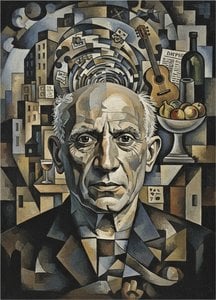
Witness Pablo Picasso's poignant 'Crying Woman,' a powerful Naive Art depiction of grief and suffering from 1937. Explore its symbolism & connection to Guernica in this iconic masterpiece.

Συνιδρυτής του Κυβισμού και δημιουργός του Γκέρνικα. Ανακαλύψτε σήμερα τα επαναστατικά έργα του Πάμπλο Πικάσο.

Το έργο τέχνης που εμφανίζεται σε αυτή τη σελίδα προστατεύεται από τους νόμους περί πνευματικών δικαιωμάτων, γεγονός που σημαίνει ότι δεν μπορούμε νομικά να δημιουργήσουμε ή να πουλήσουμε μια ταυτόσημη αναπαραγωγή του. Αυτή η προστασία επιβάλλεται βάσει διεθνών συμφωνιών, όπως η Σύμβαση της Βέρνης καθώς και από τους εθνικούς νόμους, συμπεριλαμβανομένων αυτών που ορίζονται από το Νομοθεσία περί πνευματικών δικαιωμάτων των ΗΠΑ - Τίτλος 17. Όλα τα δικαιώματα κατοχυρωμένα. Απαγορεύεται η αναπαραγωγή χωρίς άδεια.

Αυτή η μέθοδος συμμορφώνεται πλήρως με τους κανονισμούς περί πνευματικών δικαιωμάτων, καθώς δεν περιλαμβάνει την αντιγραφή ή την αναπαραγωγή του προστατευόμενου έργου. Αντίθετα, πρόκειται για μια δημιουργική ερμηνεία — ένα νέο έργο που επηρεάζεται από το πρωτότυπο, χωρίς όμως να είναι πανομοιότυπο με αυτό.

Giclée / Εκτυπώσεις Τέχνης

Εκτύπωση giclée ή σε καμβά ποιότητας μουσείου με γρήγορη παραγωγή και ευέλικτες επιλογές φινιρίσματος. ( Αγορά χειροποίητου πίνακα Μετάβαση σε Ψηφιακή Αποτέλεσμα)

Corner sample of the P118B picture frame: μολυσμένο πολυστερίνη, 5 cm wide and 3 cm thick
P118B €10
Corner sample of the P118H picture frame: μολυσμένο πολυστερίνη, 5 cm wide and 3 cm thick
P118H €10
Corner sample of the P118W picture frame: μολυσμένο πολυστερίνη, 5 cm wide and 3 cm thick
P118W €10
Corner sample of the P438Z picture frame: μολυσμένο πολυστερίνη, 5.5 cm wide and 3.5 cm thick
P438Z €10
Corner sample of the P508JH picture frame: μολυσμένο πολυστερίνη, 7 cm wide and 3.5 cm thick
P508JH €12
Corner sample of the P508YH picture frame: μολυσμένο πολυστερίνη, 7 cm wide and 3.5 cm thick
P508YH €12
Corner sample of the P805H picture frame: μολυσμένο πολυστερίνη, 5 cm wide and 3.5 cm thick
P805H €10
Corner sample of the P805Z picture frame: μολυσμένο πολυστερίνη, 5 cm wide and 3.5 cm thick
P805Z €10
Corner sample of the P919BZ picture frame: μολυσμένο πολυστερίνη, 7 cm wide and 3.5 cm thick
P919BZ €10
Corner sample of the P919G picture frame: μολυσμένο πολυστερίνη, 7 cm wide and 3.5 cm thick
P919G €10
Corner sample of the P919XJ picture frame: μολυσμένο πολυστερίνη, 7 cm wide and 3.5 cm thick
P919XJ €10
Corner sample of the P959ZH picture frame: μολυσμένο πολυστερίνη, 5 cm wide and 3 cm thick
P959ZH €10
Corner sample of the P968JZ picture frame: μολυσμένο πολυστερίνη, 6 cm wide and 4 cm thick
P968JZ €12
Corner sample of the W106C picture frame: πλήρες ξύλο, 5 cm wide and 3 cm thick
W106C €8
Corner sample of the W218G picture frame: πλήρες ξύλο, 5 cm wide and 3 cm thick
W218G €10
Corner sample of the W218JH picture frame: πλήρες ξύλο, 5 cm wide and 3 cm thick
W218JH €8
Corner sample of the W218Y picture frame: πλήρες ξύλο, 5 cm wide and 3 cm thick
W218Y €10
Corner sample of the W307PJ picture frame: πλήρες ξύλο, 6 cm wide and 3 cm thick
W307PJ €10
Corner sample of the W316G picture frame: πλήρες ξύλο, 6 cm wide and 3 cm thick
W316G €10
Corner sample of the W316PJ picture frame: πλήρες ξύλο, 6 cm wide and 3 cm thick
W316PJ €8
Corner sample of the W316Y picture frame: πλήρες ξύλο, 6 cm wide and 3 cm thick
W316Y €10
Corner sample of the W398PJ picture frame: πλήρες ξύλο, 5 cm wide and 3 cm thick
W398PJ €8
Corner sample of the W4111J picture frame: πλήρες ξύλο, 6.5 cm wide and 3.5 cm thick
W4111J €10
Corner sample of the W500HY picture frame: πλήρες ξύλο, 7 cm wide and 5 cm thick
W500HY €15
Corner sample of the W500JH picture frame: πλήρες ξύλο, 7 cm wide and 5 cm thick
W500JH €15
Corner sample of the W692G picture frame: πλήρες ξύλο, 8 cm wide and 4 cm thick
W692G €12
Corner sample of the W849H picture frame: πλήρες ξύλο, 5 cm wide and 3 cm thick
W849H €8
Corner sample of the W940BG picture frame: πλήρες ξύλο, 7.5 cm wide and 4.5 cm thick
W940BG €15
Corner sample of the W953PJ picture frame: πλήρες ξύλο, 6 cm wide and 3.5 cm thick
W953PJ €8

Πρότυπο
κατόπιν παραγγελίας
CM
INCH

Επιλέξτε από τις προκαθορισμένες διαστάσεις μας που διατηρούν τις αρχικές αναλογίες του έργου τέχνης.

πλάτος
ύψος

Εισάγετε το πλάτος και το ύψος που επιθυμείτε, ώστε να ταιριάζουν στο κάδሮ ή στον τοίχο σας. Μια εκτύπωση μπορεί μόνο να υποστεί κοψίμό και ποτέ να μην γίνει μεγαλύτερη από την αρχική εικόνα, επομένως η επιλογή μεγέθους με διαφορετικό σχήμα συνεπάγεται απώλεια ενός μέρους της εικόνας. Σας στέλνουμε ένα ψηφιακό mockup για έγκριση πριν προχωρήσουμε σε οποιαδήποτε εκτύπωση. Η εικόνα που εμφανίζεται σε αυτή τη σελίδα δεν δείχνει την πραγματική κοπή — μόνο το mockup την παρουσιάζει.

Παγκόσμια Αποστολή () σε 2 εβδομάδες αντί για τις συνήθεις 4/5 εβδομάδες. (10 Νοέμβριος)

Δωρεάν γρήγορη διεθνής αποστολή
Κάμβας από Λινό Υψηλής Ποιότητας
Πλήρης ασφάλιση μεταφοράς
Εγγύηση επιστροφής δασμών και φόρων εισαγωγής
Εγγύηση Απόλυτης Ομοιότητας Χρωμάτων
Πολιτική Επιστροφής 100 Ημερών (Μόνο σε περίπτωση ελαττωμάτων)
Εγγύηση επιστροφής 100% των χρημάτων
Προσφορά για πολλαπλές παραγγελίες

Συνολική Τιμή

€ 62

Crying woman

Giclée / Εκτυπώσεις Τέχνης

Διαστάσεις Αναπαραγωγής

-

Τελική Τιμή

€ 62

Pablo Picasso’s ‘Crying Woman’: A Portrait of Grief and Cubist Innovation

Pablo Ruiz y Picasso, a name synonymous with artistic revolution, was born in Málaga, Spain, on October 25, 1881. His very existence seemed destined for creative expression; legend has it his first uttered words were “piz, piz,” an attempt to say ‘pencil’. This early inclination was nurtured by his father, José Ruiz y Blasco, a painter and art teacher who provided young Pablo with foundational training. However, the student quickly surpassed the instructor, demonstrating a remarkable aptitude for naturalistic depiction that hinted at the prodigious talent within. The family’s subsequent moves – first to A Coruña, then Barcelona – were punctuated by personal tragedy, notably the loss of Picasso's sister, experiences which would subtly infuse his later work with themes of melancholy and mortality. Even during formal studies at the School of Fine Arts in Barcelona and a brief stint at the Royal Academy of San Fernando in Madrid, Picasso chafed against convention, rejecting academic rigidity for a path toward experimentation and personal vision.

The Naive Art Influence: Simplicity as Depth

“Crying Woman,” painted in 1937, stands as a pivotal example of Picasso’s engagement with Naive Art (Primitivism). This stylistic movement emerged from the burgeoning interest in non-Western art forms and challenged prevailing artistic norms. Artists like Picasso deliberately eschewed formal training, prioritizing direct observation and emotional expression over meticulous detail. The result was an aesthetic characterized by bold simplification—a technique that Picasso skillfully employed to convey profound psychological complexity. Unlike traditional portraiture focused on precise likenesses, “Crying Woman” prioritizes conveying emotion through abstracted forms and expressive brushstrokes. This deliberate reduction of visual elements serves not to diminish the painting’s impact but rather to heighten its resonance with the viewer's subconscious.

Composition and Symbolism: A Visual Meditation on Suffering

The composition itself is strikingly economical, placing the woman’s face squarely at the center of the canvas—a deliberate decision that commands immediate attention. Picasso utilizes a monochromatic palette – predominantly black, white, and shades of gray – amplifying the painting's solemn mood and emphasizing its focus on grief. The inclusion of symbolic elements further enriches the artwork’s narrative. A bird perched delicately on her shoulder represents hope amidst despair, while a hand clutching an object near her mouth suggests unspoken sorrow or perhaps futile attempts to stifle tears. Finally, the clock hanging in the background serves as a poignant reminder of time passing and the inevitability of loss—a motif frequently explored by Picasso throughout his oeuvre.

Contextual Significance: Guernica’s Shadow

“Crying Woman” was created during the tumultuous period surrounding the Spanish Civil War, mirroring the pervasive atmosphere of anxiety and trauma that gripped Europe at the time. It is inextricably linked to Picasso's monumental anti-war painting “Guernica,” which similarly confronts viewers with images of brutality and suffering. While “Guernica” depicts a broader panorama of conflict—a sprawling tableau capturing the horrors of aerial bombardment—“Crying Woman” offers a more intimate portrayal of individual anguish. It’s considered to be Picasso's response to the bombing of Guernica by Nazi German Luftwaffe during the Spanish Civil War, and it embodies the artist's commitment to portraying human emotion with uncompromising honesty.

Emotional Impact: A Timeless Expression of Vulnerability

Ultimately, “Crying Woman” transcends its historical context to resonate powerfully with audiences across generations. Picasso’s masterful manipulation of form and color achieves an extraordinary feat—creating a visual representation of profound emotional vulnerability without resorting to sentimental clichés. The painting compels us to confront uncomfortable truths about grief, loss, and the human condition. Its enduring appeal lies in its ability to evoke empathy and provoke contemplation on themes that remain universally relevant. Reproductions of this iconic artwork offer collectors and interior designers alike an opportunity to experience Picasso’s artistic genius firsthand—a testament to his unwavering dedication to capturing the essence of human emotion through groundbreaking stylistic innovation.

Ερωτήσεις και Απαντήσεις

Ποια είναι η αισθητή φωτεινότητα του έργου "Crying woman" του Πάμπλο Πικάσο;

Συνολικά, το "Crying woman" καταγράφεται ως σκιά. Η αισθητή φωτεινότητα περιγράφει το πόσο ανοιχτό ή σκούρο φαίνεται το έργο.

Ποιο μέγεθος προτείνεται για το "Crying woman" σε ένα Σαλονιές;

Η προτεινόμενη διαρρύθμιση για το "Crying woman" του Πάμπλο Πικάσο: μια εκτύπωση μεγέθους Μεσαίο μέγεθος σε έναν/μια Σαλονιές.

Μπορώ να δω το έργο "Crying woman" του Πάμπλο Πικάσο υπό διαφορετικό φωτισμό;

Η σελίδα Ακτινογραφική εξέταση του έργου "Crying woman" του Πάμπλο Πικάσο αποτελεί έναν διαδραστικό προβολέα που σας επιτρέπει να περιηγείστε σε έντεκα οπτικά επίπεδα της εικόνας του έργου, συμπεριλαμβανομένης μιας προβολής σε στυλ ακτινογραφίας.


Εξερευνήστε έργα τέχνης ταξινομημένα ανά θέμα, στυλ και χαρακτηριστικά.