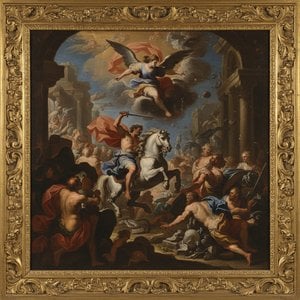
A Moment Suspended in Time
In the heart of Nicolas Poussin’s
Rinaldo and Armida, we find ourselves transported to a landscape where the boundaries between heroism and enchantment blur. Inspired by the epic verses of Torquato Tasso’s
Gerusalemme Liberata, the painting captures a pivotal, breathless encounter during the First Crusade. Here, Rinaldo, the valiant Prince of Salerno, is caught in the magnetic pull of Armida, a formidable enchantress whose beauty is as much a weapon as any blade. The scene is not merely a depiction of a mythological meeting; it is a profound meditation on the struggle between
divine duty and
human passion. As the figures interact amidst a backdrop of ancient trees and shadowed terrain, the viewer feels the palpable tension of a soul caught between the call of the crusade and the siren song of desire.
The Architecture of Light and Shadow
Poussin’s technical mastery elevates this narrative from simple storytelling to a monumental achievement of the French Baroque. Escheinting the frantic energy of his contemporaries, he employs a disciplined approach rooted in the principles of
Neoclassicism. Through the masterful use of
chiaroscuro, Poussin sculpts his figures with a sculptural precision, using the dramatic interplay of light and shadow to carve depth out of the canvas. Each layer of glaze is applied with meticulous care, creating luminous surfaces that catch the eye and invite closer inspection. This clarity of form and restraint in color do not diminish the drama; rather, they provide an intellectual framework that allows the viewer to contemplate the underlying spiritual truths of the scene. The composition is a symphony of balance, where every limb, horse, and leaf serves to guide the eye toward the emotional epicenter of the work.
An Enduring Legacy for the Discerning Collector
For the art enthusiast or the interior designer seeking to infuse a space with historical gravity,
Rinaldo and Armida offers an unparalleled sense of prestige. This is more than a mere image; it is an invitation to bring the grandeur of the 17th century into a contemporary setting. The painting’s ability to anchor a room with its classical poise makes it a perfect centerpiece for libraries, study halls, or sophisticated living areas. To possess such a work is to engage with the very foundations of Western art history—a piece that speaks of
intellectual rigor,
classical beauty, and the eternal human drama.
- Subject Matter: The legendary encounter between a knight and an enchantress.
- Artistic Movement: French Baroque with Neoclassical influences.
- Visual Elements: Masterful chiaroscuro and balanced, classical composition.
- Ideal For: High-end interior curation and collectors of historical fine art.
Whether viewed as a window into the era of the Great Masters or as a bold statement of refined taste, Poussin’s masterpiece continues to captivate, offering a timeless elegance that transcends the centuries.
Ερωτήσεις & Απαντήσεις
Για ποιο δωμάτιο προτείνεται το έργο "Rinaldo and Armida" του Νικόλαος Πουσινός, δεδομένης της χρωματικής του παλέτας;
Λαμβάνοντας υπόψη τα χρώματα της παλέτας του, "Rinaldo and Armida", προτείνεται για ένα Living Room, με βάση το Dark.
Μπορεί η εικόνα του έργου "Rinaldo and Armida" του Νικόλαος Πουσινός να αναπαραχθεί ελεύθερα;
Η απάντηση σχετικά με τα πνευματικά δικαιώματα για το έργο "Rinaldo and Armida" του Νικόλαος Πουσινός είναι: το έργο ανήκει στο δημόσιο κτήμα - τα δικαιώματα αυτορության έχουν λήξει. Αυτό καθορίζει εάν επιτρέπεται η ελεύθερη αναπαραγωγή της εικόνας.
Μπορώ να εξετάσω το "Rinaldo and Armida" με περισσότερες λεπτομέρειες;
Το "Rinaldo and Armida" μπορεί να εξεταστεί στρώμα προς στρώμα στη σελίδα Ακτινογραφία του έργου, ένας προβολέας εμπνευσμένος από τον πάγκο φωτισμού ενός συντηρητή, με έντεκα οπτικά διαβάσματα της εικόνας.
Ποια φωτεινότητα διαθέτει το "Rinaldo and Armida" του Νικόλαος Πουσινός;
Το έργο "Rinaldo and Armida" του Νικόλαος Πουσινός έχει φωτεινότητα Dark. Η φωτεινότητα περιγράφει το πόσο φως φαίνεται να αντανακλούν τα χρώματα.
Πού τοποθετείται το "Rinaldo and Armida" στο σύνολο του έργου του/της Νικόλαος Πουσινός;
Το "Rinaldo and Armida" μοιράζεται με τα υπόλοιπα έργα του Νικόλαος Πουσινός το στυλ της καλλιτεχνικής σχολής French Baroque και τα επαναλαμβανόμενα θέματα: classical antiquity, mythological narrative, dramatic storytelling, roman baroque style, poussin’s legacy.
Μπορώ να παραγγείλω μια αναπαραγωγή με λάδι του "Rinaldo and Armida";
Αντιγραφή με χειρόχειρη τεχνική του έργου "Rinaldo and Armida" του Νικόλαος Πουσινός είναι διαθέσιμες στο αυτή η ιστοσελίδα: μια με ζωγραφισμένη με λάδι αναπαραγωγή σε καμβά λινου, μέσω παραγγελίας από το αυτή η σελίδα.
Σε ποιο καλλιτεχνικό movement και σε ποια εποχή τοποθετείται το "Rinaldo and Armida" του Νικόλαος Πουσινός;
Το έργο "Rinaldo and Armida" του Νικόλαος Πουσινός ανήκει στο καλλιτεχνικό ρεύμα του French Baroque, μέσα στην εποχή του Πρώιμη Νέα Εποχή του δημιουργού του.
Πόσοι άνθρωποι επισκέπτονται το "Rinaldo and Armida";
Η σελίδα Στατιστικά του έργου "Rinaldo and Armida" του Νικόλαος Πουσινός παρουσιάζει στατιστικά στοιχεία επισκέψεων: μηνιαίες επισκέψεις αυτού του έργου, μια σύγκριση με τα πιο δημοφιλή έργα του καλλιτέχνη και την προέλευση των επισκεπτών του.



 Προεπισκόπηση
 Αγορά χειροποίητου πίνακα
 Αποστολή
 Κοινοποίηση
 Λεπτομέρειες
 Οδηγός

 Λήψη
Λήψη
 Παρόμοια αντικείμενα συλλογής
 Ακτινογραφία
 Παρουσίαση
 Στατιστικά

 Περισσότερα λεπτομέρεια






































 Η επιλογή με γυαλί είναι διαθέσιμη μόνο για μεγέθη κάτω από 110 εκ.