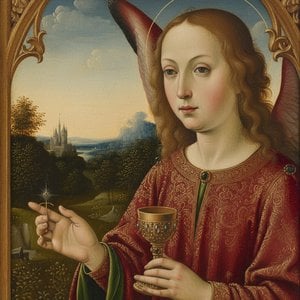
A Vision of Devotion: The Soul of the Donne Triptych
In the quiet, luminous world of Early Netherlandish painting, few works capture the delicate intersection of earthly status and divine grace as poignantly as Hans Memling’s The Donne Triptych (left wing). Created around 1475, this exquisite panel serves as a window into a period where every brushstroke was an act of prayer and every detail a vessel for meaning. As part of a larger devotional masterpiece commissioned by the Welsh diplomat Sir John Donne, this specific wing presents us with a profound encounter with Saint John the Baptist. The scene is not merely a religious icon but a masterclass in Northern Renaissance intimacy, where the boundaries between the viewer and the sacred begin to dissolve through Memling's unparalleled ability to render light, texture, and spirit.
The composition draws the eye immediately to the figure of the Saint, whose presence is both commanding and humble. Clad in a rich, deep purple robe that cascades with heavy, realistic folds, he stands as a pillar of strength against a backdrop that suggests a threshold between worlds. In his hands, he cradles a white lamb—the Agnus Dei—a symbol of purity and the ultimate sacrifice. The contrast between the soft, organic texture of the lamb's wool and the structured, architectural elements of the doorway creates a visual tension that is quintessential to Memling’s style. This interplay of textures invites the observer to linger, finding beauty in the meticulous realism that defines the Bruges Master’s hand.
Technical Brilliance and the Art of Illusion
To behold this work is to witness the pinnacle of 15th-century oil painting technique. Memling, a student of the legendary Rogier van der Weyden, utilized the unique properties of oil glazes to achieve a depth of color and a luminosity that tempera could never permit. The way light catches the edge of the Saint's robe or reflects off the subtle contours of the lamb suggests a world breathed into existence by light itself. Furthermore, the exterior panels of the triptych were famously rendered in grisaille—a technique designed to mimic the solemnity of stone sculpture. This clever illusionism creates a breathtaking transition when the triptych is opened, moving from the monochromatic, sculptural austerity of the exterior to the vibrant, jewel-toned reality of the interior panels.
For the discerning collector or interior designer, this piece offers more than mere decoration; it provides an anchor of historical depth and sophisticated elegance. The muted yet profound palette of purples, whites, and earthy tones allows the artwork to integrate seamlessly into a variety of high-end settings, from classical studies to contemporary galleries. It is a work that demands attention through its subtlety rather than through clamor, making it an ideal centerpiece for those who appreciate art that rewards slow, contemplative viewing.
A Legacy of Faith and Humanism
Beyond the technical mastery lies the heart of the piece: the humanist spirit of the late Middle Ages. The Donne Triptych was a personal testament to the piety and political allegiances of its patron, Sir John Donne. By placing himself and his family within the same visual plane as the saints, Donne bridged the gap between the temporal and the eternal. This movement toward humanism—the celebration of human emotion and individual experience within a religious framework—is what gives this painting its enduring emotional resonance. When we look upon the left wing today, we are not just looking at a relic of the past; we are participating in a centuries-old tradition of seeking beauty, meaning, and a sense of peace through the mastery of light and form.



 Δείτε σε πραγματικό χώρο
 Μετάβαση σε Εκτυπωση
 Αποστολή
 Κοινοποίηση
 Λεπτομέρειες

 Λήψη
Λήψη
 Παρόμοια αντικείμενα συλλογής
 Ακτινογραφία
 Παρουσίαση
 Στατιστικά


 Διαβάστε περισσότερα






































 Η επιλογή με γυαλί είναι διαθέσιμη μόνο για μεγέθη κάτω από 110 εκ.