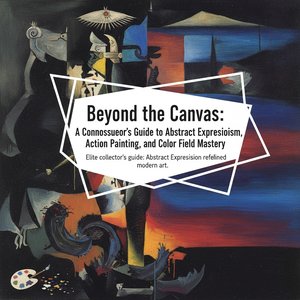
A Glimpse into Rothko’s Early Exploration of Form
This captivating black and white drawing by Mark Rothko, designated *Untitled 163*, offers a rare look into the artist's formative period before his iconic color field paintings. While renowned for large-scale canvases saturated with hue, this work reveals Rothko’s early mastery of line and composition, demonstrating a dynamic energy that foreshadows his later explorations of emotional depth.
Subject & Composition: The Reclining Figure
The artwork centers around a reclining female figure, rendered not in realistic detail but as an *evocative suggestion* of form. She dominates the composition, her body defined by swirling patterns and fragmented shapes that extend outwards, creating a sense of movement and unrest. Rothko eschews precise anatomical representation; instead, he utilizes gestural lines to convey a feeling of vulnerability and perhaps even struggle. The figure’s lack of discernible facial features further emphasizes this symbolic approach, inviting viewers to project their own emotions onto the work.
Style & Technique: A Bridge Between Expressionism & Surrealism
The style leans towards both
Expressionism and early
Surrealism. The loose, energetic lines and distorted forms are hallmarks of Expressionist aesthetics, conveying intense emotion through non-naturalistic representation. Simultaneously, the fragmented composition and dreamlike quality hint at Surrealist influences. Executed primarily in pen and ink, Rothko expertly manipulates line weight to create depth and texture. The visible paper surface adds a raw, immediate quality, suggesting an impulsive creative process.
Historical Context: Rothko’s Artistic Evolution
Born Marcus Rothkowitz in Latvia in 1903, Rothko immigrated to the United States as a child – a cultural shift that profoundly impacted his artistic vision. This drawing dates from a period when he was actively experimenting with different styles before fully embracing
Abstract Expressionism. It’s a crucial piece for understanding his journey towards the simplified forms and emotional resonance that would define his mature work, including his celebrated “color field” paintings like *No. 18 (1948)* and *Untitled (1948)*.
Symbolism & Emotional Impact
The artwork’s power lies in its ambiguity. The swirling patterns surrounding the figure can be interpreted as internal turmoil, external pressures, or simply the chaotic energy of life itself. The flat lighting and minimal perspective contribute to a sense of claustrophobia and introspection. *Untitled 163* evokes a range of emotions – vulnerability, dynamism, anxiety – prompting viewers to engage with their own feelings and experiences. It’s not merely an image; it's an emotional landscape.
Considerations for Collectors & Designers
- This drawing offers a unique opportunity to acquire a work by a master artist from a less-represented period of his career.
- Its monochromatic palette and dynamic composition make it versatile for various interior design schemes, adding depth and sophistication to any space.
- The artwork’s emotional intensity can serve as a focal point in a room, sparking conversation and contemplation.
- A high-quality reproduction would capture the nuances of Rothko's line work and textural details, bringing his artistic vision to life.
This piece is more than just a drawing; it’s a window into the mind of one of the most influential artists of the 20th century.
Ερωτήσεις & Απαντήσεις
Σε ποιο σημείο του σπιτιού θα ταιριάζει καλά μια αναπαραγωγή του "Untitled 163";
Το έργο "Untitled 163" του Μάρκος Ρόθκο προτείνεται για το Living Room. Αυτή η πρόταση βασίζεται στο θέμα, τα χρώματα και τη διάθεση του έργου.
Πώς συνδυάζονται το υλικό και η κίνηση στο "Untitled 163";
Στο "Untitled 163", η τεχνική του Acrylic On Canvas συναντά το έργο της καλλιτεχνικής κίνησης Expressionism.
Ποιο είναι το σχήμα του "Untitled 163";
Το έργο "Untitled 163" του Μάρκος Ρόθκο έχει μορφή Portrait. Η μορφή περιγράφει τις αναλογίες της σύνθεσης.



 Προεπισκόπηση
 Αγορά χειροποίητου πίνακα
 Αποστολή
 Κοινοποίηση
 Λεπτομέρειες
 Οδηγός

 Λήψη
Λήψη
 Παρόμοια αντικείμενα συλλογής
 Ακτινογραφία
 Παρουσίαση
 Στατιστικά

 Περισσότερα λεπτομέρεια






































 Η επιλογή με γυαλί είναι διαθέσιμη μόνο για μεγέθη κάτω από 110 εκ.