A Symphony of Color and Contemplation
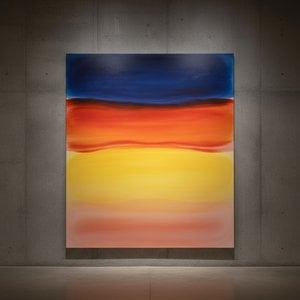
To stand before Mark Rothko’s Untitled (16) is not merely to view a painting, but to enter into a profound, silent dialogue with the human soul. As a cornerstone of the Abstract Expressionism movement, this monumental canvas transcends the boundaries of mere visual spectacle, inviting the viewer into a deep meditation on color, form, and the very essence of the human condition. Painted during a period of immense creative maturity, the work embodies the core tenets of its era—spontaneity, emotional intensity, and a courageous rejection of representational imagery in favor of pure, unadulterated feeling.
The composition presents a deceptively simple arrangement: five rectangular blocks of color stacked vertically upon a canvas of commanding scale. Predominantly featuring crimson red, earthy brown, and deep black, the work utilizes what is famously known as "color field painting." Yet, beneath this apparent austerity lies an astonishing complexity. Rothko meticulously crafted these hues using thin, translucent layers of oil paint applied with a velvety touch. This technique creates subtle gradations that blur the boundaries between shades, imbuing the canvas with an ethereal, inner luminescence that seems to pulse with its own light.
The Architecture of Emotion and History
The genesis of this masterpiece is deeply rooted in Rothko’s personal history, a narrative shaped by the anxieties of displacement and loss. Born Markus Yakovlevich Rothkowitz in Latvia, his early life was shadowed by the political unrest of the Pale of Settlement and the profound upheaval of immigrating to the United States. These existential themes—mortality, trauma, and the search for meaning—permeate every layer of the pigment. In Untitled (16), the heavy, dark tones act as anchors for the more vibrant reds, creating a tension that mirrors the struggle between despair and transcendence.
Historically, this work emerged from a transformative era in the 1950s and 60s, a time when the art world was shifting away from traditional narratives toward a more psychological exploration of existence. Alongside contemporaries like Barnett Newman, Rothko sought to bypass the intellect and speak directly to the emotions. For the modern collector or interior designer, this piece offers more than just aesthetic beauty; it provides an atmospheric gravity. It is a work that demands presence, making it an ideal centerpiece for spaces dedicated to reflection, quietude, or sophisticated intellectual engagement.
A Timeless Vision for the Modern Space
For those seeking to curate an environment of depth and prestige, a high-quality reproduction of Untitled (16) serves as a powerful tool for transformation. The painting’s ability to command a room through its sheer scale and chromatic resonance makes it a favorite among art lovers who appreciate the sublime. Whether placed in a minimalist contemporary gallery or a richly textured residential study, the artwork functions as a window into an emotional landscape.
Integrating such a profound work of art into a design scheme allows for:
- Emotional Resonance: Creating a focal point that evokes a sense of calm, mystery, or intense passion.
- Visual Depth: Utilizing the "color field" technique to add perceived dimension and light to a room.
- Historical Connection: Bringing the legacy of the Abstract Expressionist movement into a modern, lived-in context.
In every brushstroke of this reproduction, the spirit of Rothko’s quest for the infinite remains preserved, offering an enduring opportunity to possess a fragment of art history's most moving emotional landscapes.
Ερωτήσεις & Απαντήσεις
Ποιος χώρος ταιριάζει με τα χρώματα του έργου "Untitled (16)" του Μάρκος Ρόθκο;
Λαμβάνοντας υπόψη τα χρώματα της παλέτας του, "Untitled (16)", προτείνεται για ένα Lounge, με βάση το Earthy.
Το έργο "Untitled (16)" του Μάρκος Ρόθκο είναι πίνακας, σχέδιο ή γραφικό;
Το έργο "Untitled (16)" είναι ένα WallArt.
Είναι το "Untitled (16)" τυπικό για όσα δημιουργούσε συνήθως ο/η Μάρκος Ρόθκο;
Τα επαναλαμβανόμενα θέματα του/της Μάρκος Ρόθκο περιλαμβάνουν το/την rothko’s color field aesthetic, exploring human emotion depth, existential reflection visual art, symbolic representation artistic vision, central piece rothko portfolio; το/η "Untitled (16)" εστιάζει στο/στην color field, musical instruments, surrealism, abstraction, emotional expression, chromatic harmony, existential themes.



 Προεπισκόπηση
 Αγορά χειροποίητου πίνακα
 Αποστολή
 Κοινοποίηση
 Λεπτομέρειες
 Οδηγός

 Λήψη
Λήψη
 Παρόμοια αντικείμενα συλλογής
 Ακτινογραφία
 Παρουσίαση
 Στατιστικά

 Περισσότερα λεπτομέρεια






































 Η επιλογή με γυαλί είναι διαθέσιμη μόνο για μεγέθη κάτω από 110 εκ.