Mark Rothko’s Ceremonial: A Descent into Color and Emotion
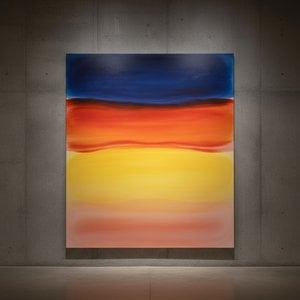
Mark Rothko's "Ceremonial," painted in 1945, isn’t merely a depiction of objects; it’s an immersion into a realm of profound feeling. This large-scale abstract composition, now rendered beautifully in a hand-painted reproduction by WahooArt.com, immediately draws the viewer inward, inviting contemplation and a quiet emotional response. The painting eschews traditional representational techniques, instead focusing on the evocative power of color and form to communicate something deeply personal – perhaps even existential.
At first glance, the eye is drawn to the central figure: a chair, rendered in muted blues and greens, positioned as a focal point within a carefully orchestrated space. Surrounding it are other elements—a clock, a bowl, a vase—each presented with an understated elegance. However, these objects aren’t arranged realistically; they float and recede into the background, contributing to the painting's dreamlike quality. The deliberate ambiguity of their placement creates a sense of detachment, as if Rothko is exploring the relationship between tangible reality and intangible emotion.
The Language of Color Field Painting
“Ceremonial” stands as a pivotal example of Mark Rothko’s development within the broader movement of Color Field painting. Emerging in the mid-1940s, this style prioritized color itself as the primary subject matter. Rothko abandoned traditional brushwork and perspective, opting instead for vast, luminous rectangles layered upon one another. These blocks of color – often deep blues, reds, and yellows – are not applied with sharp edges but bleed into each other, creating a hazy, atmospheric effect. This technique, known as “all-over,” eliminates any single point of focus, encouraging the viewer to lose themselves within the painting’s immersive field of color.
The specific palette in "Ceremonial" is particularly noteworthy. The dominant blues and greens evoke feelings of melancholy, introspection, and perhaps even a sense of mourning – reflecting, arguably, Rothko's own personal struggles with loss and displacement, themes deeply rooted in his early life in Latvia. These colors aren’t simply decorative; they are carefully chosen to trigger specific emotional responses within the viewer.
Symbolism and Existential Themes
While Rothko resisted definitive interpretations of his work, “Ceremonial” undeniably engages with profound existential themes. The title itself suggests a ritualistic or ceremonial space—a place for contemplation and perhaps even mourning. The objects scattered throughout the painting could be interpreted as symbols of memory, loss, and the passage of time. The chair, in particular, might represent a seat for reflection, a stage for personal experience.
Rothko’s work was profoundly influenced by his experiences as a Jewish refugee, navigating a world marked by instability and uncertainty. This sense of displacement and the search for meaning—a central preoccupation throughout his oeuvre—is palpable in “Ceremonial.” The painting doesn't offer easy answers; instead, it invites us to confront our own anxieties about mortality, loneliness, and the human condition.
A Reproduction Worth Cherishing
WahooArt.com’s hand-painted reproduction of "Ceremonial" captures the essence of Rothko’s original with remarkable fidelity. The meticulous attention to detail ensures that the luminous colors and atmospheric depth are faithfully reproduced, allowing you to experience the painting's emotional impact in a tangible way. This is more than just a print; it’s a window into the artist’s soul—a testament to the enduring power of abstract art to evoke profound emotion and stimulate deep reflection. Consider this reproduction as an opportunity to bring Rothko’s contemplative vision into your home, creating a space for quiet contemplation and artistic immersion.
Ερωτήσεις & Απαντήσεις
Για ποιον χώρο προτείνεται το έργο "Ceremonial" του Μάρκος Ρόθκο;
Ο προτεινόμενος χώρος για το έργο "Ceremonial" του Μάρκος Ρόθκο είναι ένα Living Room. Η πρόταση αυτή μπορεί φυσικά να προσαρμοστεί στον δικό σας εσωτερικό χώρο.
Είναι διαθέσιμη λήψη υψηλής ανάλυσης του "Ceremonial";
Για να αποκτήσετε ένα ψηφιακό αρχείο του "Ceremonial" του Μάρκος Ρόθκο, παραγγάστε το λήψη ψηφιακής εικόνας υψηλής ανάλυσης στη σελίδα Ψηφιακή Εικόνα.
Ποια παλέτα και ποιο κυρίαρχο χρώμα ορίζουν το "Ceremonial";
Το "Ceremonial" χαρακτηρίζεται από μια παλέτα με χρώματα Dark, που κυριαρχεί το Sap Green (#6a6421).



 Προεπισκόπηση
 Αγορά χειροποίητου πίνακα
 Αποστολή
 Κοινοποίηση
 Λεπτομέρειες
 Οδηγός

 Λήψη
Λήψη
 Παρόμοια αντικείμενα συλλογής
 Ακτινογραφία
 Παρουσίαση
 Στατιστικά
 Περισσότερα λεπτομέρεια






































 Η επιλογή με γυαλί είναι διαθέσιμη μόνο για μεγέθη κάτω από 110 εκ.