Περιγραφή Συλλεκτικού Αντικειμένου
Joan Miró’s “Three Gifts”: A Catalan Dreamscape
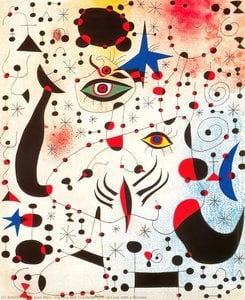
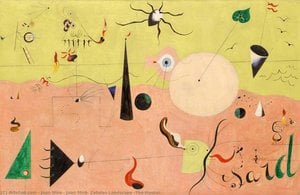
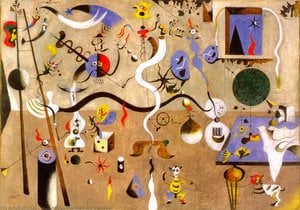
The painting "Three Gifts" by Joan Miró, created in 1935 during his formative years as an artist, embodies the spirit of Surrealism and offers a glimpse into the Catalan visionary's deeply personal worldview. More than just a depiction of figures—birds adorned with dresses—it’s a complex tapestry woven from symbolism rooted in Catalan folklore and executed with Miró’s signature technique of spontaneous abstraction.
Style and Technique: Embracing Chance
Miró’s artistic approach was characterized by “automatism,” a method championed by André Breton, where artists deliberately bypass conscious thought to allow subconscious impulses to guide their creative process. This is evident in "Three Gifts," where lines and shapes appear seemingly without premeditation, resulting in an image that feels both dreamlike and strangely familiar. The artist employed a palette dominated by earthy tones—ochres, browns, and reds—contrasting sharply with the vibrant blues and greens of the dresses worn by the birds. This juxtaposition underscores Miró’s fascination with duality and his desire to capture the elusive nature of emotion. Thick impasto – applying paint thickly onto the canvas – contributes to the textural richness of the artwork, emphasizing the physicality of the painting itself.
Historical Context: Surrealism Takes Flight
“Three Gifts” emerged during the height of Surrealist fervor in Europe. Breton and his fellow artists sought to liberate art from rational constraints, tapping into the realm of dreams and irrationality as sources of inspiration. Miró’s work aligns perfectly with this movement's ethos, reflecting anxieties about societal upheaval—the looming shadow of the Spanish Civil War—and a yearning for transcendence. The painting speaks to a broader cultural preoccupation with mythology and folklore, particularly Catalan traditions concerning offerings made to deities during festivals.
Symbolism: Birds, Dresses, and Layers of Meaning
The central figures – birds draped in dresses – are laden with symbolic significance. Birds universally represent freedom and aspiration, mirroring Miró’s own artistic ambition. The dresses symbolize femininity, nurturing, and perhaps a veiled reference to Catalan matriarchal traditions—a powerful assertion of female strength within a patriarchal society. Furthermore, the arrangement of the figures creates an intricate visual hierarchy, suggesting a complex interplay between individual consciousness and collective identity. The scattered dots and lines throughout the canvas amplify this sense of layering and contribute to the painting’s overall atmosphere of mystery.
Emotional Impact: A Quiet Resonance
Despite its bold colors and unconventional composition, “Three Gifts” possesses a remarkable serenity. It invites contemplation rather than demanding immediate interpretation. The painting evokes feelings of wonder, nostalgia, and perhaps even melancholy—a subtle acknowledgment of loss and impermanence. Ultimately, Miró’s masterpiece transcends mere visual representation; it communicates an inner truth—a profound connection to the subconscious mind and a celebration of Catalan heritage—leaving viewers with a lingering impression of beauty and contemplation.



 Αγοράστε την αναπαραγωγή
 Αποστολή
 Κοινοποίηση
 Λεπτομέρειες

 Λήψη
Λήψη
 Παρόμοια έργα
 Ακτινογραφία
 Παρουσίαση

 Περισσότερα λεπτομέρεια






































 Η επιλογή με γυαλί είναι διαθέσιμη μόνο για μεγέθη κάτω από 110 εκ.