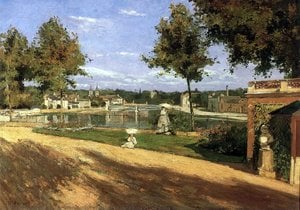
The Engineer of Light: The Dual Legacy of Henri Stanislas Rouart
In the vibrant, bustling landscape of late 19th-century Paris, few figures embodied the fascinating intersection of scientific precision and artistic soul as profoundly as Henri Stanislas Rouart. While history often reserves its brightest spotlights for the radical brushstrokes of Monet or Renoir, Rouart occupied a unique space in the French cultural fabric—a man who mastered the rigid laws of mechanics only to use that disciplined eye to capture the ephemeral dance of light. Born in Paris in 1833, his life was a remarkable tapestry woven from the threads of industrial innovation and Impressionist passion. The son of a successful manufacturer of military uniforms, Rouart was raised in an environment where structure and industry were paramount, yet his heart remained tethered to the aesthetic beauty of the natural world.
His early education at the prestigious Lycée Louis-le-Grand brought him into the orbit of one of the most influential figures in modern art: Edgar Degas. This friendship, forged in the halls of academia, would become a cornerstone of his life and career. As Rouart pursued rigorous studies at the École Polytechnique, mastering mathematics and engineering, he simultaneously nurtured his artistic temperament. This duality was never a conflict for him; rather, the precision required by his engineering feats—such as his pioneering work on the Paris pneumatic post and artificial ice production—informed the meticulous way he observed the atmospheric shifts in the French countryside. He possessed the rare ability to see both the structural skeleton of a landscape and the delicate, translucent veil of light that draped over it.
A Visionary Patron and Impressionist Soul
Beyond his own canvas, Rouart’s significance to the art world was deeply rooted in his role as a visionary patron and collector. His wealth and intellect allowed him to act as a vital pillar for the burgeoning Impressionist movement. He did not merely observe the revolution from the sidelines; he actively championed it, providing financial support and hosting exhibitions that brought the works of masters like Berthe Morisot, Toulouse-Lautrec, and Renoir to the public eye. His home became a sanctuary for modernism, and his collection was so significant that upon his death in 1912, the subsequent sale of his works sent ripples through the art market, famously increasing the global valuation of Impressionist masterpieces.
As an artist, Rouart’s development was a journey from the structured naturalism of his mentors to a more fluid, atmospheric style. Influenced by the tonal mastery of Corot and the earthy realism of Millet, he began his career with a focus on the quiet dignity of rural life. However, as the Impressionist era matured, so did his technique. His later works demonstrate a profound sensitivity to the fleeting moments of time—the way a shadow stretches across a meadow or how sunlight filters through a canopy of trees. His palette often leaned toward muted, harmonious tones, avoiding the jarring contrasts of some contemporaries in favor of a serene, poetic realism that captured the very essence of the French landscape.
The Enduring Impression of a Quiet Master
The works of Henri Rouart serve as a window into a vanished era of French tranquility. Whether depicting a sun-drenched terrace on the banks of the Seine or the intimate, melodic grace of a Joueuse de mandoline, his paintings evoke a sense of timelessness. His ability to blend the technical accuracy of an engineer with the emotive depth of a painter allowed him to create scenes that feel both physically grounded and spiritually ethereal.
His life was marked by notable achievements that spanned the spectrum of human endeavor:
- Scientific Innovation: Developing essential components for the Paris pneumatic post and advancing refrigeration technology.
- Civic Leadership: Serving as the Mayor of La Queue-en-Brie, demonstrating a commitment to his community.
- Artistic Contribution: Maintaining a consistent presence at the Salon from 1868 until his death, bridging the gap between academic tradition and modern innovation.
- Cultural Stewardship: Acting as a crucial patron whose collection and support helped solidify the legacy of the Impressionist movement.
Ultimately, Henri Stanislas Rouart remains an intriguing figure of the Belle Époque—a man who understood that while engineering could build the infrastructure of a modern city, it was art that provided its heartbeat. He leaves behind a legacy where the precision of the mind and the passion of the eye exist in perfect, luminous harmony.



 Προεπισκόπηση
 Μετάβαση σε Εκτυπώσεις
 Αποστολή
 Κοινοποίηση
 Λεπτομέρειες
 Οδηγός

 Λήψη
Λήψη
 Παρόμοια αντικείμενα συλλογής
 Ακτινογραφία
 Παρουσίαση
 Στατιστικά
 Περισσότερα λεπτομέρεια






































 Η επιλογή με γυαλί είναι διαθέσιμη μόνο για μεγέθη κάτω από 110 εκ.