A Symphony of Grace: The Equestrian Majesty of Castiglione
In the quietude of a sun-drenched meadow, three horses stand as silent sentinels of a bygone era, captured with a breathtaking precision that transcends time. This exquisite work by Giuseppe Castiglione, titled Untitled (D2WVJ2), offers more than just a depiction of animals; it provides a window into a unique moment in art history where the Renaissance traditions of Europe met the imperial grandeur of the Qing Dynasty. The composition is masterfully balanced, guiding the viewer's eye across a lush, verdant landscape where each equine figure possesses its own distinct character and presence. One horse stands slightly larger, commanding the center of the frame, while its companions flank it with a gentle, naturalistic poise that suggests a moment of peaceful repose in their natural habitat.
The technique employed here is nothing short of miraculous, showcasing Castiglione’s legendary ability to blend Western chiaroscuro with the delicate, linear elegance of Chinese brushwork. Through subtle gradations of light and shadow, the artist breathes life into the muscular anatomy of the horses, giving them a palpable sense of weight and three-dimensional form. The texture of their coats, the soft undulations of the grassy foreground, and the receding depth of the distant hillside all contribute to a profound sense of realism. This mastery of light—often referred to as his "Jesuit style"—creates an atmospheric luminosity that makes the scene feel as though it is bathed in the soft, golden glow of a late afternoon, inviting the observer to step directly into the pastoral serenity.
Beyond its technical brilliance, the painting carries a deep emotional resonance and historical significance. As a court painter to the emperors Kangxi, Yongzheng, and Qianlong, Castiglione was tasked with documenting the majesty of the empire. The horse, a symbol of strength, nobility, and imperial power, serves as the perfect subject for this cross-cultural dialogue. For the discerning collector or interior designer, this piece offers an unparalleled opportunity to introduce a sense of classical sophistication and tranquil grandeur into a space. Whether placed in a formal gallery setting or as a focal point in a contemporary living room, the artwork radiates a timeless elegance that inspires contemplation and evokes the enduring beauty of the natural world.
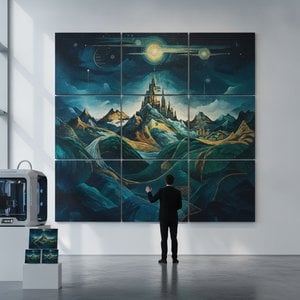
Integrating such a magnificent reproduction into an interior design scheme allows for a narrative-driven decor. The expansive scale of 94 x 789 cm makes it a commanding presence, capable of anchoring a room with its rich textures and historical depth. It is a piece that does not merely decorate a wall; it transforms an environment, offering a sophisticated touch of heritage and a serene escape into the harmonious landscapes of the eighteenth century.



 Δείτε σε πραγματικό χώρο
 Switch to Print
 Αποστολή
 Κοινοποίηση
 Λεπτομέρειες

 Λήψη
Λήψη
 Παρόμοια αντικείμενα συλλογής
 Ακτινογραφία
 Παρουσίαση
 Stats
Stats


 Διαβάστε περισσότερα






































 Η επιλογή με γυαλί είναι διαθέσιμη μόνο για μεγέθη κάτω από 110 εκ.