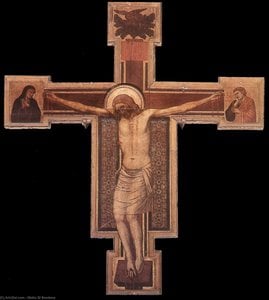
A Brushstroke of Devotion: The Life and Legacy of Giovanni da Modena
Giovanni da Modena, born around 1409 in the heart of Italy, remains a compelling yet somewhat enigmatic figure within the Early Renaissance landscape. While biographical details are scarce – a common fate for artists predating widespread documentation – his surviving works speak volumes about his skill, piety, and the artistic currents shaping 15th-century Modena. He lived during a period of significant religious fervor and political upheaval, both of which profoundly influenced his art. Modena itself was a thriving center of culture, nestled between powerful city-states like Florence and Venice, allowing for an exchange of ideas and styles that undoubtedly impacted Giovanni’s development. His death in 1455 marked the loss of a talented artist whose frescoes continue to captivate viewers with their dramatic intensity and emotional depth. He is sometimes referred to as Giovanni Alfieri Henrique, but this appears to be a later attribution or confusion within historical records.
The Modena School and Early Influences
Giovanni da Modena is most closely associated with the “Modena School” of painting – not a formal academy, but rather a localized artistic tradition characterized by its vibrant colors, narrative clarity, and strong religious focus. This school drew upon influences from both Northern Italian Gothic traditions and the burgeoning Renaissance styles emanating from Florence. Early in his career, Giovanni likely absorbed techniques from local masters, learning the intricacies of fresco painting – a demanding medium requiring speed, precision, and an understanding of pigment chemistry. The influence of artists like Michele Pannoni is often cited, particularly in the use of rich blues and golds that adorn many of Giovanni’s compositions. However, he quickly developed his own distinctive style, marked by a heightened sense of drama and a more naturalistic approach to depicting human emotion.
The Return of the Magi, his most celebrated work, showcases this emerging individuality, moving beyond the stylized forms of earlier Gothic painting towards a greater realism in portraying figures and settings.
The Return of the Magi: A Masterpiece of Narrative Power
Undoubtedly Giovanni da Modena’s magnum opus is the extensive fresco cycle depicting *The Return of the Magi* within the walls of the Schifanoia Palace in Ferrara, commissioned by Borso d'Este. This monumental work isn’t merely a depiction of a biblical event; it’s a complex allegorical statement reflecting Borso’s ambitions and his vision for a just and prosperous reign. The frescoes are divided into three registers, each brimming with detailed scenes and symbolic imagery. The lower register portrays the journey of the Magi, filled with vivid depictions of landscapes, exotic animals, and diverse figures representing different nations and social classes. The middle register focuses on the adoration of the Christ Child, showcasing Borso d'Este himself among the adoring figures – a clear assertion of his power and piety. The upper register is dedicated to astrological symbols and representations of the months of the year, reflecting the Renaissance fascination with astronomy and its connection to earthly events.
What sets Giovanni’s interpretation apart is the sheer emotional intensity he imbues into each scene. The faces of the Magi are etched with wonder and reverence, while the surrounding crowds display a range of emotions – from curiosity to skepticism to joyous celebration. The use of light and shadow further enhances the dramatic effect, drawing the viewer's eye to key moments within the narrative.
Technique and Style: A Synthesis of Tradition and Innovation
Giovanni da Modena’s technical prowess was evident in his masterful handling of fresco painting. He employed a vibrant palette, utilizing pigments derived from natural sources to create rich, luminous colors that have remarkably endured over centuries. His compositions are characterized by their clarity and narrative coherence, guiding the viewer's eye through complex scenes with ease. While rooted in the Gothic tradition, Giovanni’s style also demonstrates an increasing awareness of Renaissance principles. He experimented with perspective – though not as rigorously as artists working in Florence – to create a greater sense of depth and realism within his compositions. His figures are more anatomically accurate than those found in earlier works, reflecting a growing interest in human form and proportion.
- Emphasis on emotional expression through facial features and gestures.
- Use of vibrant colors and gold leaf to create a sense of opulence and sacredness.
- Narrative clarity and detailed depictions of scenes and figures.
- Integration of symbolic imagery reflecting religious beliefs and political aspirations.
Historical Significance and Enduring Legacy
Giovanni da Modena’s contribution to the Early Renaissance lies in his ability to synthesize traditional Gothic techniques with emerging Renaissance ideals. He wasn't a revolutionary innovator like Masaccio or Donatello, but he was a skilled craftsman who infused his works with a unique emotional intensity and narrative power. His frescoes at Schifanoia Palace stand as a testament to the artistic vibrancy of Modena during the 15th century and offer valuable insights into the religious beliefs and political ambitions of Borso d'Este.
Although relatively few other works are definitively attributed to him, his influence can be seen in the paintings of subsequent artists working in the region. Today, Giovanni da Modena is recognized as a pivotal figure in Italian Renaissance art – a master painter whose frescoes continue to inspire awe and reverence in viewers centuries after their creation. His work serves as a powerful reminder of the enduring power of art to convey faith, celebrate human achievement, and capture the spirit of an era.



 Δείτε σε πραγματικό χώρο
 Αγορά εκτύπωσης
 Αποστολή
 Κοινοποίηση
 Λεπτομέρειες

 Λήψη
Λήψη
 Παρόμοια αντικείμενα συλλογής
 Ακτινογραφία
 Παρουσίαση
 Διαβάστε περισσότερα