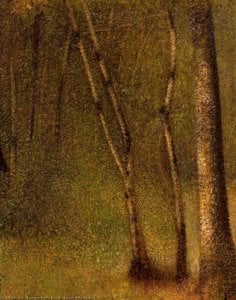
A Symphony of Light and Color: Unveiling Georges Seurat’s “Cirque”
Georges Pierre Seurat's "Cirque," painted in 1891, isn’t merely a depiction of a circus; it’s an immersive experience, a carefully constructed illusion rendered in the revolutionary technique of Pointillism. This work stands as a pivotal moment in art history, bridging the Impressionist era with the nascent movements that would define modern painting. Seurat, a meticulous and intellectually driven artist, sought to capture not just what he *saw*, but how the eye perceives light and color – a pursuit rooted in scientific observation and a desire to unlock the secrets of visual sensation.
The scene unfolds with an almost dreamlike quality. A woman, poised and elegant atop a magnificent white horse, commands the center of attention, her presence radiating both power and grace. Around her swirl a vibrant tableau of performers – acrobats, animal handlers, and spectators – all bathed in the dappled light of a late afternoon sun. The artist’s eye doesn't simply record; it orchestrates an atmosphere of joyous chaos, capturing the energy and spectacle of the circus with remarkable precision. Notice how Seurat deliberately avoids sharp outlines, instead relying on countless tiny dots of color to build form and create a sense of depth and movement. This technique, born from his study of optics and color theory, is not haphazard; it’s a deliberate strategy to mimic the way our eyes actually perceive light.
The Language of Pointillism: A Scientific Approach to Art
Seurat's innovation, Pointillism – also known as Divisionism – was far more than just a stylistic choice. He meticulously developed his own system, based on the theories of Eugène Chevreul regarding simultaneous contrast and optical mixing. Each individual dot, or *point*, is intended to reflect light in a specific way, and when viewed from a distance, these dots coalesce into larger, blended colors that create an astonishingly luminous effect. It’s akin to building an image with tiny fragments of color, allowing the viewer's eye to do the work of mixing them together.
-
Color Theory:
Seurat employed a carefully calibrated palette, favoring complementary colors – blues and oranges, yellows and purples – to heighten the vibrancy and intensity of his composition.
-
Optical Mixing:
The brilliance of “Cirque” lies in its ability to create color through optical mixing rather than physical blending on the canvas. This technique results in a shimmering, almost ethereal quality.
-
Scientific Precision:
Seurat’s approach was deeply rooted in scientific principles, reflecting his belief that art could be informed by observation and experimentation.
A Symbol of Ephemeral Joy and Modernity
Beyond its technical brilliance, “Cirque” offers a glimpse into the anxieties and aspirations of late 19th-century France. The circus, a symbol of spectacle, entertainment, and escape, represented a world increasingly defined by industrialization and urbanization. Seurat’s depiction captures both the allure and the fleeting nature of this experience – a momentary burst of joy amidst a rapidly changing society. The woman on horseback can be interpreted as representing beauty, grace, and perhaps even a touch of danger, while the surrounding chaos hints at the underlying tensions of modern life.
Furthermore, “Cirque” embodies the spirit of *fin de siècle* – a period marked by both optimism and uncertainty. The vibrant colors and dynamic composition reflect a desire to celebrate beauty and pleasure, while the meticulous technique suggests a yearning for order and control in a world undergoing profound transformation. The painting’s influence can be seen in subsequent movements like Neo-Impressionism and Fauvism, demonstrating Seurat's lasting legacy on the course of art history.
Bringing “Cirque” Home: A Reproduction to Cherish
WahooArt offers meticulously crafted hand-painted reproductions of Georges Seurat’s "Cirque," allowing you to experience the magic of this masterpiece in your own space. Our skilled artists faithfully recreate Seurat's Pointillist technique, capturing the luminous quality and intricate detail with exceptional accuracy. Whether adorning a gallery wall or adding a touch of artistic flair to your interior design, our reproductions provide an authentic representation of this iconic work.
Invest in a piece of art history – order your “Cirque” reproduction today
Ερωτήσεις & Απαντήσεις
Γιατί η κατάσταση των πνευματικών δικαιωμάτων του "cirque" είναι αυτή που είναι;
Το έργο "cirque" του Georges Pierre Seurat ανήκει στο δημόσιο κτήμα - τα δικαιώματα αυτορության έχουν λήξει. Οι όροι πνευματικών δικαιωμάτων υπολογίζονται από το έτος θανάτου του καλλιτέχνη, και ο/η Georges Pierre Seurat απεβίωσε το 1891.
Ποιος πουλάει χειροποίητα αντίγραφα του "cirque" του Georges Pierre Seurat;
Το έργο "cirque" είναι διαθέσιμο ως μια με ζωγραφισμένη με λάδι αναπαραγωγή σε καμβά λινου. Η παραγγελία μπορεί να πραγματοποιηθεί στη σελίδα Αντιγραφή με Χειρόχειρο Ζωγράφισμα, με δυνατότητα επιλογής μεγέθους.
Ποιος είναι ο δημιουργός του "cirque" και σε ποιο καλλιτεχνικό ρεύμα ανήκει;
Ο/Η Georges Pierre Seurat δημιούργησε το "cirque" στο πλαίσιο του movements Μετα-Επιρρησιασμός.



 Προεπισκόπηση
 Αγορά χειροποίητου πίνακα
 Αποστολή
 Κοινοποίηση
 Λεπτομέρειες
 Οδηγός

 Λήψη
Λήψη
 Παρόμοια αντικείμενα συλλογής
 Ακτινογραφία
 Παρουσίαση
 Στατιστικά

 Περισσότερα λεπτομέρεια






































 Η επιλογή με γυαλί είναι διαθέσιμη μόνο για μεγέθη κάτω από 110 εκ.