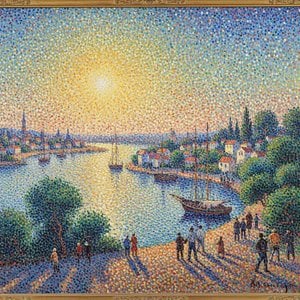
A Moment of Quiet Contemplation: Georges Seurat’s ‘Seated Nude’
Georges Seurat's “Seated Nude: Study for” is not merely a drawing; it’s a distilled essence of the artist’s revolutionary approach to art, a poignant glimpse into his creative process. Completed in 1883, this monochromatic work immediately draws the viewer into a world of meticulous detail and profound emotional resonance. The subject – a male nude seated in profile – is rendered with an almost obsessive precision using dry point technique, creating a surface that vibrates with texture and depth. It’s a study, yes, but one brimming with a quiet dignity and vulnerability that transcends its preparatory status.
The composition centers on the figure's back and shoulders, subtly angled towards the viewer, inviting a sense of intimacy despite the formal restraint. The lower body is deliberately obscured by shadow, fostering an atmosphere of contemplation – a suggestion of introspection rather than overt sensuality. Seurat’s genius lies in his ability to convey complex emotion through deceptively simple forms. This isn't a celebration of the nude form; it’s a meditation on stillness, solitude, and perhaps even a touch of melancholy.
The Language of Pointillism: Technique and Innovation
Executed with an extraordinary level of control, “Seated Nude” exemplifies Seurat's groundbreaking technique of Pointillism – or, as he termed it, chromoluminarism. Rather than blending colors directly on the canvas, Seurat employed thousands of tiny, distinct dots of pure color, meticulously arranged to create optical mixtures when viewed from a distance. This method, rooted in scientific observation of how the eye perceives light and color, was radically innovative for its time.
- Dry Point Technique: The use of dry point creates an incredibly fine, textured surface – a network of tiny dots that mimics the appearance of fabric and muscle.
- Layered Construction: Seurat built up tones and textures through countless layers of graphite, achieving remarkable depth and volume with minimal material.
- Optical Mixing: The viewer’s eye naturally blends these individual dots to create a vibrant, luminous effect – a testament to Seurat's understanding of color theory.
The drawing isn’t just about technique; it’s about the *process* of seeing and representing reality. Seurat wasn’t interested in simply copying what he saw; he was attempting to capture the very essence of light and form through a system of scientific observation.
Historical Context: A Pioneer of Modern Art
“Seated Nude: Study for” emerged during a pivotal moment in art history – the transition from Impressionism to modernism. Georges Seurat, born in Paris in 1859, was deeply influenced by artists like Eugène Delacroix and the scientific theories of Charles Darwin, particularly regarding perception and color. He sought to move beyond the fleeting impressions of Impressionism and create a more structured, rational approach to art.
His work aligns with the broader intellectual currents of the late 19th century, reflecting a fascination with science, technology, and the pursuit of objective truth. Seurat’s meticulous methodology and his exploration of optical effects paved the way for later movements such as Neo-Impressionism and Fauvism. The drawing stands as a crucial bridge between these artistic traditions.
Symbolic Resonance: Quietude and Vulnerability
Beyond its technical brilliance, “Seated Nude” possesses a subtle yet powerful symbolic resonance. The pose itself – seated, contemplative, slightly vulnerable – evokes a sense of introspection and quiet dignity. The somber tone and the deliberate use of monochrome contribute to this atmosphere of melancholy and contemplation.
It’s important to note that Seurat was not simply depicting a nude figure; he was exploring themes of human experience—the beauty of stillness, the weight of solitude, and perhaps even the acceptance of mortality. This drawing invites us to pause, reflect, and consider our own place within the larger context of existence.



 Δείτε σε πραγματικό χώρο
 Μετάβαση σε Εκτυπωση
 Αποστολή
 Κοινοποίηση
 Λεπτομέρειες

 Λήψη
Λήψη
 Παρόμοια αντικείμενα συλλογής
 Ακτινογραφία
 Παρουσίαση
 Στατιστικά


 Διαβάστε περισσότερα






































 Η επιλογή με γυαλί είναι διαθέσιμη μόνο για μεγέθη κάτω από 110 εκ.