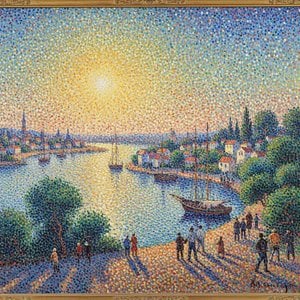
A Symphony of Light and Motion
When Helene Kröller-Müller first laid eyes on Georges Seurat’s Le Chahut, she was so profoundly moved that she famously recounted her son's bewilderment at her desire to purchase such a vibrant piece of Parisian nightlife. This emotional resonance is precisely what makes the painting an enduring masterpiece for any collection. At its heart, Le Chahut is far more than a mere depiction of a dance hall; it is a rhythmic explosion of energy that captures the very pulse of late 19th-century Paris. The scene presents a chorus line of dancers mid-performance, their limbs captured in an upward surge of motion that seems to defy the stillness of the canvas. Through Seurat’s eyes, we are not just spectators watching a cabaret; we are participants in a luminous celebration of life, where the boundaries between the stage and the viewer begin to dissolve.
The technical brilliance of this work lies in Seurat’s revolutionary application of Pointillism. Moving away from the spontaneous, often blurred brushstrokes of the Impressionists, Seurat embraced a more disciplined, scientific approach known as Divisionism. He meticulously applied tiny, distinct dots of pure color, relying on the viewer's eye to optically mix them into a cohesive, shimmering whole. This technique creates a unique atmospheric effect where light does not simply sit upon the surface but seems to emanate from within it. For an interior designer or art enthusiast, this means the painting offers a dynamic visual experience that changes subtly depending on the lighting of the room, providing a sense of depth and vitality that traditional painting styles often lack.
The Geometry of Joy
Beyond the scientific precision of his dots, Seurat utilized a sophisticated structural language to guide the viewer's emotions. The composition is defined by a series of ascending lines—visible in the spirited legs of the dancers, the upright posture of the musicians, and even the subtle tilt of heads. These vertical movements create an inherent sense of optimism and upward momentum, mirroring the exhilarating spirit of the can-can dance itself. This structural rigor is balanced by a warm, radiant color palette; golds, oranges, and soft pinks dominate the stage, reflecting the glow of gaslights and casting a nostalgic, celebratory warmth over the entire scene.
For those looking to curate a space with character and intellectual depth, Le Chahut serves as a magnificent focal point. It embodies a pivotal moment in art history—the transition from the fleeting impressions of nature to the structured modernism of the 20th century. Owning a high-quality reproduction of this work allows one to bring a piece of Neo-Impressionist history into a contemporary setting, offering a sophisticated blend of scientific precision and raw, emotional energy. It is an invitation to contemplate the beauty of light, the complexity of perception, and the timeless allure of the human spirit in motion.
Ερωτήσεις και Απαντήσεις
Τι συναίσθημα αποπνέει το "Le Chahut" του Georges Pierre Seurat;
Η ατμόσφαιρα του έργου "Le Chahut" του Georges Pierre Seurat είναι Serene, ενώ ο συναισθηματικός του τόνος είναι Joyful.
Πόσο είχε ο/η Georges Pierre Seurat όταν δημιουργήθηκε το "Le Chahut";
Όταν δημιουργήθηκε το "Le Chahut" το 1890, ο/η Georges Pierre Seurat - γεννημένος/η το 1859 - ήταν μόλις 31 ετών.
Πώς είναι δομημένη η χρωματική σύνθεση του "Le Chahut" του Georges Pierre Seurat;
Η χρωματική σύνθεση του έργου "Le Chahut" του Georges Pierre Seurat συνδυάζει μια Gentle αντίθεση με μια Discordant Palette αρμονία.



 Προεπισκόπηση σε πραγματική κλίμακα
 Αγορά χειροποίητου πίνακα
 Αποστολή
 Κοινοποίηση
 Λεπτομέρειες
 Οδηγός

 Λήψη
Λήψη
 Παρόμοια αντικείμενα συλλογής
 Ακτινογραφία
 Παρουσίαση
 Q&A
Q&A Στατιστικά


 Περισσότερα






































 Η επιλογή με γυαλί είναι διαθέσιμη μόνο για μεγέθη κάτω από 110 εκ.