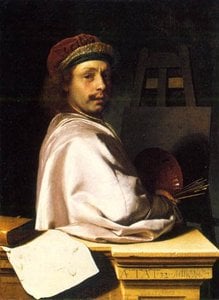
A Moment Frozen in Time: Frans van Mieris’ ‘Boy Blowing Bubbles’
Frans van Mieris' “Boy Blowing Bubbles,” painted in 1663, isn’t merely a portrait; it’s a carefully constructed tableau of Dutch Golden Age life, brimming with subtle symbolism and an exquisite attention to detail that defines the artist’s signature style. Housed within the Mauritshuis in The Hague, this captivating scene invites us into a world where innocence dances alongside contemplation, and the ephemeral beauty of childhood is juxtaposed against deeper philosophical questions about mortality and the passage of time.
The ‘Fijnschilder’ Technique: A Masterclass in Illusion
Van Mieris was a leading figure in the “fijnschilder” movement, a group of Dutch painters known for their meticulous realism and mastery of illusionistic techniques. He achieved this through painstaking layering of glazes – incredibly thin washes of paint applied over dry layers – creating an astonishingly lifelike surface that seems to shimmer with depth and texture. Observe the delicate rendering of the boy’s skin, the subtle folds in his clothing, and the way the light catches on the bubbles themselves. Van Mieris didn't simply depict; he constructed a convincing illusion of reality, employing techniques borrowed from both painting and drawing – a testament to his rigorous training under Gerrit Dou.
Symbolism Woven into the Scene: A Tapestry of Meaning
The composition is rich with layered symbolism, reflecting the intellectual currents of 17th-century Holland. The boy, seemingly lost in a simple pleasure – blowing bubbles – represents fleeting joy and innocence. However, the artist subtly introduces an undercurrent of melancholy. The woman behind him, dressed in luxurious fabrics, holds a baby, suggesting motherhood and domesticity, yet her gaze is distant, hinting at the burdens of responsibility. The dog, a symbol of loyalty, stands attentively beside her, perhaps representing steadfastness amidst uncertainty. Even the objects within the room – the vases overflowing with flowers, the clock measuring the relentless march of time, and the window offering a glimpse to an unseen world – contribute to this complex web of meaning.
Contextualizing the Image: The ‘Paragone’ and the Illusion of Space
“Boy Blowing Bubbles” exists within the broader context of the “paragone,” a heated debate in 17th-century Europe concerning the relative merits of painting versus sculpture. Van Mieris, through his masterful manipulation of perspective and texture, powerfully demonstrated painting’s ability to create convincing illusions of space and depth – a skill that directly challenged the perceived superiority of three-dimensional sculpture. The window itself serves as a visual metaphor for this illusionistic prowess, inviting the viewer to step into the scene and contemplate its intricacies. The artist deliberately employs techniques reminiscent of Renaissance perspective, elevating painting’s status within the artistic hierarchy.
Beyond its technical brilliance and symbolic depth, “Boy Blowing Bubbles” evokes a profound sense of nostalgia for a bygone era – a poignant reminder of childhood's fleeting beauty and the inevitable passage of time. It is a work that continues to resonate with viewers today, offering a glimpse into the complexities of human experience and the enduring power of art to capture a single, unforgettable moment.
- Artist: Frans van Mieris the Elder
- Date: 1663
- Location: Mauritshuis, The Hague
- Medium: Oil on Panel
Learn more about the artwork at the Mauritshuis
Ερωτήσεις & Απαντήσεις
Τι κοινό έχει το "Boy Blowing Bubbles" με το υπόλοιπο έργο του/της Frans van Mieris;
Το "Boy Blowing Bubbles" ανήκει στο έργο της καλλιτεχνικής κατεύθυνσης Dutch Golden Age του Frans van Mieris, των οποίων τα καταγεγραμμένα θέματα περιλαμβάνουν το dutch golden age realism, symbolic moral interpretation, paragone competition influence, illusionistic depth techniques, van mieris’ detailed portraits.
Μπορώ να δω το έργο "Boy Blowing Bubbles" του Frans van Mieris στον δικό μου τοίχο πριν από την αγορά;
Η σελίδα Προεπισκόπηση AR του έργου "Boy Blowing Bubbles" του Frans van Mieris χρησιμοποιεί την τεχνολογία augmented reality για να σας δείξει το έργο στον δικό σας χώρο, μέσω μιας συμβατής συσκευής.
Ποια διάθεση εκφράζει το "Boy Blowing Bubbles" του Frans van Mieris εντός του Dutch Golden Age;
Το Nostalgic συναίσθημα του "Boy Blowing Bubbles" συνοδεύει το στυλ της καλλιτεχνικής κίνησης Dutch Golden Age.



 Προεπισκόπηση
 Μετάβαση σε Εκτυπώσεις
 Αποστολή
 Κοινοποίηση
 Λεπτομέρειες
 Οδηγός

 Λήψη
Λήψη
 Παρόμοια αντικείμενα συλλογής
 Ακτινογραφία
 Παρουσίαση
 Στατιστικά


 Περισσότερα λεπτομέρεια






































 Η επιλογή με γυαλί είναι διαθέσιμη μόνο για μεγέθη κάτω από 110 εκ.