Βιογραφικό Καλλιτέχνη
A Pioneer of the Italianate Landscape: The Life and Art of Cornelis van Poelenburgh
Cornelis van Poelenburgh, a name perhaps less instantly recognizable than some of his Dutch Baroque contemporaries, nevertheless occupies a pivotal position in the development of landscape painting during the 17th century. Born in Utrecht around 1594/95 – the precise year remains somewhat elusive – Van Poelenburgh emerged as a key figure bridging the Mannerist traditions of Northern Europe with the burgeoning Italianate style that would captivate audiences for generations. His journey, marked by formative training, an extended sojourn in Rome, and patronage from royal courts, shaped a distinctive artistic voice characterized by serene compositions, classical allusions, and a delicate balance between realism and idealization. Early records place him within a Catholic household in Utrecht, his father serving as a canon at the local cathedral chapter. This upbringing likely instilled a sense of refinement that would later permeate his work. His initial artistic education took place under the tutelage of Abraham Bloemaert, a leading figure in the Utrecht school and a master of Mannerist techniques. However, it was Van Poelenburgh’s move to Rome around 1617 that proved truly transformative.
Rome and the Circle of the Bentvueghels
The Roman art scene of the early 17th century pulsed with creative energy, attracting artists from across Europe seeking inspiration in the classical ruins and sun-drenched landscapes of Italy. Van Poelenburgh quickly integrated into this vibrant community, becoming a founding member of the *Bentvueghels*, a society of predominantly Flemish and Dutch painters who adopted playful nicknames – his own being ‘Satyr’ – and engaged in spirited artistic rivalries. This fellowship fostered an exchange of ideas and techniques that profoundly influenced Van Poelenburgh's style. He absorbed the lessons of Adam Elsheimer, whose small-scale, meticulously detailed landscapes resonated with his own predilection for intimate scenes. The Roman countryside became his studio, providing a wealth of motifs – crumbling temples, verdant hillsides, and picturesque waterways – that would populate his canvases. His early works from this period demonstrate a remarkable ability to capture the atmospheric qualities of light and shadow, creating a sense of depth and tranquility. It was in Rome that he began to develop his signature style: small-scale paintings featuring Italianate landscapes populated by figures enacting biblical or mythological narratives, or simply engaged in everyday activities within a classical setting.
A Style Defined: Blending Narrative with Landscape
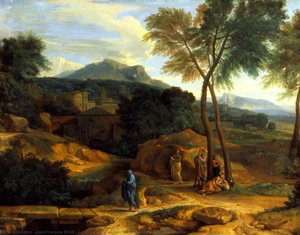
Van Poelenburgh’s artistic output is characterized by a harmonious fusion of landscape and figure painting. He wasn't merely depicting scenes *in* a landscape; he was creating landscapes that served as the stage for human drama, or contemplative moments. His figures, often small in scale relative to the expansive vistas, are rendered with elegance and grace, their poses echoing classical sculpture. This deliberate balance between the grandeur of nature and the intimacy of human experience is one of the hallmarks of his work. He skillfully employed a muted palette, favoring earthy tones and subtle gradations of color that contribute to the overall sense of serenity. While early paintings can be difficult to distinguish from those of Bartholomeus Breenbergh – both artists shared a similar aesthetic sensibility – Van Poelenburgh gradually developed a more refined technique and a greater emphasis on atmospheric perspective. His compositions often feature classical ruins, not as symbols of decay but as evocative reminders of the past, lending a sense of timelessness to his scenes.
Patronage and Later Years: From England to Utrecht
Van Poelenburgh’s reputation extended beyond Rome, attracting the attention of discerning patrons across Europe. In the 1630s, he received a summons from Charles I of England, who commissioned numerous small cabinet pieces for his royal collection. Records indicate that Van Poelenburgh and fellow painter Alexander Keirincx were granted housing in Westminster as part of their employment by the king. This period represents a high point in his career, solidifying his status as a sought-after artist. Following his return to Utrecht, he continued to paint prolifically, establishing a successful studio and training a generation of aspiring landscape painters. He died in Utrecht in 1667, leaving behind a legacy that would influence artists for decades to come. Among his notable pupils were Daniël Vertangen, Dirck van der Lisse, François Verwilt, and Jan van Haensbergen, each carrying forward elements of his distinctive style.
Historical Significance: A Bridge Between Traditions
Cornelis van Poelenburgh’s significance lies in his role as a pivotal figure in the transition from Mannerism to the Dutch Baroque landscape tradition. He was among the first Northern European artists to fully embrace the Italianate aesthetic, adapting it to suit the sensibilities of his own cultural context. His work foreshadowed the later achievements of Claude Lorraine and Nicolas Poussin, who would become synonymous with the classical landscape genre. While not as widely celebrated as some of his more famous contemporaries, Van Poelenburgh’s paintings offer a compelling glimpse into the artistic ferment of the 17th century, revealing a master craftsman whose delicate touch and refined sensibility continue to captivate audiences today. His ability to imbue landscapes with narrative depth and emotional resonance ensures his enduring place in the history of art.



 Προεπισκόπηση
 Μετάβαση σε Εκτυπώσεις
 Αποστολή
 Κοινοποίηση
 Λεπτομέρειες
 Οδηγός

 Λήψη
Λήψη
 Παρόμοια αντικείμενα συλλογής
 Ακτινογραφία
 Παρουσίαση
 Στατιστικά

 Περισσότερα λεπτομέρεια