Προεπισκόπηση Προεπισκόπηση σε AR Αγορά χειροποίητου πίνακα Μετάβαση σε Ψηφιακή Εικόνα Αποστολή
Λεπτομέρειες Οδηγός Προσθήκη στα αγαπημένα Λήψη Παρόμοια αντικείμενα συλλογής Ακτινογραφία Παρουσίαση Στατιστικά

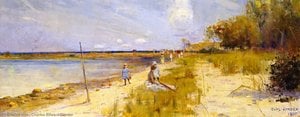
Springtime

Charles Conder's 'Springtime' captures a serene Australian countryside scene with figures and nature bathed in sunlight. A beautiful example of Heidelberg School art.

Ο Κάρλος Έντουαρδος Κόντερ (1868-1909) ήταν ζωγράφος της Αυστραλίας, σημαντικός εκπρόσωπος της Heidelberg School με εντυπωσιακά έργα λιθόγραφων και σχεδίων. Ανακαλύψτε τα τοπία και τις εμπνευσμένες εικονογραφήσεις του στην WahooArt!

Giclée / Εκτυπώσεις Τέχνης

Εκτύπωση giclée ή σε καμβά ποιότητας μουσείου με γρήγορη παραγωγή και ευέλικτες επιλογές φινιρίσματος. ( Αγορά χειροποίητου πίνακα Μετάβαση σε Ψηφιακή Εικόνα)

Corner sample of the P118B picture frame: μολυσμένο πολυστερίνη, 5 cm wide and 3 cm thick
P118B €10
Corner sample of the P118H picture frame: μολυσμένο πολυστερίνη, 5 cm wide and 3 cm thick
P118H €10
Corner sample of the P118W picture frame: μολυσμένο πολυστερίνη, 5 cm wide and 3 cm thick
P118W €10
Corner sample of the P438Z picture frame: μολυσμένο πολυστερίνη, 5.5 cm wide and 3.5 cm thick
P438Z €10
Corner sample of the P508JH picture frame: μολυσμένο πολυστερίνη, 7 cm wide and 3.5 cm thick
P508JH €12
Corner sample of the P508YH picture frame: μολυσμένο πολυστερίνη, 7 cm wide and 3.5 cm thick
P508YH €12
Corner sample of the P805H picture frame: μολυσμένο πολυστερίνη, 5 cm wide and 3.5 cm thick
P805H €10
Corner sample of the P805Z picture frame: μολυσμένο πολυστερίνη, 5 cm wide and 3.5 cm thick
P805Z €10
Corner sample of the P919BZ picture frame: μολυσμένο πολυστερίνη, 7 cm wide and 3.5 cm thick
P919BZ €10
Corner sample of the P919G picture frame: μολυσμένο πολυστερίνη, 7 cm wide and 3.5 cm thick
P919G €10
Corner sample of the P919XJ picture frame: μολυσμένο πολυστερίνη, 7 cm wide and 3.5 cm thick
P919XJ €10
Corner sample of the P959ZH picture frame: μολυσμένο πολυστερίνη, 5 cm wide and 3 cm thick
P959ZH €10
Corner sample of the P968JZ picture frame: μολυσμένο πολυστερίνη, 6 cm wide and 4 cm thick
P968JZ €12
Corner sample of the W106C picture frame: φυστικό ξύλο, 5 cm wide and 3 cm thick
W106C €8
Corner sample of the W218G picture frame: φυστικό ξύλο, 5 cm wide and 3 cm thick
W218G €10
Corner sample of the W218JH picture frame: φυστικό ξύλο, 5 cm wide and 3 cm thick
W218JH €8
Corner sample of the W218Y picture frame: φυστικό ξύλο, 5 cm wide and 3 cm thick
W218Y €10
Corner sample of the W307PJ picture frame: φυστικό ξύλο, 6 cm wide and 3 cm thick
W307PJ €10
Corner sample of the W316G picture frame: φυστικό ξύλο, 6 cm wide and 3 cm thick
W316G €10
Corner sample of the W316PJ picture frame: φυστικό ξύλο, 6 cm wide and 3 cm thick
W316PJ €8
Corner sample of the W316Y picture frame: φυστικό ξύλο, 6 cm wide and 3 cm thick
W316Y €10
Corner sample of the W398PJ picture frame: φυστικό ξύλο, 5 cm wide and 3 cm thick
W398PJ €8
Corner sample of the W4111J picture frame: φυστικό ξύλο, 6.5 cm wide and 3.5 cm thick
W4111J €10
Corner sample of the W500HY picture frame: φυστικό ξύλο, 7 cm wide and 5 cm thick
W500HY €15
Corner sample of the W500JH picture frame: φυστικό ξύλο, 7 cm wide and 5 cm thick
W500JH €15
Corner sample of the W692G picture frame: φυστικό ξύλο, 8 cm wide and 4 cm thick
W692G €12
Corner sample of the W849H picture frame: φυστικό ξύλο, 5 cm wide and 3 cm thick
W849H €8
Corner sample of the W940BG picture frame: φυστικό ξύλο, 7.5 cm wide and 4.5 cm thick
W940BG €15
Corner sample of the W953PJ picture frame: φυστικό ξύλο, 6 cm wide and 3.5 cm thick
W953PJ €8

Πρότυπο
κατόπιν παραγγελίας
CM
INCH

Επιλέξτε από τις προκαθορισμένες διαστάσεις μας που διατηρούν τις αρχικές αναλογίες του έργου τέχνης.

πλάτος
ύψος

Πληκτρολογήστε το πλάτος και το ύψος που επιθυμείτε, ώστε να ταιριάζουν στο κάδሮ ή στον τοίχο σας. Μια εκτύπωση μπορεί μόνο να κοπεί και ποτέ να μην γίνει μεγαλύτερη από την εικόνα, επομένως ένα μέγεθος με διαφορετικό σχήμα συνεπάγεται απώλεια ενός μέρους της εικόνας. Σας στέλνουμε ένα ψηφιακό mockup για έγκριση πριν εκτυπώσουμε οτιδήποτε. Η εικόνα που εμφανίζεται σε αυτή τη σελίδα δεν δείχνει την πραγματική κοπή — μόνο το mockup την παρουσιάζει.

Παγκόσμια Αποστολή () σε 2 εβδομάδες αντί για τις συνήθεις 4/5 εβδομάδες. (24 Οκτώβριος)

Δωρεάν γρήγορη διεθνής αποστολή
Κάμβας από Λινό Υψηλής Ποιότητας
Πλήρης ασφάλιση μεταφοράς
Εγγύηση επιστροφής δασμών και φόρων εισαγωγής
Εγγύηση Απόλυτης Ομοιότητας Χρωμάτων
Πολιτική Επιστροφής 100 Ημερών (Μόνο σε περίπτωση ελαττωμάτων)
Εγγύηση επιστροφής 100% των χρημάτων
Έκπτωση για πολλαπλές παραγγελίες

Συνολική Τιμή

€ 60

Springtime

Giclée / Εκτυπώσεις Τέχνης

Διαστάσεις Αναπαραγωγής

-

Συνολικό Κόστος

€ 60

Βασικά στοιχεία

  • Medium: Oil on canvas
  • Title: Springtime
  • Movement: Heidelberg School
  • Location: NGV, Melbourne
  • Artist: Charles Conder

ΚВИΖ Τέχνης

Για κάθε ερώτηση υπάρχει μόνο μία σωστή απάντηση.

Ερώτηση 1:
What artistic movement is Charles Edward Conder primarily associated with?
Ερώτηση 2:
In 'Springtime', what is the primary subject matter depicted?
Ερώτηση 3:
What year was 'Springtime' painted?
Ερώτηση 4:
Charles Edward Conder was born in which city?
Ερώτηση 5:
Which of the following best describes Conder's style as evident in 'Springtime'?

Charles Edward Conder’s “Springtime,” A Window into Heidelberg’s Soul

Charles Edward Conder's "Springtime," painted in 1888, isn’t merely a depiction of a rural scene; it’s a vibrant distillation of the Heidelberg School’s artistic philosophy – a celebration of light, color, and the fleeting beauty of the Australian landscape. This oil on canvas captures a moment of idyllic tranquility nestled within the rolling hills of New South Wales, yet it resonates with a deeper sense of observation and emotional resonance that distinguishes Conder's work from purely topographical representations.

The painting immediately draws the eye to the luminous quality of the light, characteristic of the Heidelberg School’s approach. Conder masterfully employs broken brushstrokes and a palette dominated by greens, blues, and yellows – not in a photographic realism, but rather as an expression of how these colors *feel* under the intense Australian sun. The composition is deceptively simple: a meandering dirt track cuts through a field dotted with grazing sheep and cows, leading towards distant trees that are rendered with a hazy, atmospheric quality. A small group of figures – likely children – are visible in the foreground, adding a touch of human presence to this otherwise serene vista.

The Heidelberg School and its Artistic Roots

To fully appreciate “Springtime,” it’s crucial to understand the context within which Conder was working. The Heidelberg School, emerging in Melbourne during the 1880s, represented a significant shift away from the academic traditions of European art that had previously dominated Australian painting. Artists like Conder, Tom Roberts, and Frederick McCubbin sought inspiration directly from the Australian landscape, rejecting idealized representations in favor of capturing its raw beauty and inherent drama. They embraced *plein air* painting – working outdoors directly from nature – a technique championed by Impressionist painters in Europe.

Conder’s early life, marked by his mother's death in India and subsequent relocation to England before returning to Australia, undoubtedly shaped his artistic sensibility. His experiences as a surveyor instilled a keen eye for detail and an appreciation for the natural world, while his time spent studying art in London exposed him to the burgeoning Impressionist movement. However, Conder ultimately forged his own unique style, blending European influences with a distinctly Australian perspective.

Symbolism and Emotional Resonance

Beyond its picturesque subject matter, “Springtime” is rich in symbolic meaning. The dirt track suggests a journey – perhaps a metaphorical one – while the grazing animals represent the bounty of the land. The figures in the foreground invite us to contemplate our relationship with nature and the simple pleasures of rural life. There’s an underlying sense of nostalgia for a bygone era, a yearning for connection with the earth and its rhythms.

The hazy atmosphere and diffused light contribute significantly to the painting's emotional impact. It evokes a feeling of warmth, tranquility, and perhaps even melancholy – a recognition that such moments of beauty are fleeting and precious. Conder’s use of color is particularly effective in conveying this mood, creating a sense of depth and luminosity that draws the viewer into the scene.

A Legacy of Australian Impressionism

“Springtime” stands as a pivotal work in the development of Australian Impressionism. It exemplifies the Heidelberg School’s commitment to capturing the essence of the Australian landscape with vibrant color, loose brushwork, and an emphasis on light and atmosphere. Conder's ability to imbue his paintings with both visual beauty and emotional depth cemented his place as one of Australia’s most important artists. Reproductions of this captivating work continue to resonate with audiences today, offering a glimpse into the soul of Heidelberg and the enduring appeal of the Australian landscape.

Ερωτήσεις & Απαντήσεις

Πώς εντάσσεται το "Springtime" στα θέματα και το στυλ του/της Χάρλς Έντουαρδος Κόντερ;

Το "Springtime" μοιράζεται με τα υπόλοιπα έργα του Χάρλς Έντουαρδος Κόντερ το στυλ της καλλιτεχνικής σχολής Heidelberg School και τα επαναλαμβανόμενα θέματα: heidelberg school realism, australian landscape painting, impressionistic light study, rural life depiction”, “conder’s artistic evolution”.

Παρουσιάζει το "Springtime" έντονες αντιθέσεις φωτός και σκότους;

Το επίπεδο αντίθεσης του έργου "Springtime" του Χάρλς Έντουαρδος Κόντερ είναι Bold.

Ποιο μέγεθος και προσανατολισμός προτείνεται για μια εκτύπωση του "Springtime" του Χάρλς Έντουαρδος Κόντερ;

Προτείνεται εκτύπωση του έργου "Springtime" του Χάρλς Έντουαρδος Κόντερ σε μέγεθος Medium με προσανατολισμό Landscape.


Βιογραφικό Καλλιτέχνη

Early Life and Artistic Journey

Charles Edward Conder (1868 – 1909) was an English-born painter, lithographer and designer who emigrated to Australia and became a pivotal figure in the Heidelberg School*, arguably marking the genesis of a distinctive Australian tradition within Western art. Born in Tottenham, Middlesex, the second son of six children, James Conder, civil engineer and Mary Ann Ayres, possessed a lineage steeped in artistic heritage – his father was Louis-François Roubiliac, renowned sculptor.

From a young age, Conder experienced profound influence from India, where he resided until his mother’s untimely passing in May 1873 at the tender age of 31. Subsequently, he returned to England and attended several schools including Eastbourne School, fostering an early inclination towards formal education.

Despite his father's preference for a career in engineering—a path antithetical to Conder’s innate artistic sensibilities—he pursued his passion relentlessly, recognizing it as a fundamental aspect of his identity.

Australia and the Heidelberg School

In 1884, at the age of 16, Conder embarked on a transformative journey to Sydney, Australia, where he joined his uncle’s firm as a land surveyor. However, this profession proved unfulfilling compared to his burgeoning fascination with landscape painting—a pursuit that swiftly superseded his surveyor's duties.

By 1886, Conder secured employment at *Illustrated Sydney News*, collaborating alongside fellow artists such as Albert Henry Fullwood and Frank Mahony. He enrolled in painting classes under Alfred James Daplyn and quickly established connections with Julian Ashton, immersing himself in the vibrant artistic milieu of Melbourne.

Crucially, Conder’s association with G. P. Nerli—an itinerant Italian painter—significantly broadened his artistic horizons, introducing him to European stylistic innovations. This encounter profoundly shaped his creative trajectory.

Together with Tom Roberts and Arthur Streeton, Conder participated in the Heidelberg School exhibition of 1888, cementing his position as a cornerstone of this groundbreaking movement. The exhibition showcased a bold departure from academic conventions, prioritizing spontaneity and capturing the ephemeral beauty of the Australian bush.

Notable Works and Artistic Style

Conder’s magnum opus, *Departure of the Orient – Circular Quay* (1888), exemplifies his mastery of form and brushwork. This evocative depiction of Sydney Harbour at dusk—the moment when the *has cast off for her voyage to England*—immediately garnered acclaim from the Art Gallery of New South Wales, securing its place as Conder’s inaugural work within a public collection.

Alongside Roberts, Conder captured the idyllic charm of Mentone (1888), portraying a serene seaside scene replete with leisurely figures enjoying the warmth of the Australian sun. The painting's composition—borrowed from Whistler’s celebrated bridge motif—underscores Conder’s sensitivity to artistic precedent.

Conder’s oeuvre encompasses a diverse range of subjects, including portraits and lithographs, reflecting his versatility as an artist. His paintings are characterized by luminous color palettes, textured brushstrokes, and a masterful rendering of light—elements that imbue his artworks with palpable emotion and immediacy.

Legacy and Later Life

Despite facing debilitating health challenges—including paralysis and delirium tremens—Conder persevered in his artistic endeavors until his untimely demise in 1909. His art gained considerable recognition upon returning to England, surpassing the acclaim he received during his Australian years.

Henri de Toulouse-Lautrec immortalized Conder’s likeness in a portrait completed in 1892—a testament to Conder's enduring presence within the artistic landscape of his time.

Χάρλς Έντουαρδος Κόντερ

Χάρλς Έντουαρδος Κόντερ

1868 - 1909 , Ηνωμένο Βασίλειο

Στοιχεία καλλιτέχνη

  • Artistic Movement Or Style: Heidelberg School
  • Artists Who Influenced This Artist:
    • Alfred Daplyn
    • Victor Mann
    • Julian Ashton
  • Date Of Birth: October 24, 1868
  • Date Of Death: February 9, 1909
  • Full Name: Charles Edward Conder
  • Nationality: British
  • Notable Artworks:
    • Departure of the Orient – Circular Quay
    • A holiday at Mentone
    • Under The Southern Sun
  • Place Of Birth: Tottenham, United Kingdom
Εξερευνήστε έργα τέχνης ταξινομημένα ανά θέμα, στυλ και χαρακτηριστικά.