Χειροποίητη oil painting σε καμβά στο δικό σας μέγεθος και πλαίσιο, κατά παραγγελία από τους καλλιτέχνες μας. ( Αγορά εκτύπωσης Αγορά ψηφιακής εικόνας)





























Επιλέξτε από τις προκαθορισμένες διαστάσεις μας που διατηρούν τις αρχικές αναλογίες του έργου τέχνης.

Μπορείτε να ορίσετε δικές σας διαστάσεις ώστε το έργο να ταιριάζει σε ένα συγκεκριμένο πλαίσιο ή χώρο. Εάν το επιλεγμένο μέγεθος δεν συμπίπτει με τις αναλογίες της αρχικής εικόνας, θα περικοψούμε το έργο ή θα επεκτείνουμε τη ζωγραφιά με πρόσθετα χειρόγραφα στοιχεία. Ένα ψηφιακό προσχέδιο θα σας αποσταλεί για έγκριση πριν την έναρξη της παραγωγής.
Παρακαλούμε σημειώστε ότι η προεπισκόπηση στην οθόνη δεν αντικατοπτρίζει την πραγματική περικοπή ή επέκταση. Μόνο το προσχέδιο θα δείξει με ακρίβεια την τελική σύνθεση.
Παρόλο που είναι διαθέσιμα προσαρμοσμένα μεγέθη, συνιστούμε να επιλέξετε μια διάσταση από τη λίστα των προκαθορισμένων μεγεθών για τη διατήρηση των αρχικών αναλογιών.
Παγκόσμια Αποστολή () σε 3-4 εβδομάδες αντί για τις συνήθεις 5 εβδομάδες. (7 Σεπτέμβριος). Χωρίς συμβιβασμούς στην ποιότητα.


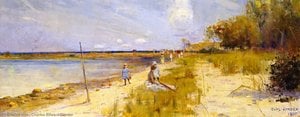
MIrage
Διαστάσεις Αναπαραγωγής
Charles Edward Conder's "Mirage," painted in 1889, isn’t merely a depiction of a landscape; it’s an invitation into a realm where reality subtly bends, inviting contemplation on the ephemeral nature of perception and the allure of the Australian outback. Born in Tottenham, London, Conder’s journey led him to Australia, where he became a pivotal figure within the Heidelberg School – a movement that championed a distinctly Australian artistic voice, rejecting European academic traditions in favor of capturing the light, color, and spirit of the continent.
The painting immediately draws the eye with its vibrant palette. Warm ochres dominate the foreground, punctuated by the cool blues and greens of distant trees and sky. Conder masterfully employs an Impressionistic technique, utilizing loose brushstrokes and broken colors to capture the shimmering heat haze that defines the Australian landscape. This isn’t a photographic representation; rather, it's a subjective experience translated onto canvas – a distillation of light, color, and atmosphere. The composition itself is deceptively simple: a woman holding a ball in her hand, positioned beside a solitary tree against a backdrop of rolling hills. Yet, within this apparent stillness lies a subtle dynamism, a sense of movement created by the play of light and shadow.
While superficially appearing as a charming pastoral scene, “Mirage” is rich in symbolic meaning. The woman holding the ball evokes a sense of carefree leisure – a quintessential image of Australian summer. It speaks to a time of relaxation, social gatherings, and the simple pleasures of life. However, the presence of the ball itself introduces an element of illusion. Balls are often associated with games, entertainment, and even fleeting moments of joy. In this context, it suggests that these experiences, like the mirage itself, can be deceptive – beautiful but ultimately transient.
The solitary tree further amplifies this theme. Trees represent resilience, strength, and connection to the earth. Yet, its isolation within the vast landscape hints at a sense of loneliness or detachment. The woman’s position beside it suggests a moment of quiet contemplation, perhaps questioning the nature of her own place in this world.
"Mirage" exemplifies the core tenets of the Heidelberg School – a group of Australian artists who sought to capture the unique character of their homeland. Unlike their European counterparts, they were deeply interested in portraying the light and color of the Australian landscape, often focusing on scenes of rural life and leisure. Conder’s work is characterized by its vibrant colors, loose brushstrokes, and emphasis on capturing the fleeting effects of light and atmosphere. His use of local pigments and his rejection of academic conventions firmly established him as a key figure in shaping Australian art.
Conder’s skill lies not just in depicting a scene, but in conveying its *feeling*. The painting isn't about literal accuracy; it’s about capturing the subjective experience of being immersed in the heat haze of the Australian outback. The shimmering quality of the landscape, the sense of distance and ambiguity, all contribute to a powerful emotional impact. “Mirage” invites us to question our perceptions, to appreciate the beauty of illusion, and to contemplate the transient nature of life itself. It remains a captivating testament to Conder’s artistic vision and his profound connection to the Australian landscape.

Charles Edward Conder (1868 – 1909) was an English-born painter, lithographer and designer who emigrated to Australia and became a pivotal figure in the Heidelberg School*, arguably marking the genesis of a distinctive Australian tradition within Western art. Born in Tottenham, Middlesex, the second son of six children, James Conder, civil engineer and Mary Ann Ayres, possessed a lineage steeped in artistic heritage – his father was Louis-François Roubiliac, renowned sculptor.
From a young age, Conder experienced profound influence from India, where he resided until his mother’s untimely passing in May 1873 at the tender age of 31. Subsequently, he returned to England and attended several schools including Eastbourne School, fostering an early inclination towards formal education.
Despite his father's preference for a career in engineering—a path antithetical to Conder’s innate artistic sensibilities—he pursued his passion relentlessly, recognizing it as a fundamental aspect of his identity.
In 1884, at the age of 16, Conder embarked on a transformative journey to Sydney, Australia, where he joined his uncle’s firm as a land surveyor. However, this profession proved unfulfilling compared to his burgeoning fascination with landscape painting—a pursuit that swiftly superseded his surveyor's duties.
By 1886, Conder secured employment at *Illustrated Sydney News*, collaborating alongside fellow artists such as Albert Henry Fullwood and Frank Mahony. He enrolled in painting classes under Alfred James Daplyn and quickly established connections with Julian Ashton, immersing himself in the vibrant artistic milieu of Melbourne.
Crucially, Conder’s association with G. P. Nerli—an itinerant Italian painter—significantly broadened his artistic horizons, introducing him to European stylistic innovations. This encounter profoundly shaped his creative trajectory.
Together with Tom Roberts and Arthur Streeton, Conder participated in the Heidelberg School exhibition of 1888, cementing his position as a cornerstone of this groundbreaking movement. The exhibition showcased a bold departure from academic conventions, prioritizing spontaneity and capturing the ephemeral beauty of the Australian bush.
Conder’s magnum opus, *Departure of the Orient – Circular Quay* (1888), exemplifies his mastery of form and brushwork. This evocative depiction of Sydney Harbour at dusk—the moment when the *has cast off for her voyage to England*—immediately garnered acclaim from the Art Gallery of New South Wales, securing its place as Conder’s inaugural work within a public collection.
Alongside Roberts, Conder captured the idyllic charm of Mentone (1888), portraying a serene seaside scene replete with leisurely figures enjoying the warmth of the Australian sun. The painting's composition—borrowed from Whistler’s celebrated bridge motif—underscores Conder’s sensitivity to artistic precedent.
Conder’s oeuvre encompasses a diverse range of subjects, including portraits and lithographs, reflecting his versatility as an artist. His paintings are characterized by luminous color palettes, textured brushstrokes, and a masterful rendering of light—elements that imbue his artworks with palpable emotion and immediacy.
Despite facing debilitating health challenges—including paralysis and delirium tremens—Conder persevered in his artistic endeavors until his untimely demise in 1909. His art gained considerable recognition upon returning to England, surpassing the acclaim he received during his Australian years.
Henri de Toulouse-Lautrec immortalized Conder’s likeness in a portrait completed in 1892—a testament to Conder's enduring presence within the artistic landscape of his time.

1868 - 1909 , Ηνωμένο Βασίλειο

Master the nuances of Impressionism vs. Post-Impressionism with our expert guide. Explore the revolutionary shift from Monet’s fleeting light to Van Gogh’s emotional depth. Discover how these iconic movements continue to inspire fine art collectors and modern interiors today.

 Δείτε σε πραγματικό χώρο
 Αποστολή
 Κοινοποίηση
 Λεπτομέρειες

 Λήψη
Λήψη
 Παρόμοια αντικείμενα συλλογής
 Ακτινογραφία
 Παρουσίαση


 Διαβάστε περισσότερα







 Η επιλογή με γυαλί είναι διαθέσιμη μόνο για μεγέθη κάτω από 110 εκ.