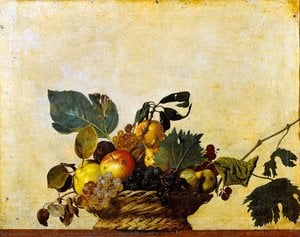
A Shadowed Genius: Exploring Caravaggio’s “Untitled (1574)”
Michelangelo Merisi da Caravaggio, a name that reverberates through the annals of Baroque art history, wasn't merely a painter; he was a revolutionary who fundamentally altered artistic conventions. Born in Milan in 1571 amidst the turbulent backdrop of plague and familial loss—experiences profoundly shaping his worldview—Caravaggio’s early life instilled within him an unwavering empathy for human suffering, a preoccupation that would become central to his oeuvre.
His formative training under Simone Peterzano, a former pupil of Titian, provided him with the foundational skills of Renaissance painting. However, Caravaggio swiftly rejected these established traditions, forging instead a path characterized by audacious experimentation and an uncompromising commitment to realism. This rebellious spirit found its ultimate expression in Rome around 1592, where he wrestled for recognition amidst fierce competition and endured considerable hardship—challenges that fueled his artistic drive.
The Dramatic Power of Chiaroscuro: Caravaggio’s Technique
Caravaggio's genius lay not just in depicting biblical narratives with visceral immediacy but also in mastering a technique known as tenebrism – dramatic chiaroscuro. Unlike the subtle gradations of light prevalent in earlier Renaissance art, Caravaggio employed stark contrasts between darkness and illumination, creating an unsettling yet profoundly captivating visual experience. This masterful manipulation of light wasn’t merely stylistic; it served to heighten emotional impact, drawing viewers into the scene and emphasizing key figures—particularly Jesus—amidst oppressive gloom.
Religious Iconography and Emotional Resonance
“Untitled (1574)” exemplifies Caravaggio's signature style perfectly. The depiction of Christ crucified embodies the core tenets of Baroque religious art: unflinching realism combined with intense emotional expression. The artist meticulously rendered every detail—the musculature of Jesus’s body, the texture of his garments—creating a portrait that transcends mere representation and aspires to evoke profound contemplation.
The inclusion of subtle symbolic elements – the book at the bottom left corner representing divine wisdom, and the vase atop the cross symbolizing resurrection – reinforces Caravaggio's thematic preoccupation with faith and redemption. The painting’s overall composition compels viewers to confront mortality and grapple with questions of spiritual significance.
Influence Beyond Rome
Caravaggio’s influence extended far beyond the confines of Rome, impacting artists across Europe—most notably Rubens and Rembrandt—who adopted his tenebristic style. His groundbreaking approach irrevocably altered the course of Baroque painting, establishing a precedent for dramatic lighting and psychological depth that continues to inspire artists today.
- Artist: Michelangelo Merisi da Caravaggio
- Born Year: 1571
- Death Year: 1610
- Birth City: Milan
- Birth Country: Spain
Ερωτήσεις και Απαντήσεις
Ποια απόχρωση κυριαρχεί στο "untitled (1574)";
Το "untitled (1574)" κυριαρχείται από μια Golden Yellow Range απόχρωση.
Ποιο χρώμα κυριαρχεί στο "untitled (1574)";
Το κυρίαρχο χρώμα του έργου "untitled (1574)" του Καραβάτζο είναι το Walnut (#734f38).
Ποια χρωματική αρμονία παρουσιάζει το "untitled (1574)" του Καραβάτζο;
Η χρωματική αρμονία του "untitled (1574)" περιγράφεται ως Strong Color Unity.



 Προεπισκόπηση σε πραγματική κλίμακα
 Μετάβαση σε Εκτυπώσεις
 Αποστολή
 Κοινοποίηση
 Λεπτομέρειες
 Οδηγός

 Λήψη
Λήψη
 Παρόμοια αντικείμενα συλλογής
 Ακτινογραφία
 Παρουσίαση
 Q&A
Q&A Στατιστικά
 Περισσότερα






































 Η επιλογή με γυαλί είναι διαθέσιμη μόνο για μεγέθη κάτω από 110 εκ.