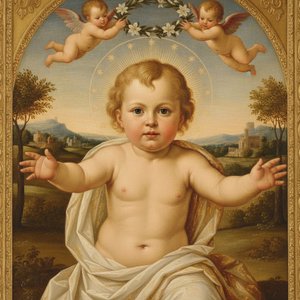
A Window into Renaissance Devotion
In the quiet intimacy of Andrea Mantegna’s 'Virgin and Child', painted around 1470, we encounter more than a mere religious icon; we step into a profound dialogue between the earthly and the divine. This masterpiece serves as a breathtaking embodiment of the humanist spirit that began to pulse through Renaissance Italy. Rather than presenting a flattened, symbolic arrangement common in earlier medieval art, Mantegna utilizes an unprecedented mastery of linear perspective to create a window of immense depth. The viewer is not merely observing a scene but is drawn into a sacred space where the architectural grandeur of Roman antiquity meets the tender vulnerability of maternal love. It is a work that commands attention through its structural brilliance and its ability to make the spiritual feel tangibly present.
The composition is a triumph of spatial illusion, reflecting Mantegna’s deep fascination with classical Roman principles. By meticulously calculating the recession of space, he mirrors the monumental feeling of ancient temples and theaters, elevating the figures of Mary and Jesus above the mundane. The Virgin Mary sits upon a throne that evokes the dignity of imperial iconography, her pose radiating an authority that is both regal and deeply compassionate. As she gazes down at the infant Christ, her expression carries a weight of contemplative melancholy, a subtle foreshadowing of the sacrifice to come. This emotional complexity is balanced by the peaceful slumber of the Child, whose innocence provides a serene counterpoint to the heavy historical significance surrounding him.
The Alchemy of Light and Symbolism
Mantegna’s technical prowess is most evident in his restrained yet luminous palette. Dominated by earthy, resonant hues such as ochre, umber, and terracotta, the painting possesses a somber beauty that feels grounded in the very soil of Italy. Through the meticulous layering of thin glazes over precise underdrawings, Mantegna achieved a surface of remarkable smoothness and light-catching luminosity. This technique allows for subtle gradations of color that breathe life into the fabric of Mary’s blue cloak—a hue traditionally used to symbolize purity and divinity—and the fine white cloth swaddling the Christ child. This white shroud, while representing innocence, also serves as a poignant symbolic link to the shroud of the crucifixion, adding a layer of theological depth to the visual narrative.
For the discerning collector or interior designer, this artwork offers an unparalleled sense of timelessness and gravitas. The soft, diffused lighting creates an atmosphere of quiet sanctuary, making it an ideal centerpiece for spaces designed for reflection, study, or sophisticated repose. The interplay between the dark, indistinct background and the highly detailed, realistic facial features ensures that the emotional core of the piece remains the focal point. To possess a reproduction of this work is to bring into one's environment a fragment of the Renaissance—a piece that celebrates the intersection of archaeological accuracy, technical innovation, and the enduring power of human emotion.



 Δείτε σε πραγματικό χώρο
 Αγορά χειροποίητου πίνακα
 Αποστολή
 Κοινοποίηση
 Λεπτομέρειες

 Λήψη
Λήψη
 Παρόμοια αντικείμενα συλλογής
 Ακτινογραφία
 Παρουσίαση
 Στατιστικά

 Διαβάστε περισσότερα






































 Η επιλογή με γυαλί είναι διαθέσιμη μόνο για μεγέθη κάτω από 110 εκ.