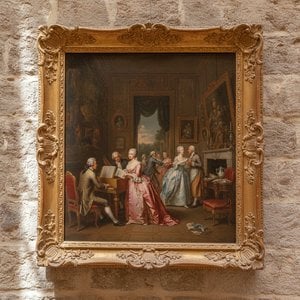
A Window into Dutch Life: Adriaen van Ostade’s “In a Tavern”
Adriaen van Ostade's "In a Tavern," painted in 1671, isn’t merely a depiction of a drinking establishment; it’s a remarkably astute and poignant observation of everyday life within the Dutch Golden Age. Far removed from idealized courtly scenes, this painting plunges us directly into the heart of a bustling tavern – a microcosm reflecting the social realities, struggles, and quiet joys of the working class. Ostade masterfully captures a scene brimming with activity, yet imbued with an underlying sense of melancholy and realism that distinguishes his work from many of his contemporaries.
The painting’s Baroque style, while evident in its dramatic lighting and dynamic composition, is tempered by a distinctly earthy quality. Unlike the polished surfaces favored by some of his peers, Ostade employs a rougher brushstroke, lending the scene an immediacy and sense of authenticity. The colors are muted – browns, ochres, and greys dominate – mirroring the humble surroundings and reflecting the lives of those depicted. This deliberate choice avoids romanticizing poverty; instead, it presents a truthful portrayal of a common setting.
The Scene Unfolds: Composition and Detail
A dense gathering occupies the tavern’s interior, arranged around a sturdy wooden table. Twelve figures are visible, a mix of men and women engaged in conversation, drinking, and perhaps even gambling – activities typical for the time. Ostade doesn't shy away from portraying the less flattering aspects of this social space: a dog sprawls near the bottom left corner, suggesting a lack of refinement, while several individuals appear weary or burdened. Yet, amidst these details, there’s an undeniable sense of camaraderie and shared experience.
The arrangement of furniture – multiple chairs, a bench, and two couches – contributes to the feeling of crowded intimacy. A simple bowl sits on the table, its contents obscured but hinting at sustenance or drink. The lighting, skillfully rendered with chiaroscuro (the dramatic contrast between light and dark), draws our attention to key figures and creates a sense of depth within the room. Notice how Ostade uses light to highlight faces in conversation, emphasizing their expressions and gestures.
A Reflection of Dutch Society
"In a Tavern" offers a valuable glimpse into 17th-century Dutch society. The tavern was more than just a place for drinking; it served as a vital social hub – a meeting point for laborers, merchants, travelers, and even the occasional criminal. Ostade’s painting captures this multifaceted role, revealing the complexities of daily life in a rapidly changing nation. It's important to note that taverns were often associated with moral ambiguity, representing a space outside the rigid structures of social order.
Considering the historical context, it’s fascinating to compare Ostade’s work with other depictions of tavern scenes from this period, such as those by David Teniers the Younger or Adriaen Brouwer. While all three artists explored similar themes, each brought a unique perspective and stylistic approach. Brouwer's paintings often emphasize the boisterousness and revelry of tavern life, while Teniers tends to focus on more idyllic scenes. Ostade’s work stands apart through its unflinching realism and subtle emotional depth.
Symbolism and Emotional Resonance
Beyond its realistic portrayal of a tavern scene, “In a Tavern” is rich in symbolic meaning. The weary faces, the simple furnishings, and the overall atmosphere evoke a sense of hardship and resilience – qualities that were prevalent among the Dutch working class. Ostade doesn’t offer easy answers or sentimental narratives; instead, he presents a raw and honest depiction of human existence.
The painting's enduring appeal lies in its ability to connect with viewers on an emotional level. It invites us to contemplate the lives of ordinary people, their struggles, and their moments of connection. “In a Tavern” is not simply a historical record; it’s a powerful testament to the human spirit – a reminder that even within the most humble circumstances, there can be beauty, warmth, and shared humanity.



 Δείτε σε πραγματικό χώρο
 Μετάβαση σε Εκτυπωση
 Αποστολή
 Κοινοποίηση
 Λεπτομέρειες

 Λήψη
Λήψη
 Παρόμοια αντικείμενα συλλογής
 Ακτινογραφία
 Παρουσίαση
 Στατιστικά


 Διαβάστε περισσότερα






































 Η επιλογή με γυαλί είναι διαθέσιμη μόνο για μεγέθη κάτω από 110 εκ.