early life and reign
Abdulhamid II, Ottoman sultan from 1876 to 1909, under whose autocratic rule the reform movement of Tanzimat (Reorganization) reached its climax and who adopted a policy of pan-Islamism in opposition to Western intervention in Ottoman affairs. He was deposed after the Young Turk Revolution.He was born in Constantinople (modern-day Istanbul) in 1842, the son of Tîr-î-Müjgan Kadınefendi, a Tscherkessin of the Schapsugen Stamm and Sultan Abdülmecid I. His mother died shortly after his birth, and he was subsequently raised by Perestû, the Sultan’s wife.
He received an extensive education in Arabic, Persian, Islamic theology and Ottoman history, fostering a lifelong appreciation for classical European music and opera.
His ascension to the throne followed a coup d'état against Abdülaziz in August 1876 orchestrated by a coalition of high officials, officers, and religious scholars led by Midhat Pascha. Initially, Murad V was appointed as Sultan, but he abdicated after just three months due to mental incapacity.
Abdülhamid II swiftly rejected the constitutional settlement proposed by Midhat Pascha and reinstated autocratic rule, employing a sophisticated system of secret police and censorship.
The Young Turk Revolution in 1908 ultimately ended his reign, marking the culmination of decades of resistance to Western influence and signaling the decline of Ottoman power.
artistic patronage
Abdulhamid II possessed a profound passion for art and actively championed artists of his era. Notably, he commissioned Fausto Zonaro, an Italian realist painter, to depict Mehmed II entering Constantinople through Adrianople Gate (https://WahooArt.com/@@/9dgsbp). This monumental painting not only showcased Zonaro’s artistic prowess but also served as a deliberate effort to commemorate Ottoman history.Jean Baptiste vanmour's masterpiece, “The Reis Effendi,” Head of the Chancery (https://WahooArt.com/@@/d377ml), exemplifies vanmour’s ability to capture the grandeur and intricacies of Ottoman bureaucracy.
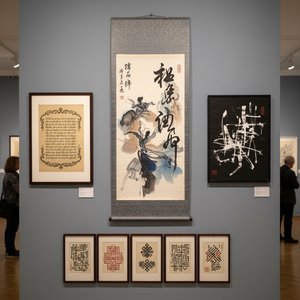
Abu al-thanā’ shihāb ad-dīn sayyid maḥmūd ibn ‘abd allāh al-ḥusaynī al-ālūsī al-baghdādī entrusted Hüseyin Zekai Pasha with creating “Levha,” a calligraphic inscription (https://WahooArt.com/@@/d4k4fb), reflecting the Sultan’s admiration for Islamic calligraphy.
Furthermore, Hüseyin Zekai Pasha's “Still Life with Roses” (https://WahooArt.com/@@/d4k6g2) stands as a testament to the burgeoning artistic landscape of the Ottoman Empire during Abdülhamid II’s reign.
The Sakıp Sabancı Museum (https://WahooArt.com), housing an impressive collection of artworks commissioned by Abdülhamid II, serves as a lasting symbol of his contribution to Ottoman art and culture.
artistic influences and notable works
Abdulhamid II’s court attracted artists from diverse backgrounds, fostering a vibrant artistic environment.The monumental painting “Mehmed II enters Constantinople through Adrianople Gate” by Fausto Zonaro is considered one of the most important artworks of his reign.
Jean Baptiste vanmour's depiction of Ottoman chancery ("The Reis Effendi") skillfully portrays the administrative complexities of the empire.
Abu al-thanā’ shihāb ad-dīn sayyid maḥmūd ibn ‘abd allāh al-ḥusaynī al-ālūsī al-baghdādī collaborated with Hüseyin Zekai Pasha on “Levha,” a stunning example of Islamic calligraphy.
Hüseyin Zekai Pasha’s “Still Life with Roses” exemplifies the stylistic trends prevalent during Abdülhamid II's rule, showcasing Ottoman artistic sensibilities.
historical significance
Abdulhamid II’s reign witnessed significant transformations within the Ottoman Empire, marked by both triumphs and tribulations.His commitment to Tanzimat—a series of reforms aimed at modernizing Ottoman institutions—represented a crucial step toward addressing challenges posed by Western powers.
However, his autocratic governance and suppression of dissent ultimately contributed to the empire’s decline and eventual dissolution.
Despite these complexities, Abdülhamid II remains an iconic figure in Ottoman history, remembered for his patronage of the arts and his unwavering defense of Islamic traditions. His legacy continues to inspire scholarly debate and artistic interpretation. ## Further Information
Fragen & Antworten
Woher kommt Abdülhamid Ii.?
Abdülhamid Ii. wurde in Türkei geboren.
Wo finde ich Statistiken zu den Werken von Abdülhamid Ii.?
Statistiken zu den Werken von Abdülhamid Ii. finden Sie auf der Statistiken-Seite des Künstlers.
Gibt es eine Zeitachse der Werke von Abdülhamid Ii.?
Die Zeitstrahl der Kunstwerke-Seite des Künstlers präsentiert die Werke von Abdülhamid Ii., chronologisch nach Jahren geordnet.