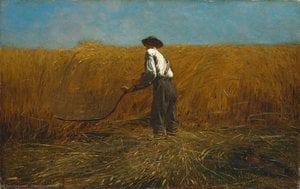
A Portrait of Resilience: The Soul of the American Landscape
In the quiet, sun-drenched aftermath of a harvest, Winslow Homer’s "The Gleaners" invites viewers into a profound moment of American history. Painted in 1867, this evocative work serves as more than just a depiction of rural labor; it is a poignant tableau of life during the Reconstruction era. As the nation grappled with the immense social and economic upheavals following the Civil War, Homer turned his gaze toward the enduring spirit of the people. The painting captures three elderly women meticulously gathering leftover grains from a harvested field, their movements steady and purposeful. Through this simple act of gleaning, Homer explores themes of perseverance and dignity amidst hardship, presenting a narrative that resonates with anyone who has found strength in the face of adversity.
The technical mastery behind this piece is nothing short of extraordinary, making it a captivating subject for collectors and those looking to bring depth to a curated interior. Homer’s style is rooted in an understated realism, yet it is infused with an expressive brushstroke that breathes life into the canvas. He employs a muted, sophisticated palette dominated by earthy ochres, deep browns, and soft greens, eschewing dramatic lighting in favor of capturing the raw textures of weathered skin and coarse clothing. A secret to the painting's luminous quality lies in Homer’s technique: his masterful use of watercolor underpainting provides a hidden depth that allows the oil paint layers to glow from within, creating an illusionistic effect that draws the eye deep into the golden fields.
Symbolism and the Weight of History
Beyond its surface beauty, "The Gleaners" is rich with symbolic imagery that speaks to the very heart of the American identity. The figures themselves act as powerful symbols of faith and resilience—the ones left behind after the primary harvest is complete, yet still finding sustenance through diligent toil. This sense of quiet determination is mirrored in the surrounding landscape; the presence of horses suggests a lingering strength and productivity, while scattered farm tools like scythes and plows serve as somber reminders of the arduous realities of rural existence. For an interior designer, this painting offers a layer of intellectual and emotional complexity, providing a focal point that anchors a room with a sense of history and groundedness.
To possess a reproduction of such a masterpiece is to invite a piece of the American spirit into one's home. The emotional impact of the work lies in its ability to balance vulnerability with unwavering strength. It does not romanticize poverty, but rather celebrates the quiet dignity found in the cycle of nature and human labor. Whether displayed in a sunlit gallery or as a centerpiece in a sophisticated living space, "The Gleaners" continues to inspire awe, reminding us that even in the most challenging seasons of life, there is beauty to be found in the persistence of the human spirit.



 In echtem Maßstab anzeigen
 Handgemalte Reproduktion kaufen
 Versenden als Grußkarte
 Teilen
 Details anzeigen
 Leitfaden

 Herunterladen
 Ähnliche Objekte
 Röntgenaufnahme
 Diashow
 Besucherstatistiken

 Mehr anzeigen






































 Die Glasoption ist nur für Größen unter 110 cm verfügbar.