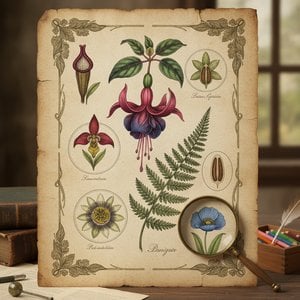
A Tapestry of History: The Intricate Legacy of William Morris
In the delicate interplay of flora and geometry, Design for stands as a profound testament to the visionary genius of William Morris. Created in 1876, this exquisite piece is far more than a mere decorative pattern; it is a bridge between the artisanal traditions of the past and the burgeoning aesthetic movements of the nineteenth century. The work captures a moment where nature and craftsmanship converge, offering a rhythmic dance of leaves and blossoms that seems to breathe with an organic vitality. For the discerning collector or interior designer, this piece serves as a window into the soul of the Arts and Crafts movement, embodying a period when beauty was viewed as a fundamental necessity for the human spirit.
The origins of this design are rooted in a deep reverence for historical craftsmanship. Morris drew his inspiration from two seventeenth-century Italian lacis work panels, which had been acquired by the South Kensington Museum. This technique, involving handmade net onto which intricate designs are darned, provided the structural blueprint for Morris’s botanical arrangement. By translating the delicate, lace-like textures of lacis into a broader design language, he achieved a sense of layered depth. The composition features flowers positioned at varying distances, creating a sophisticated illusion of foreground and background that draws the eye through a lush, verdant labyrinth.
Symbolism and the Natural Order
At its heart, this work reflects Morris’s lifelong devotion to the English countryside and his belief in the moral superiority of natural beauty over industrial mechanization. Every leaf and petal is rendered with an intentionality that suggests a deeper cosmic order. The way the foliage intertwines and overlaps symbolizes the interconnectedness of all living things—a theme that resonates deeply with those who seek to bring the tranquility of the outdoors into their living spaces. There is a romanticism here, a nod to medieval chivalry and the pastoral idylls of his youth, which imbues the pattern with a sense of timelessness and grace.
For those looking to curate an environment of sophistication and warmth, this design offers unparalleled versatility. Whether integrated into a grand period room or used as a focal point in a contemporary minimalist setting, the piece commands attention through its subtle complexity. The monochrome essence of the original study highlights the masterful use of line and negative space, making it an ideal inspiration for high-quality reproductions that aim to capture the true essence of Morris’s hand. To possess such a design is to hold a fragment of history, a piece of art that continues to whisper the secrets of a more beautiful, handcrafted age.
Fragen & Antworten
Wo finde ich einen Leitfaden zu „Design for“?
Der Leitfaden zu „Design for“ ist die Leitfaden-Seite des Kunstwerks – ein druckbares Infoblatt, das das Kunstwerk mit seiner Bildunterschrift, dem Urhebervermerk und einer Identifikationstabelle (Künstler, Daten, Medium, Originalgröße, Sammlung) zeigt.
Wer ist der Urheber von "Design for" und welcher Stilrichtung ist das Werk zuzuordnen?
"Design for" wurde von William Morris im Stil der Arts and Crafts geschaffen. Künstler und Epoche bestimmen die Tradition des Werkes.
Warum ist der Urheberrechtsstatus von "Design for" so, wie er ist?
"Design for" von William Morris ist gemeinfrei – das Urheberrecht ist abgelaufen. Die Urheberrechtsfristen werden ab dem Todesjahr des Künstlers berechnet, und William Morris verstarb im Jahr 1896.
Unter welchen anderen Namen ist William Morris bekannt?
William Morris ist auch unter dem Namen Wilhelm Markus bekannt.
Darf "Design for" von William Morris, das sich im William Morris Galerie befindet, rechtmäßig reproduziert werden?
"Design for" von William Morris, aufbewahrt im William Morris Galerie, ist gemeinfrei – das Urheberrecht ist abgelaufen. Dieser Status bestimmt, ob Reproduktionen des Bildes angefertigt werden dürfen.
Welche Farbharmonie weist "Design for" von William Morris auf?
Die Farben von "Design for" von William Morris zeigen eine Unified Palette Harmonie. Harmonie beschreibt, wie die Farben zueinander in Beziehung stehen.
An welcher Stelle innerhalb des Gesamtwerks von William Morris lässt sich "Design for" einordnen?
Innerhalb des Œuvres von William Morris steht „Design for“ im Stil der Arts and Crafts, geprägt von den Themen italian lacis work, seventeenth-century design, nature and medievalism, arts and crafts movement, decorative pattern design.
Worum geht es in "Design for"?
Die in "Design for" von William Morris enthaltenen Themen umfassen floral design, nature, botanical, pattern, leaves, lacis work, ornamental. Zusammen fassen sie den Gegenstand des Kunstwerks zusammen.



 In echtem Maßstab anzeigen
 Zum Druck wechseln
 Versenden als Grußkarte
 Teilen
 Details anzeigen
 Leitfaden öffnen

 Herunterladen
 Ähnliche Objekte
 Röntgenaufnahme
 Diashow
 Besucherstatistiken


 Mehr anzeigen






































 Die Glasoption ist nur für Größen unter 110 cm verfügbar.