


 CeramicsArts and Crafts
 1897
1897 46.0 x 15.0 cm
 Los Angeles County Museum of Art
Erwerben Sie ein hochauflösendes, optimiertes digitales Bild, das der Online-Vorschau weit überlegen ist.
Jede Datei wird von unseren hauseigenen Spezialisten mit modernsten Werkzeugen und fachmännischer manueller Retusche sorgfältig vorbereitet. Wir stellen sicher, dass jedes Bild eine außergewöhnliche Klarheit, präzise Farbgenauigkeit und feinste Details aufweist.
Die endgültige Datei wird innerhalb von 72 Stunden per E-Mail zugestellt und ist für den sofortigen Einsatz in professionellen, redaktionellen und Druckumgebungen optimiert. Es handelt sich um dieselbe Qualität, der führende Designstudios, Verlage und Galerien vertrauen.
Laden Sie eine hochauflösende Datei für die persönliche Präsentation, den Druck und kreative Projekte herunter. ( Druck bestellen Handgemalte Reproduktion bestellen)
Wenn Sie sich für WahooArt.com entscheiden, erhalten Sie nicht nur ein Bild – Sie erhalten ein professionell aufbereitetes digitales Kunstwerk, das mit höchster Präzision erstellt und durch eine Zufriedenheitsgarantie abgesichert wird. Hier ist alles, was automatisch mit Ihrer Bestellung geliefert wird:

Ihre hochauflösende digitale Bilddatei wird Ihnen innerhalb von 72 Stunden nach der Bestellung per E-Mail zugestellt – bereit zur sofortigen Verwendung.

Ihre Kunstwerke werden professionell mithilfe fortschrittlicher KI-Tools und manueller Bearbeitung optimiert, um maximale Detailtreue, Klarheit und Farbgenauigkeit zu gewährleisten.

Datei versehentlich gelöscht oder verloren? Keine Sorge – wir senden sie Ihnen jederzeit kostenlos erneut zu.

Genießen Sie Ihr Kunstwerk sofort ohne Zollgebühren, Einfuhrabgaben oder Versandkosten – digitale Downloads sind immer steuerfrei.

Wir garantieren, dass Ihr digitales Bild mithilfe professioneller Werkzeuge und Farbmanagement die Originalfarben so präzise wie möglich wiedergibt.

Wenn Sie mit Ihrem digitalen Bild nicht zufrieden sind, werden wir es überarbeiten oder 100% innerhalb von 100 Tagen erstatten – ohne Wenn und Aber.

Nicht zufrieden? Erhalten Sie innerhalb von 100 Tagen nach Erhalt Ihrer digitalen Datei eine vollständige Rückerstattung – ohne Wenn und Aber.

3 Bilder kaufen, 10% sparen – 5 Bilder kaufen, 15% sparen – Ab 10 Bildern 20% sparen. Ideal für kreative Projekte, Galerien und Agenturen.
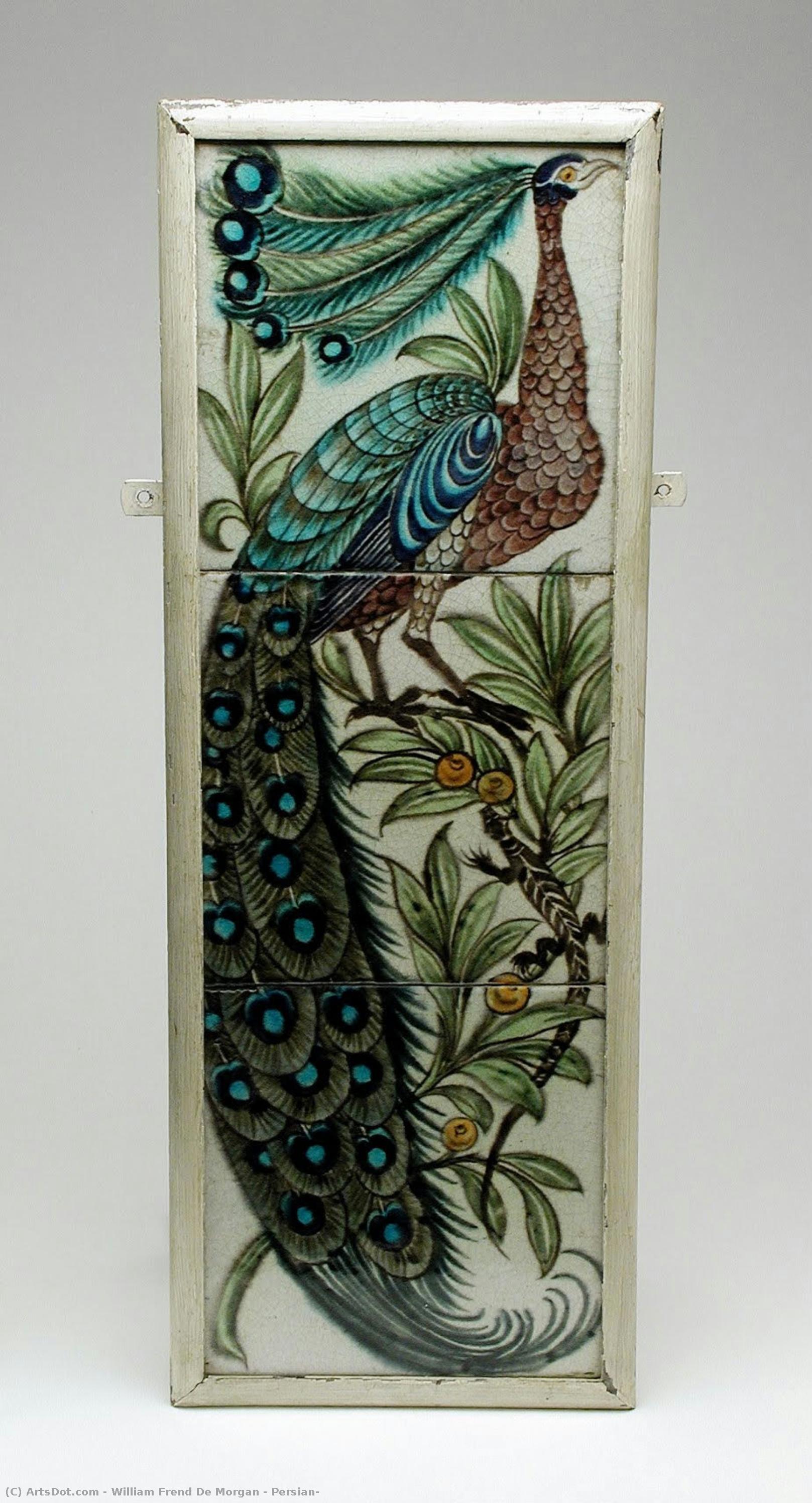
Within the rich tapestry of 19th-century decorative arts, few pieces possess the captivating blend of artistry and exoticism as William Frend De Morgan’s “Persian” tile panel. Created in 1888-1897 during his prolific period at Merton Abbey, this work transcends mere ornamentation; it's a portal to a reimagined East, infused with Victorian sensibilities and a profound understanding of ancient artistic traditions. More than just a decorative object, it’s a testament to De Morgan’s innovative spirit and his ability to synthesize diverse influences into a singularly beautiful whole.
The panel immediately draws the eye with its vibrant palette – deep blues reminiscent of Persian Iznik ware, punctuated by turquoise highlights, manganese purples hinting at ancient dyes, and the warm glow of Indian red. These colors aren’t simply applied; they are meticulously layered to create a luminous depth that seems to shift and shimmer in the light. The intricate design is dominated by stylized peacocks, their tails spread in an explosion of feathers, each feather rendered with painstaking detail. Surrounding these majestic birds are delicate floral motifs – lotus blossoms, irises, and stylized leaves – all arranged within a complex geometric framework. This combination of natural forms and structured patterns speaks to De Morgan’s fascination with both the organic beauty of nature and the order inherent in ancient civilizations.
De Morgan's “Persian” panel is a product of its time, deeply rooted in the artistic currents of the late Victorian era. The Arts and Crafts movement, with its emphasis on handcrafted quality and rejection of mass-produced goods, provided the intellectual framework for his work. However, De Morgan’s inspiration extended far beyond England; he was profoundly influenced by the art and architecture of the Islamic world, particularly the exquisite ceramics of Persia (modern-day Iran). He meticulously studied examples of Iznik tiles – renowned for their vibrant colors and intricate designs – recognizing their potential to create a similar effect on English earthenware.
This fascination with the East wasn’t merely aesthetic; it reflected a broader cultural shift. The Victorian era witnessed a growing interest in Orientalism—a Western fascination with, and often romanticized depiction of, Eastern cultures. De Morgan skillfully navigated this trend, avoiding simplistic stereotypes and instead creating a nuanced representation that celebrated the beauty and sophistication of Persian art while firmly grounding it within his own artistic vision.
The creation of “Persian” involved a complex and demanding process. De Morgan’s studio employed a combination of traditional and innovative techniques. The tiles themselves were typically made from biscuit-fired earthenware, providing a sturdy base for the intricate decoration. The lustrous glaze—the hallmark of this piece—was achieved through a painstaking layering of colored oxides applied to the wet clay before firing. This process required immense skill and control, as even slight variations in temperature or humidity could dramatically affect the final result.
The use of multiple layers of color created an almost three-dimensional effect, with the colors seeming to float above the surface of the tile. The intricate detailing—the feathers of the peacocks, the delicate petals of the flowers—was achieved through a combination of hand-painting and stenciling. De Morgan’s assistants played a crucial role in this process, meticulously applying the pigments and ensuring that each element of the design was executed with precision.
William Frend De Morgan’s “Persian” tile panel stands as a remarkable achievement—a testament to his artistic vision, technical skill, and deep understanding of art history. It embodies the spirit of the Arts and Crafts movement while simultaneously celebrating the beauty and sophistication of Persian art. Today, reproductions of this iconic piece continue to captivate audiences with their vibrant colors, intricate designs, and evocative symbolism. It remains a powerful reminder of the enduring legacy of Victorian decorative arts and the transformative power of artistic inspiration.


1839 - 1917 , Vereinigtes Königreich

 Versenden
 Teilen
 Details anzeigen

 Herunterladen
 Ähnliche Objekte
 Diashow
 Weiterlesen


![Vida De Miguel De Cervantes Saavedra (leben Von Miguel De Cervantes Saavedra). Buch V Der Ausgabe Von Don Quijote (biblioteca Nacional De España) [7] — Martín Fernández De Navarrete, Akademische Kunst](/media/artworks/images-thumb/8c/b6/8cb67a4dd450447373a546c8dd039e57.jpg)


