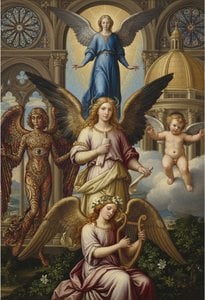
William Blake’s “The Ecstasy” – A Visionary Exploration of Spiritual Transformation
“The Ecstasy,” painted by William Blake in 1822, stands as an emblem of Romantic idealism and a testament to the artist's unparalleled ability to translate inner experience into visual form. More than just a depiction of biblical narrative—the crucifixion of Jesus Christ—it’s a profound meditation on divine love, spiritual ascension, and the transformative power of imagination itself.
- Subject Matter: The painting portrays Jesus Christ ascending towards heaven, accompanied by angels and symbolic figures representing humanity's yearning for transcendence. Blake meticulously captures the moment of divine grace as Jesus emerges from the tomb, bathed in radiant light.
- Style: Blake’s style is characterized by its otherworldly beauty and expressive dynamism—a hallmark of Romantic art. He eschewed academic conventions, prioritizing emotional intensity over realistic representation. The composition is deliberately asymmetrical, creating a sense of movement and conveying the spiritual fervor of the scene.
- Technique: Blake employed encaustic painting—a technique combining beeswax resin, pigment, and oil—to achieve remarkable luminosity and textural depth. This method allowed him to capture subtle nuances of color and form, imbuing the artwork with an ethereal quality that transcends mere visual perception.
Historical Context – The Romantic Spirit Unleashed
Blake’s “The Ecstasy” emerged during a period of fervent intellectual and artistic ferment—the Romantic Age. Influenced by thinkers like Rousseau and Coleridge, Blake championed the primacy of feeling over reason, advocating for an embrace of imagination as a conduit to spiritual truth. The painting reflects the broader cultural preoccupation with themes of divine revelation, moral regeneration, and the sublime experience of confronting the infinite.
Symbolism – Layers of Meaning Beyond the Visible
Blake’s artwork is replete with symbolic imagery—each element contributing to a complex tapestry of meaning. The radiant light emanating from Jesus symbolizes divine illumination and spiritual enlightenment, while the angels represent messengers of God and guardians of virtue. The figures surrounding Jesus embody humanity's aspiration for holiness and communion with the divine.
Emotional Impact – A Journey Towards Transcendence
"The Ecstasy" compels viewers to contemplate profound questions about faith, morality, and the human condition. Its luminous palette and dynamic composition evoke a sense of awe and wonder—drawing us into a realm beyond ordinary sensory experience. Blake’s masterpiece serves as an enduring reminder that true beauty resides not merely in outward appearance but also in the inner landscape of consciousness—a place where imagination reigns supreme and spiritual transformation becomes possible.
- Interior Designers Note: Consider incorporating shades of gold, ivory, and azure to capture the ethereal glow of Blake’s masterpiece. Placing a high-quality reproduction within a serene space can inspire contemplation and foster a connection with timeless artistic ideals.



 Vorschau anzeigen
 Zu Druck wechseln
 Versenden
 Teilen
 Details anzeigen

 Herunterladen
 Ähnliche Objekte
 Röntgenaufnahme
 Diashow
 Statistiken
 Weiterlesen






































 Die Glasoption ist nur für Größen unter 110 cm verfügbar.