x
Vorschau anzeigenVorschau anzeigen In AR erlebenIn AR erleben Handgemalte Reproduktion bestellen Handgemalte Reproduktion bestellenBild kaufen Bild kaufen VersendenVersenden
Details anzeigenDetails anzeigen Zu Favoriten hinzufügen Zu Favoriten hinzufügen HerunterladenHerunterladen Ähnliche ObjekteÄhnliche Objekte RöntgenaufnahmeRöntgenaufnahme DiashowDiashow

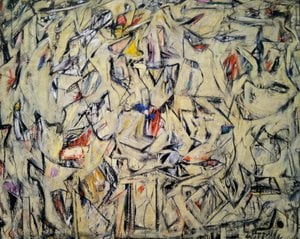
Whose Name Was Writ in Water

Willem de Kooning's 'Whose Name Was Writ in Water,' an explosive abstract expressionist painting from 1975, showcases a dynamic blend of red, blue, and green with the artist’s name subtly integrated. Explore this powerful work by a pivotal figure in American art history and bring its raw emotion into your space.

Erkunden Sie die mutige Welt von Willem de Kooning (1904-1997), einem Pionier des abstrakten Expressionismus. Entdecken Sie seine ikonischen Gemälde wie 'Frau I', bekannt für dynamische Pinselstriche, Figuration und emotionale Intensität. Eine Schlüsselperson der New Yorker Schule.

Giclée / Kunstdruck

Giclée- oder Leinwanddruck in Museumsqualität mit schneller Produktion und flexiblen Veredelungsoptionen. (Handgemalte Reproduktion bestellen Handgemalte Reproduktion bestellenBild kaufen Bild kaufen)

P118B $10
P118H $10
P118W $10
P438Z $10
P508JH $12
P508YH $12
P805H $10
P805Z $10
P919BZ $10
P919G $10
P919XJ $10
P959ZH $10
P968JZ $12
W106C $8
W218G $10
W218JH $8
W218Y $10
W307PJ $10
W316G $10
W316PJ $8
W316Y $10
W398PJ $8
W4111J $10
W500HY $15
W500JH $15
W692G $12
W849H $8
W940BG $15
W953PJ $8

Standardformat
individuell anpassbar
CM
INCH

Wählen Sie aus unseren vordefinierten Formaten, die den ursprünglichen Proportionen des Kunstwerks entsprechen.

Breite
Höhe

Sie können Ihre eigenen Maße eingeben, um ein bestimmtes Format oder einen speziellen Platz einzupassen. Wenn das von Ihnen gewählte Format nicht den Proportionen des Originalbildes entspricht, werden wir das Kunstwerk entweder beschneiden oder das Bild mit einem gespiegelten oder einfarbigen Rand erweitern. Ein digitaler Entwurf wird Ihnen zur Genehmigung zugesandt, bevor die Produktion beginnt.
Bitte beachten Sie, dass die Vorschau auf dem Bildschirm nicht den tatsächlichen Zuschnitt oder die Erweiterung widerspiegelt. Nur der Entwurf zeigt die endgültige Komposition präzise an.
Obwohl Sondermaße verfügbar sind, empfehlen wir die Auswahl eines Maßes aus der vordefinierten Liste, um die ursprünglichen Proportionen zu bewahren.

Weltweiter Versand () innerhalb von 2 Wochen statt der üblichen 4/5 Wochen. (6 September)

why_choose_icon
Kostenloser weltweiter Expressversand
why_choose_icon
Hochwertige Leinenleinwand
why_choose_icon
Umfassender Versicherungsschutz beim Versand
why_choose_icon
Zollgebühren-Rückerstattungsgarantie
why_choose_icon
Garantie für exakte Farbtreue
why_choose_icon
60 Tage Rückgaberecht (nur bei Mängeln)
why_choose_icon
100% Geld-zurück-Garantie
why_choose_icon
Mengenrabatt verfügbar

Gesamtpreis

$ 68

reproduction

Whose Name Was Writ in Water

Giclée / Kunstdruck

Format der Reproduktion

-

Gesamtpreis

$ 68

Eckdaten

  • Subject or theme: Abstraction
  • Artist: Willem de Kooning
  • Title: Whose Name Was Writ
  • Influences: De Kooning
  • Year: 1975
  • Notable elements: Water, brushstrokes

Whose Name Was Writ in Water: A Testament to De Kooning’s Raw Emotion

Willem de Kooning's "Whose Name Was Writ in Water," painted in 1975, is a powerfully evocative work that encapsulates the core tenets of Abstract Expressionism – a movement he helped define. This close-up view reveals not just paint on canvas, but a visceral outpouring of emotion and a deliberate disruption of traditional artistic representation. The painting’s dynamism stems from de Kooning's masterful manipulation of color and texture, creating a surface that seems to writhe with energy. Dominating the composition are bold strokes of red and blue, interwoven with strategic accents of green, yellow, and white – colors he frequently employed to convey intense psychological states. The title itself, “Whose Name Was Writ in Water,” adds another layer of complexity, hinting at themes of memory, loss, and perhaps even the elusive nature of identity.

A Masterclass in Technique: De Kooning’s Brushstroke

De Kooning's technique is immediately apparent in this piece. The application of paint is anything but smooth; it’s deliberately rough, fragmented, and layered. Thick impasto – built-up areas of heavy paint – creates a tactile surface that demands attention. He employed a vigorous, almost violent brushstroke, often applying the paint with a palette knife as much as with his brushes. This technique wasn't simply about creating an image; it was about imbuing the canvas with feeling. The visible brushstrokes aren’t accidental; they are deliberate marks of energy and struggle, reflecting de Kooning’s own turbulent emotional landscape. The close-up view allows us to appreciate the sheer physicality of his process – a testament to his commitment to expressive abstraction.

Historical Context: De Kooning and the Abstract Expressionists

"Whose Name Was Writ in Water" was created during a pivotal moment in art history, roughly halfway through de Kooning’s career. Following his early figurative work, particularly his iconic "Woman" series, he increasingly embraced abstraction, though always retaining a raw, almost confrontational quality. This painting reflects the broader trends of Abstract Expressionism – a movement born out of the anxieties and uncertainties of post-World War II America. Artists like de Kooning sought to express fundamental human emotions through non-representational forms, rejecting traditional notions of beauty and harmony. De Kooning’s work stands as a crucial bridge between his earlier explorations of figuration and his later, more purely abstract endeavors, showcasing the evolution of one of art's most influential figures.

Symbolism and Emotional Impact

The title itself is laden with potential symbolism. "Writ in Water" suggests something fleeting, ephemeral – perhaps a memory fading away or an attempt to capture a moment that’s inherently unstable. The dominant colors—red for passion and violence, blue for melancholy and introspection—contribute to the painting's overall mood of unease and intensity. Ultimately, “Whose Name Was Writ in Water” is not about literal representation; it’s about conveying an emotional state – a feeling of disorientation, struggle, and perhaps even a desperate search for meaning. It invites viewers to confront their own anxieties and grapple with the complexities of human experience.


Über den Künstler

frühes Leben und Karriere

Willem de Kooning, ein renommierter niederländisch-amerikanischer abstrakter Expressionist, wurde am 24. April 1904 in Rotterdam, Niederlande, geboren. Seine Eltern, Leendert de Kooning und Cornelia Nobel, trennten sich 1907, und Willem de Kooning lebte zunächst mit seinem Vater, bevor er in die Obhut seiner Mutter überging. Er verließ die Schule 1916 und arbeitete als Lehrling in einer Werbeagentur.

Künstlerische Entwicklung

De Kooning besuchte von 1916 bis 1924 Abendkurse an der Akademie für Bildende Künste und Technische Wissenschaften in Rotterdam. Im Jahr 1927 zog er nach New York City, wo er als Hausmaler arbeitete und seinen einzigartigen künstlerischen Stil entwickelte.

Abstrakter Expressionismus

De Koonings Werk verschob sich in den späten 1950er Jahren hin zum abstrakten Expressionismus, der durch kräftige Pinselstriche und leuchtende Farben gekennzeichnet ist. Sein Gemälde Woman I (1950-1952) ist ein wegweisendes Werk dieser Bewegung, das Figuration mit Spontaneität und emotionaler Intensität verbindet.

Bekannte Werke und Sammlungen

* The Glazier (137 x 112 cm, Öl auf Leinwand): Ein düsteres, erdtoniges Gemälde, inspiriert von den Fresken von Boscoreale. * Door to the River (Abstrakter Expressionismus): Ein breitschichtiges Gemälde, das an seine Tätigkeit als Hausmaler erinnert. * Standing Man (Abstrakter Expressionismus): Ein charakteristisches Beispiel für De Koonings abstrakten Expressionismus.

Museen und Sammlungen

* Museum Boijmans van Beuningen, Rotterdam, Niederlande: Bietet eine beeindruckende Sammlung von über 151.000 Kunstwerken. * Universitätsbibliothek Leiden, Niederlande: Ein bedeutendes Kulturzentrum mit über 5.200.000 Büchern und 1.000.000 E-Books. Willem de Koonings Vermächtnis inspiriert weiterhin Künstler und Kunstliebhaber gleichermaßen und festigt seinen Platz als Pionier des abstrakten Expressionismus.
Willem de Kooning

Willem de Kooning

1904 - 1997 , Niederlande

Kurzinfos

  • Beeinflusste Künstler: ['Arshile Gorky']
  • Bemerkenswerte Werke:
    • Frau I
    • The Glazier
    • Excavation
  • Geburtsdatum: 24. April 1904
  • Geburtsort: Rotterdam, Niederlande
  • Künstlerische Bewegung: Abstrakter Expressionismus
  • Nationalität: Niederländisch-Amerikanisch
  • Todatum: 1997
  • Vollständiger Name: Willem de Kooning
Entdecken Sie Kunstwerke, die nach Themen, Stilen und Merkmalen sortiert sind.