Willem de Kooning’s “Composition”: A Dance of Color and Raw Emotion
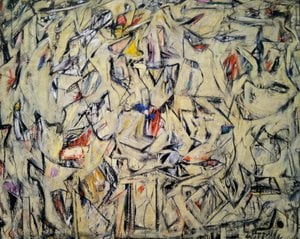
Willem de Kooning's "Composition" isn't merely a painting; it’s an embodiment of the turbulent spirit that defined Abstract Expressionism. Created in the aftermath of World War II, this work stands as a powerful testament to the movement’s rejection of traditional representation and its embrace of subjective experience. De Kooning, a Dutch-American artist born in Rotterdam in 1904, arrived in New York with a restless energy that found its most potent expression through his brushstrokes – strokes that seem to vibrate with an almost palpable urgency. The painting immediately draws the eye with its dominant palette: a fiery blend of reds and yellows, punctuated by strategic accents of blue. These colors aren’t simply decorative; they are instruments of emotional intensity, suggesting both passion and underlying tension.
Geometric Fragments and Expressive Gestures
Despite the overall abstraction, “Composition” is far from chaotic. De Kooning meticulously employs geometric forms – squares, rectangles, and blocks – which are scattered across the canvas like fragments of a shattered landscape. However, these shapes aren’t rendered with precision; instead, they possess an inherent instability, as if caught in a perpetual state of flux. This deliberate imperfection is crucial to understanding de Kooning's technique. He utilized a dynamic brushstroke, applying paint with broad, sweeping gestures that reveal the physicality of his process. The texture itself becomes a significant element – thick impasto layers build up on the surface, creating a palpable sense of depth and movement. It’s as if we are witnessing the artist wrestling with the canvas, pouring his emotions directly onto its surface.
A Window into Abstract Expressionism
“Composition” is inextricably linked to the broader context of Abstract Expressionism, an art movement that fundamentally shifted the landscape of 20th-century art. Emerging in the United States following World War II, this movement sought to move beyond objective representation and delve into the realm of pure emotion and subjective experience. Artists like Jackson Pollock and Mark Rothko were key figures, each developing their own unique approaches to capturing the inner turmoil and anxieties of the post-war era. De Kooning’s work, however, possesses a particularly raw and confrontational quality – a sense of struggle that distinguishes it from some of his contemporaries. The influence of this movement extends far beyond its immediate participants, paving the way for subsequent artistic developments such as Pop Art and Minimalism by challenging established conventions and prioritizing individual expression.
Symbolism and Emotional Resonance
While de Kooning deliberately avoided overt symbolism, “Composition” invites interpretation on a deeply emotional level. The aggressive reds and yellows can be seen as representing anger, passion, or even violence – echoes of the wartime experiences that shaped his generation. The fragmented geometric forms might symbolize brokenness, uncertainty, or the disintegration of traditional values. Yet, amidst this apparent chaos, there’s also a sense of dynamism and vitality. The painting isn't simply depicting despair; it’s capturing a moment of intense creative struggle – a battle between order and disorder, control and release. The blue accents offer brief moments of respite, suggesting the possibility of hope or introspection within the larger emotional landscape.
A Timeless Masterpiece: Reproductions for Your Space
Willem de Kooning’s “Composition” remains a profoundly impactful work of art, continuing to resonate with viewers today. WahooArt offers meticulously crafted hand-painted reproductions that faithfully capture the energy and emotion of this iconic piece. Whether you're an art enthusiast, a collector seeking to expand your collection, or an interior designer looking for a statement piece, our high-quality reproductions provide a beautiful and authentic way to bring de Kooning’s vision into your home or office. Experience the power of Abstract Expressionism firsthand – order your reproduction of “Composition” today.
Fragen & Antworten
Gibt es eine Diashow für "Komposition" von Willem de Kooning?
"Komposition" von Willem de Kooning kann als Diashow auf der Diashow-Seite des Kunstwerks betrachtet werden.
Welche Bedeutung kommt "Komposition" von Willem de Kooning in der Kunstgeschichte zu?
Die kunsthistorische Einordnung von "Komposition" von Willem de Kooning ist Abstract Expressionism, aus der Epoche der – Frühe Neuzeit.
Zu welcher Stilrichtung gehört "Komposition"?
"Komposition" von Willem de Kooning gehört der Strömung des Abstract Expressionism an. Diese Stilrichtung bildet den künstlerischen Kontext des Werkes.



 In echtem Maßstab anzeigen
 Handgemalte Reproduktion kaufen
 Versenden als Grußkarte
 Teilen
 Details anzeigen
 Leitfaden öffnen

 Herunterladen
 Ähnliche Objekte
 Röntgenaufnahme
 Diashow
 Besucherstatistiken

 Mehr anzeigen






































 Die Glasoption ist nur für Größen unter 110 cm verfügbar.