Still Life with Apples
Vincent van Gogh's
Still Life with Apples, created in 1887, is a cornerstone of Post-Impressionism and exemplifies the artist’s profound ability to transform commonplace objects into visually arresting scenes. This painting, currently available for reproduction at
https://WahooArt.com, speaks volumes about Van Gogh’s artistic vision and his masterful manipulation of color and texture—a testament to the enduring beauty of Impressionist principles adapted for a distinctly personal expression.
Composition and Elements
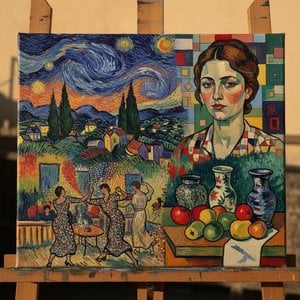
The artwork presents a meticulously arranged still life featuring several apples resting upon the earthen ground. The artist's careful consideration of placement is evident; the fruits are positioned in varying degrees of proximity, creating an interplay of light and shadow that draws the viewer’s eye across the canvas. Notably, a bowl occupies a prominent position on the right side of the image, serving as a focal point and adding depth to the composition. The subtle variations in apple size and shape contribute to the overall visual dynamism, reflecting Van Gogh's fascination with capturing natural forms in their simplest yet most expressive form.
Artistic Influences
Van Gogh’s artistic journey was undeniably shaped by the prevailing art movements of his time, particularly Impressionism and Pointillism. However, he transcended mere stylistic imitation, integrating these influences into a uniquely emotive style. The influence of Japanese woodblock prints—
Ukiyo-e—is palpable in the flattened perspective and bold color palette characteristic of this period. Artists like Hiroshige and Hokusai had revolutionized Western art with their innovative techniques for depicting landscapes and scenes from daily life, inspiring Van Gogh to experiment with similar approaches.
Evolution of Style
Prior to 1887, Van Gogh’s artistic output demonstrated a darker palette and a preoccupation with themes of poverty and hardship—a reflection of his experiences in the Netherlands. Yet, by this year, he had begun to embrace a more expansive stylistic range, incorporating elements of modern art that foreshadowed developments in Cubism and Fauvism. Consider his series of portraits depicting individuals from rural Belgium, where he skillfully employed color to convey psychological states—a departure from the muted tones favored by earlier artists. The
Pairs of Shoes series and
Blue Vases paintings exemplify this stylistic evolution—marking a crucial step toward Van Gogh’s groundbreaking artistic breakthroughs.
Still Life as an Art Form
The genre of still life emerged in Western art during the late 16th century, gaining considerable prestige among connoisseurs and artists alike. Unlike portraiture or landscape painting, which aim to represent individuals or environments realistically, still life prioritizes capturing the essence of a particular moment—often imbued with symbolic significance. Early still-life painters frequently employed religious iconography, reflecting the pervasive influence of Christianity on European culture. However, as the centuries progressed, still life expanded its expressive horizons, embracing diverse artistic styles and techniques—from Baroque grandeur to Rococo delicacy. The term “still life” derives from the Dutch word stilleven, signifying "quiet life" or "silent existence"—a concept that resonated deeply with artists seeking to convey profound emotional truths through visual imagery.
Camille Pissarro's Influence
Jacob Abraham Camille Pissarro (1830–1903), a Danish-French Impressionist painter, served as an important mentor and collaborator for Vincent van Gogh during his formative years in Paris. Influenced by Gustave Courbet and Jean-Baptiste-Camille Corot—artists who championed realism and tonal harmony—Pissarro encouraged Van Gogh to explore innovative approaches to color and composition. Together, they embarked on numerous artistic expeditions—particularly to Normandy—where Pissarro’s unwavering dedication to capturing the subtleties of natural light profoundly impacted Van Gogh's artistic sensibilities. Their partnership represents a pivotal moment in the history of Impressionism, demonstrating how artistic dialogue can propel creative experimentation and enrich the visual landscape.
WahooArt.com offers high-quality, handmade oil painting reproductions of famous artworks. Explore our collection and discover the beauty of art in your own home.



 In echtem Maßstab anzeigen
 Handgemalte Reproduktion kaufen
 Versenden als Grußkarte
 Teilen
 Details anzeigen

 Herunterladen
 Ähnliche Objekte
 Röntgenaufnahme
 Diashow
 Besucherstatistiken

 Mehr anzeigen






































 Die Glasoption ist nur für Größen unter 110 cm verfügbar.




![Irisen [1889]](/media/artworks/images-thumb/ca/85/ca85582a4fd1dc392efef83ec4dc3124.jpg)


