Victor Vasarely's Yvaral: A Dance of Perception
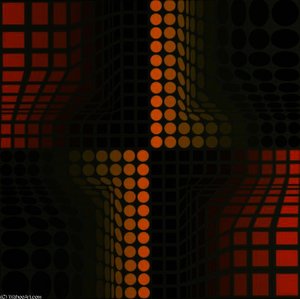
Victor Vasarely’s Yvaral, completed in 1956, is more than just an image; it’s a carefully constructed illusion, a testament to the burgeoning field of Op Art and a profound exploration of how our eyes perceive space and movement. This striking work, measuring 210 x 200 cm, immediately captivates with its stark contrast – a pristine white background punctuated by precisely arranged black circles that seem to vibrate with an almost unsettling energy. Born in Pécs, Croatia (then Austria-Hungary) in 1906, Vasarely’s artistic trajectory began unexpectedly, initially pursuing medical studies before embracing the visual world with unwavering conviction. His journey, shaped by influences from the Bauhaus movement and his time within Bortnyik's Műhely workshop, culminated in a revolutionary approach to art – one that deliberately manipulated perception through geometric abstraction.
- Op Art’s Genesis: Yvaral stands as a cornerstone of Op Art, a movement that emerged in the mid-20th century with the goal of creating optical illusions through precise arrangements of shapes and colors. Vasarely was a key figure in this revolution, pioneering techniques to challenge our understanding of reality.
- A Grid Disrupted: The artwork’s composition is based on a subtly disrupted grid system. Four quadrants are defined by densely packed circles, creating a dynamic tension between order and chaos. A central square acts as a focal point, further amplifying the visual effect.
Color, Form, and Illusion
The deliberate restriction of the color palette – solely black and white – is crucial to Yvaral’s impact. This stark dichotomy dramatically enhances the optical illusion, making the circles appear to pulsate and shift with every glance. Vasarely wasn't simply depicting shapes; he was engineering a visual experience, exploiting the way our brains process information. The dominant form, of course, is the circle – repeated countless times – but it’s not merely repetition for its own sake. Vasarely meticulously arranged these circles to create larger geometric forms—squares and quadrants—that contribute to the overall structure while simultaneously disrupting any sense of static stability.
Technique and Materials: A Serigraph's Precision
The artwork’s execution suggests a serigraph or screen print, a technique favored by Vasarely for its ability to achieve incredibly precise color application and uniform tonal values. The smooth texture, characteristic of printed media, speaks to this meticulous process. It is likely that the original work was created using this method, ensuring the consistent distribution of ink across the canvas. While a photograph of an original work could also account for the image’s appearance, the level of detail and precision strongly points towards a serigraphic reproduction.
Symbolic Resonance: Movement and Perception
Beyond its purely visual impact, Yvaral evokes deeper symbolic resonances. The dynamic arrangement of circles can be interpreted as representing movement, energy, and perhaps even disorientation – mirroring the very experience of engaging with Op Art. The repetitive patterns might also suggest themes of order and chaos, a fundamental duality that Vasarely consistently explored in his work. This piece isn’t just about seeing; it's about *experiencing* perception itself.



 Handgemalte Reproduktion bestellen
 Versenden
 Teilen
 Details anzeigen

 Herunterladen
 Ähnliche Objekte
 Diashow
 Statistiken


 Weiterlesen






































 Die Glasoption ist nur für Größen unter 110 cm verfügbar.