A Vortex of Perception: Exploring Victor Vasarely’s VY-47-D
Victor Vasarely's VY-47-D is not merely an image; it’s an invitation to question the very nature of visual experience. This meticulously hand-painted artwork, a cornerstone of Op Art, plunges the viewer into a mesmerizing vortex of geometric abstraction, born from a fascinating confluence of medical aspirations and a radical embrace of modern design principles. Created by the Hungarian artist during his pivotal years exploring optical illusions and kinetic art – a period marked by intense study within the Bauhaus-influenced Műhely workshop – VY-47-D embodies Vasarely’s lifelong quest to translate mathematical concepts into tangible, emotionally resonant forms. The artwork's genesis lies in Pécs, Croatia, 1906, a city that shaped his early worldview before he deliberately redirected his path towards the dynamic realm of visual art.
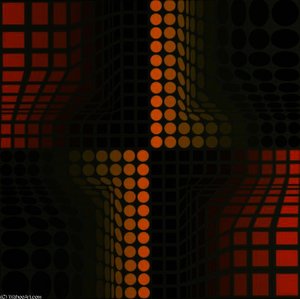
- Geometric Precision: At its core, the piece is defined by an obsessive control over geometric forms – predominantly squares and circles – arranged in a rigorously systematic grid. This isn’t haphazard arrangement; it's a deliberate orchestration designed to manipulate perception, creating an illusion of depth and movement that draws the eye relentlessly towards the luminous central circle.
- Op Art’s Manifestation: VY-47-D is a quintessential example of Op Art, a movement dedicated to stimulating optical illusions through precise patterns and contrasting colors. Vasarely's mastery lies in his ability to harness these techniques not just for aesthetic effect, but to evoke a visceral response within the viewer.
- A Legacy of Innovation: Vasarely’s work anticipated many developments in contemporary art, influencing generations of artists who sought to explore the relationship between perception and reality.
The Dance of Light and Shadow
The composition of VY-47-D is dominated by a central circular area radiating outwards with increasingly darker blue and gray squares. This radial symmetry isn’t accidental; it's a carefully constructed device to amplify the illusion of depth. The artist skillfully employs variations in tone within each square, creating subtle shifts that mimic the effects of light and shadow – a technique borrowed directly from principles of perspective and chiaroscuro, albeit applied to an entirely abstract domain. The diminishing size of the squares as they recede into the background simulates a three-dimensional space, further enhancing the sense of movement and drawing the viewer deeper into the artwork’s vortex.
Lighting appears to emanate from the central circle, casting subtle shadows and highlights across the checkered surface. This deliberate manipulation of light creates an almost hypnotic effect, reinforcing the artwork's status as a powerful visual stimulus. The meticulous hand-painting technique, likely executed with precise brushwork, ensures the uniformity of the checkered pattern – a testament to Vasarely’s dedication to technical perfection.
Symbolism and Emotional Resonance
While VY-47-D is fundamentally abstract, its central light could be interpreted as representing enlightenment or a focal point of energy. This symbolic element adds another layer of complexity to the artwork, inviting viewers to contemplate themes of perception, knowledge, and transformation. The overall effect is disorienting yet captivating – a deliberate strategy employed by Vasarely to challenge conventional notions of representation and invite active engagement from the viewer.
The use of traditional oil paints on canvas contributes to the artwork’s rich texture and enduring quality. The careful layering and blending of colors create a sense of depth and luminosity, further enhancing its visual impact. The piece speaks to a desire for order within chaos, a fascination with the underlying structure of reality, and a profound appreciation for the power of geometric forms to evoke emotion.
A Statement for Your Space
VY-47-D is more than just a reproduction; it’s an investment in a piece of art history. Its bold geometric design and captivating optical effects will undoubtedly become a focal point within any interior space, adding a touch of intellectual sophistication and visual dynamism. Whether adorning a modern gallery or a contemporary living room, this artwork promises to spark conversation and inspire contemplation – a timeless testament to Victor Vasarely’s visionary genius.



 Vorschau anzeigen
 Zu Druck wechseln
 Versenden
 Teilen
 Details anzeigen

 Herunterladen
 Ähnliche Objekte
 Röntgenaufnahme
 Diashow
 Statistiken

 Weiterlesen






































 Die Glasoption ist nur für Größen unter 110 cm verfügbar.