Victor Vasarely's "Vega-Sakk": A Symphony of Geometric Illusion
Victor Vasarely’s “Vega-Sakk,” a captivating circular composition, stands as a testament to the revolutionary impact of Op Art – Optical Art. Created by this Hungarian artist during his pivotal exploration into geometric abstraction, the work embodies a profound engagement with perception and the very nature of visual experience. Born in 1906 in Pécs, Croatia, Vasarely’s artistic trajectory began unexpectedly, initially driven by an interest in medicine before he ultimately succumbed to the compelling force of visual expression. His journey, shaped by influences from the Bauhaus movement and his time within Bortnyik's “Műhely” workshop, led him to develop a unique style characterized by meticulously crafted geometric patterns designed to manipulate the viewer’s perception.
Deconstructing Depth: A Masterclass in Optical Illusion
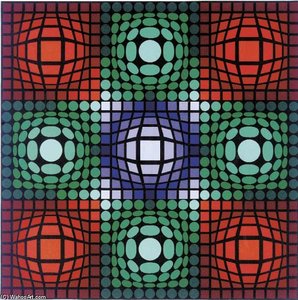
"Vega-Sakk" immediately draws the eye with its symmetrical arrangement of repeating circles and diamonds, layered within concentric rings. This isn't merely a decorative piece; it’s an intricate experiment in creating depth and perspective through purely visual means. The artist skillfully employs overlapping shapes that scale in size as they move outward from a central point, mimicking the way our eyes naturally perceive distance. The warm palette – dominated by golds, yellows, blacks, and grays – subtly shifts to cooler tones of purple and blue at the periphery, further enhancing the illusion of space. The smooth texture achieved through layered acrylic paint contributes significantly to this effect, creating a surface that seems to shimmer with movement.
The Legacy of Op Art and Kinetic Perception
Vasarely’s work aligns perfectly with the broader movement of Op Art, which emerged in the 1960s as a reaction against representational art. Artists like Vasarely sought to challenge traditional notions of reality by creating artworks that actively engaged the viewer's visual system. “Vega-Sakk” exemplifies this approach, prompting a dynamic interaction between the artwork and the observer’s eye. The piece evokes a sense of infinite space and order, reflecting a fascination with mathematical principles and their application in art. It’s a powerful demonstration of how carefully constructed geometric forms can profoundly alter our perception of depth and dimension.
Symbolism and Emotional Resonance: Beyond the Geometry
While “Vega-Sakk” is fundamentally abstract, devoid of recognizable imagery, it doesn't lack emotional resonance. The precise, ordered composition speaks to a desire for control, stability, and perhaps even a yearning for the infinite. The repetition inherent in the design can be interpreted as a meditation on rhythm, harmony, and the underlying patterns that govern the universe. The artwork’s impact is not about conveying a specific narrative but rather about stimulating a visceral response – a feeling of wonder, curiosity, and a heightened awareness of visual perception.
Technical Execution & Reproduction
This artwork showcases Vasarely's mastery of acrylic paint layering. The meticulous application creates a rich surface texture that enhances the optical illusion. WahooArt offers high-quality hand-painted reproductions meticulously crafted to capture the essence of this iconic piece, ensuring an authentic and captivating display for your home or office.



 In echtem Maßstab anzeigen
 Zum Druck wechseln
 Versenden als Grußkarte
 Teilen
 Details anzeigen
 Leitfaden

 Herunterladen
 Ähnliche Objekte
 Röntgenaufnahme
 Diashow
 Besucherstatistiken

 Mehr anzeigen






































 Die Glasoption ist nur für Größen unter 110 cm verfügbar.