Vega-Lila: A Dive into Vasarely's Op-Art Universe
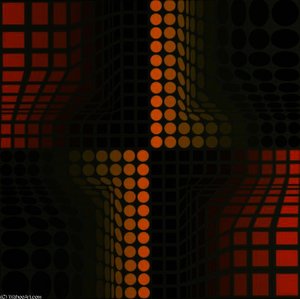
Victor Vasarely’s “Vega-Lila” isn’t merely a painting; it’s an invitation to experience reality through the lens of perception itself. Created in the heart of the 1960s, during the burgeoning Op Art movement, this work embodies the revolutionary spirit of challenging our visual assumptions. The piece immediately captivates with its hypnotic blue sphere – a carefully constructed illusion of depth and movement achieved through meticulously arranged geometric forms. It’s a testament to Vasarely's mastery in manipulating light and shadow, creating an immersive experience that draws the viewer into its vibrant, pulsating core.
- Subject: A stylized blue sphere with intricate patterned surface.
- Style: Op Art – characterized by geometric abstraction and optical illusions.
- Technique: Oil on canvas, utilizing precise layering and color gradients to generate a three-dimensional effect.
The composition of “Vega-Lila” is deceptively simple yet profoundly complex. The sphere isn’t a solid form but rather an assemblage of countless small squares, each subtly varying in shade of blue. This technique, born from Vasarely's exploration of visual perception and the way our eyes process information, generates a dynamic vibration – a sense of movement that seems to emanate directly from the canvas. It’s as if the painting is breathing, shifting slightly with every glance.
The Genesis of Op Art: Context and Influence
To fully appreciate “Vega-Lila,” one must understand the historical context in which it was created. The 1960s witnessed a growing fascination with scientific discoveries related to optics and perception, particularly the work of Gestalt psychologists who demonstrated how our brains actively organize visual information. Op Art, spearheaded by artists like Vasarely, Maurice Barré, and Bridget Riley, responded directly to these findings, employing geometric abstraction to deliberately manipulate our visual system. Vasarely’s approach was deeply rooted in the principles of functional design, a legacy from his time at the Bauhaus-influenced “Műhely” workshop, where he honed his skills in creating dynamic, visually stimulating forms.
The influence of Vasarely extends far beyond the Op Art movement. His work anticipated many developments in contemporary art and design, particularly in areas like kinetic art and digital imagery. The deliberate use of repetition, color modulation, and geometric abstraction continues to resonate with artists today, demonstrating the enduring power of his vision.
Decoding the Symbolism: Beyond Illusion
While “Vega-Lila” is undeniably a masterful illusion, it’s important to recognize that Vasarely wasn't simply interested in creating visual tricks. The sphere itself can be interpreted as a symbol of wholeness, unity, and perhaps even the cosmos – a contained universe of geometric forms. The vibrant blue hue evokes feelings of tranquility, depth, and contemplation, further enhancing the painting’s immersive quality. The meticulous attention to detail suggests a desire to understand and control the fundamental building blocks of visual experience.
A Legacy of Visual Innovation
"Vega-Lila" stands as a cornerstone in Victor Vasarely's oeuvre and a pivotal work within the Op Art movement. Its enduring appeal lies not only in its technical brilliance but also in its profound exploration of perception, illusion, and the very nature of seeing. This handmade reproduction captures the essence of Vasarely’s vision, offering an opportunity to bring this captivating artwork into your space – a testament to the power of art to transform our understanding of reality.



 In echtem Maßstab anzeigen
 Handgemalte Reproduktion kaufen
 Versenden als Grußkarte
 Teilen
 Details anzeigen
 Leitfaden öffnen

 Herunterladen
 Ähnliche Objekte
 Röntgenaufnahme
 Diashow
 Besucherstatistiken

 Mehr anzeigen






































 Die Glasoption ist nur für Größen unter 110 cm verfügbar.