A Symphony of Perception: Unveiling Vega 1
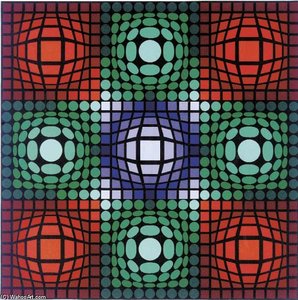
Victor Vasarely’s *Vega 1* isn't merely a painting; it’s an invitation. An invitation to step outside the confines of traditional representation and into a world governed by perception itself. Born in 1906 in Pécs, Croatia – then part of Austria-Hungary – Vasarely’s artistic trajectory was initially rooted in medicine before he decisively embraced the burgeoning field of visual abstraction. This pivotal shift, fueled by his studies at the Podolini-Volkmann Academy and profoundly influenced by the Bauhaus movement's emphasis on functional design and geometric principles, led him to pioneer Op Art – a style dedicated to manipulating our visual experience through carefully orchestrated optical illusions. *Vega 1*, with its vibrant circle and meticulously arranged dots, stands as a testament to this revolutionary approach, a tangible manifestation of Vasarely’s lifelong fascination with the relationship between form, color, and human perception.
- Style: Op Art – Characterized by geometric abstraction and optical illusions.
- Artist: Victor Vasarely (1906-1997) – A key figure in 20th-century art.
- Technique: Hand-Painted Reproduction – Utilizing traditional oil painting techniques to faithfully recreate Vasarely’s original vision.
Decoding the Visual Language
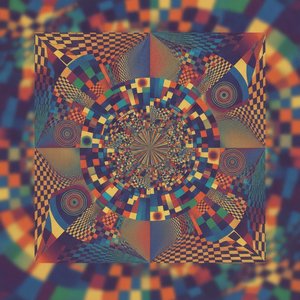
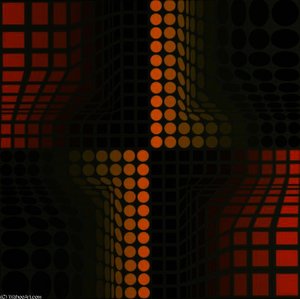
The immediate impact of *Vega 1* is undeniably arresting. The central circle, a vortex of concentrated color, draws the eye immediately, while the surrounding dots – rendered in a dazzling array of reds, greens, blues, and yellows – create an illusion of depth and movement. Vasarely’s genius lies not simply in the arrangement of these shapes but in their deliberate disruption of our natural visual expectations. The varying sizes and densities of the dots subtly shift our focus, creating a dynamic interplay that seems to pulse with energy. This isn't about depicting a recognizable scene; it’s about exploring the very mechanics of how we see. The painting invites the viewer into an active process of observation, challenging them to consciously engage with the artwork and decipher its underlying structure.
Historical Context & The Birth of Op Art
Created in the mid-20th century, *Vega 1* emerged during a period of significant artistic experimentation. Following the devastation of World War II, artists sought new ways to express themselves, rejecting representational art and embracing abstraction as a means of exploring psychological and emotional states. Vasarely’s work was at the forefront of this movement, anticipating the rise of Pop Art and Minimalism. His meticulous approach to color theory and his exploration of optical illusions paved the way for future generations of artists working with visual perception. The Fondation Vasarely in Aix-en-Provence holds a vast collection of his works, offering invaluable insight into the development of Op Art and its lasting influence on modern art.
Emotional Resonance & Artistic Value
*Vega 1* transcends mere aesthetic appeal; it evokes a profound sense of wonder and intrigue. The painting’s vibrant colors and dynamic composition stimulate the senses, creating an immersive experience that is both intellectually stimulating and emotionally engaging. A hand-painted reproduction offers a unique opportunity to own a piece of art history – a tangible connection to one of the 20th century's most innovative artistic minds. This artwork is not just decoration; it’s an investment in beauty, intellect, and a deeper understanding of the power of perception.



 Vorschau anzeigen
 Zu Druck wechseln
 Versenden
 Teilen
 Details anzeigen

 Herunterladen
 Ähnliche Objekte
 Röntgenaufnahme
 Diashow
 Statistiken

 Weiterlesen






































 Die Glasoption ist nur für Größen unter 110 cm verfügbar.